
Description
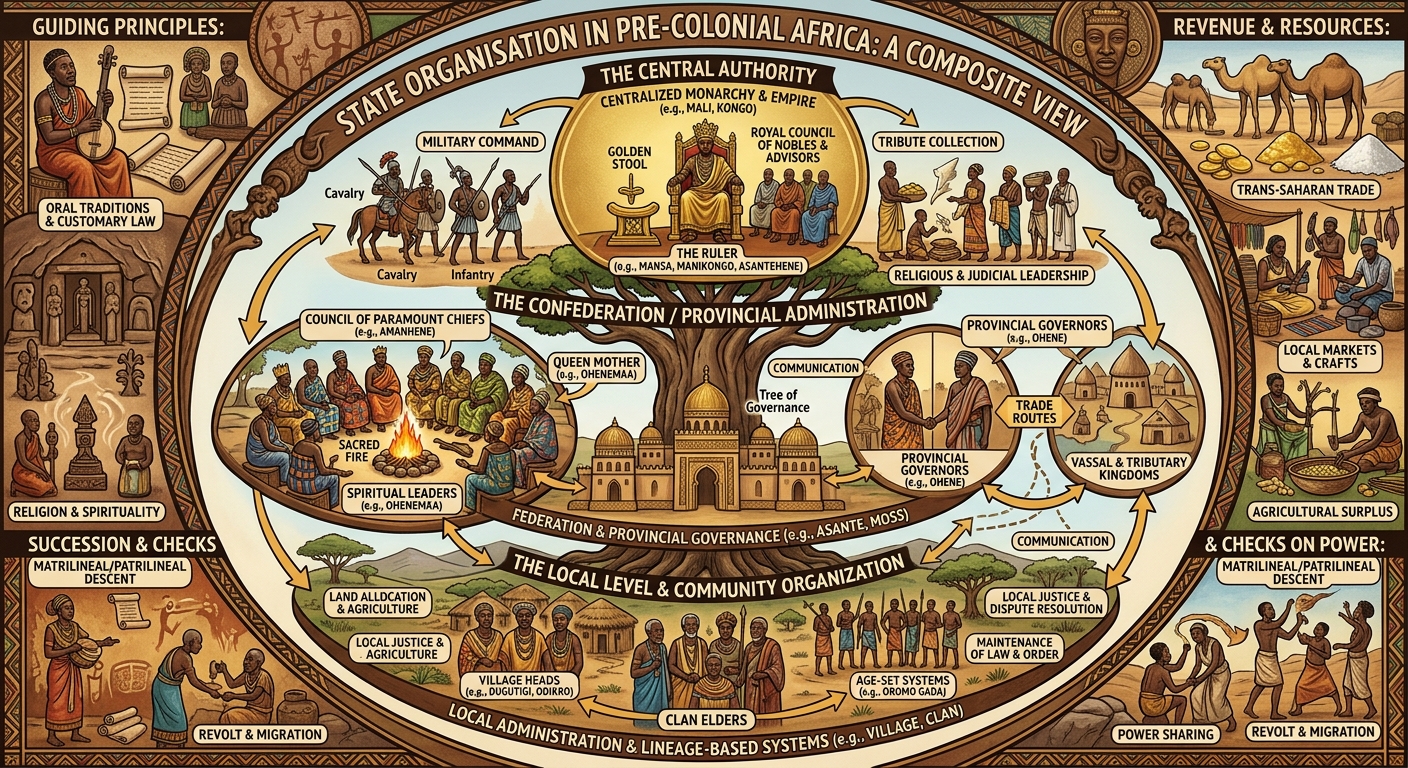
📘 Topic 7: State Organisation in Pre-Colonial Africa – Form 1 Study Guide
Explore the Rise, Organisation, and Decline of Africa’s Great Pre-Colonial States
🏛️ What Is This Topic About?
This topic examines the state organisation in pre-colonial Africa. It covers the meaning and elements of a state, the centralised states in East Africa (Buganda, Bunyoro), the Western Sudanic states (Ghana, Mali, Songhay), the Forest States of West Africa (Asante, Ife, Benin, Oyo), the Central African kingdoms (Kongo, Mwenemutapa, Luba, Lunda), and the Southern African kingdoms (Zulu). It explains the factors for the rise and decline of each state.
✅ What You’ll Learn Inside
🔹 Meaning of a State
Definition – A centralised political organisation that imposes and enforces rules over resources and people within a territory
Elements of a State:
People – The population living within the state
Territorial Boundaries – Defined borders marking the area under the state’s control
Sovereignty – Freedom from foreign rule; supreme authority within its territory
Government – The institution that makes and enforces laws
Development – Political centralisation in Africa began with Ancient Egypt around the 3rd millennium BCE; became widespread from the 5th century CE through the 19th century
🔹 Centralised States in East Africa
A. Bunyoro Kingdom
Location – Present-day Uganda
Origin – Traced to Bunyoro-Kitara founded by the Bachwezi in the 13th century
Title of King – Omukama
Factors for the Rise:
Influence of traditions (Omukama chosen from Babito dynasty)
Role of strong kings (Omukama Kabarega created Abarusura army of 20,000 soldiers)
Geographical conditions (fertile soil, good climate)
Strong political system (provinces ruled by Saza chiefs)
Factors for the Decline:
Expansion of the kingdom
Disputes in the ruling family
Limited control over provincial chiefs
B. Buganda Kingdom
Location – Southwest of modern Uganda
Origin – Started as a small political unit in the 16th century; peaked in the mid-19th century
Title of King – Kabaka
Factors for the Rise:
Development of agriculture (bananas)
Strong and stable army
Clear system of leadership succession
Control of trade
Strong link between the state and clans
Religious beliefs and practices
Development of iron technology
Political Organisation:
Kabaka – Overall political leader and final decision maker
Lukiiiko – Advisory council (Katikiro, Omuvanika, Mugema)
Administrative Hierarchy – Chiefs spread the Kabaka’s authority
Factors for the Weakening:
Establishment of colonialism (Buganda Agreement of 1900)
Religious differences and conflicts
Introduction of colonial economy
Conflicting administrative interests
🔹 Western Sudanic States
A. Ghana Empire
Factors for the Rise:
Good geographical position (Trans-Saharan trade routes)
Availability of gold
Efficient administrative system
Military strength (200,000 soldiers)
Development of iron technology
Factors for the Decline:
Attacks by Almoravids (1076–1077)
Dissatisfaction of traders
Dissatisfaction of vassal states
Vastness of the empire
B. Mali Empire
Location – Upper bend of River Niger
Founder – Sundiata Keita
Capital – Niami
Title of King – Mansa
Famous Ruler – Mansa Kankan Musa
Factors for the Rise:
Strong standing army
Role of Islam
Development of agriculture
Control of gold mines and trade routes
Strong leadership
Factors for the Decline:
Internal struggles for succession
Attacks from trade competitors
Rise of the Songhay Empire
C. Songhay Empire
Location – Largest of the Western Sudanic states
Capital – Gao
Title of King – Sunni
Famous Rulers – Sunni Ali and Askia Mohamed
Factors for the Rise:
Control of trade routes
Strong leadership
Role of Islam
Strength of the army
Development of agriculture and industry
Factors for the Decline:
Succession disputes
Resistance to heavy tributes
Change of trade routes
Moroccan invasion
🔹 Forest States of West Africa
A. Asante Kingdom
Location – Forest zone of West Africa (modern Ghana)
Founders – The Oyoko people (Akan clan) in the 17th century
Capital – Kumasi
Title of King – Asantehene
Famous Rulers – Obiri Yeboa, Osei Tutu, Opokwu Ware
Factors for the Rise:
Soil fertility
Military strength
Long-distance trade
Strong leadership (Osei Tutu, Golden Stool)
Traditional belief (Okomfo Anokye)
Factors for the Decline:
British imperial activities (1871–1901)
Abolition of the slave trade
Vastness of the kingdom
B. Ife Kingdom
Location – Yorubaland (modern Nigeria)
Founder – Oduduwa
Time Period – Formed around the 14th century
Factors for the Rise:
Good climatic conditions
Collection of revenues
Good leadership
Factors for the Decline – Growing influence of the Oyo Kingdom
C. Benin Kingdom
Location – Southern part of Ife near the Niger Delta
Founders – Edo-speaking people in the 13th century
Title of King – Oba
First Oba – Oranmiyan
Factors for the Rise:
Strong leadership (Oba Ewuare the Great)
Strong army
Involvement in trade (ivory, gums, pepper, cotton cloth)
Factors for the Decline:
Civil wars and dynastic disputes
Slave trade
British invasion (1897)
D. Oyo Kingdom
Location – North of the tropical forests in the savannah (southwestern Nigeria)
Origin – Descendants of Oduduwa
Title of King – Alaafin
Factors for the Rise:
Invasion by Bariba and Nupe
Military strength (horses, tsetse fly-free zone)
Involvement in trade
Strong leadership (Alaafin Orompoto, Abiodun)
Factors for the Decline:
Leadership problems
Fall of the Trans-Atlantic Slave Trade
Weakening of the army
Disintegration of central authority
Conflicts between the Oyo Mesi and kings
🔹 Central African Kingdoms
A. Kongo Kingdom
Location – Central Africa (modern-day Angola, DRC, Congo)
Time Period – Started towards the end of the 14th century
Title of King – Mani Kongo
Capital – Mbanza (renamed San Salvador by the Portuguese)
First Mani Kongo – Nzinga Nkuwu
Factors for the Rise:
Development of arts and crafts
Frequent movement of people
Religious beliefs
Monopoly of trade
Favourable climatic conditions
Factors for the Decline:
Introduction of Christianity
Resistance from provincial governors
Introduction of the slave trade
B. Mwenemutapa Kingdom
Location – North of Mashonaland (modern Zimbabwe)
Founder – Nyatsimba Mutota
Capital – Great Zimbabwe
Meaning of Name – “Master of the conquered land”
Factors for the Rise:
Trading activities (gold, copper, ivory)
Ambitious leaders
Role of indigenous religion (Mwari, Svikiro)
Strong army
Factors for the Decline:
Resistance against payment of tributes
Arrival of Portuguese
C. Luba Kingdom
Location – Upper Lualaba River valley around Lake Kisale
Time Period – United into a single kingdom between 1300 and 1400 CE
Dynasties – Nkongolo (early), then Ilunga
Factors for the Rise:
Geographical location
Development of iron and copper technology
Fishing
Good leadership
Factors for the Decline:
Slave trade
Succession conflicts
D. Lunda Empire
Location – Modern DRC, north-eastern Angola, and north-western Zambia
Origin – Established by immigrants from the Luba Kingdom in the 15th century
Title of King – Mwaant Yaav or Mwata Yamvo (“Lord of Vipers”)
Factors for the Rise:
Role of immigrants (Chibunda Ilunga and Queen Rweej)
Long-distance trade
Raiding of neighbouring ethnic groups
Factors for the Decline:
Chokwe invasion
Partition of Africa (1880s)
🔹 Southern African Kingdoms
Zulu Kingdom
Location – From the Indian Ocean and Tugela River to the Pongola River (modern South Africa)
Time Period – Rose in the 19th century under Dingiswayo (1800–1817) and Shaka
Factors for the Rise:
Centralisation of power under Shaka
Annual cultural festivals (Incwala)
Control of trade
Standing army (cow horn formation, assegai, spying, smoke signals)
Development of agriculture
Factors for the Decline:
Boer Invasion (1830s)
Weak leadership of Shaka’s successor (Dingane)
British colonisation of South Africa
🎯 Key Features
10 Clear Summary Points for quick revision
5 Short-Answer Questions to test understanding
5 Structured Questions for deeper analysis
5 Essay Questions for critical thinking and exam preparation
Comprehensive Coverage of states across East, West, Central, and Southern Africa
Comparison Tables for factors of rise and decline
Focus on Strong Leadership, Trade, Military Power, and Religion
Detailed Explanation of political organisation (e.g., Buganda’s Lukiiko, Asante’s Golden Stool)
👨🎓 Who Is This For?
Form 1 Students beginning their secondary history course
Teachers looking for a well-structured, ready-to-use teaching resource
Parents supporting their children’s learning at home
Anyone preparing for national examinations (NECTA)
💡 Why Choose This Guide?
✔ Aligned with the Tanzanian secondary school syllabus
✔ Written in clear, simple English for easy comprehension
✔ Packed with examples from across the African continent
✔ Includes practice questions with varying difficulty levels
✔ Perfect for classroom teaching, self-study, and revision
✔ Covers cross-topic connections (links to Topics 1, 3, 4, 5, and 6)
📥 Get Your Copy Today!
Whether you’re a student aiming for top marks, a teacher preparing engaging lessons, or a parent investing in your child’s academic success — Topic 7: State Organisation in Pre-Colonial Africa is your essential companion for understanding the rise, organisation, and decline of Africa’s great pre-colonial states.
Start exploring Africa’s rich political history today!
MITIHANI POPOTE — Quality educational resources wherever you are.




Reviews
There are no reviews yet.