
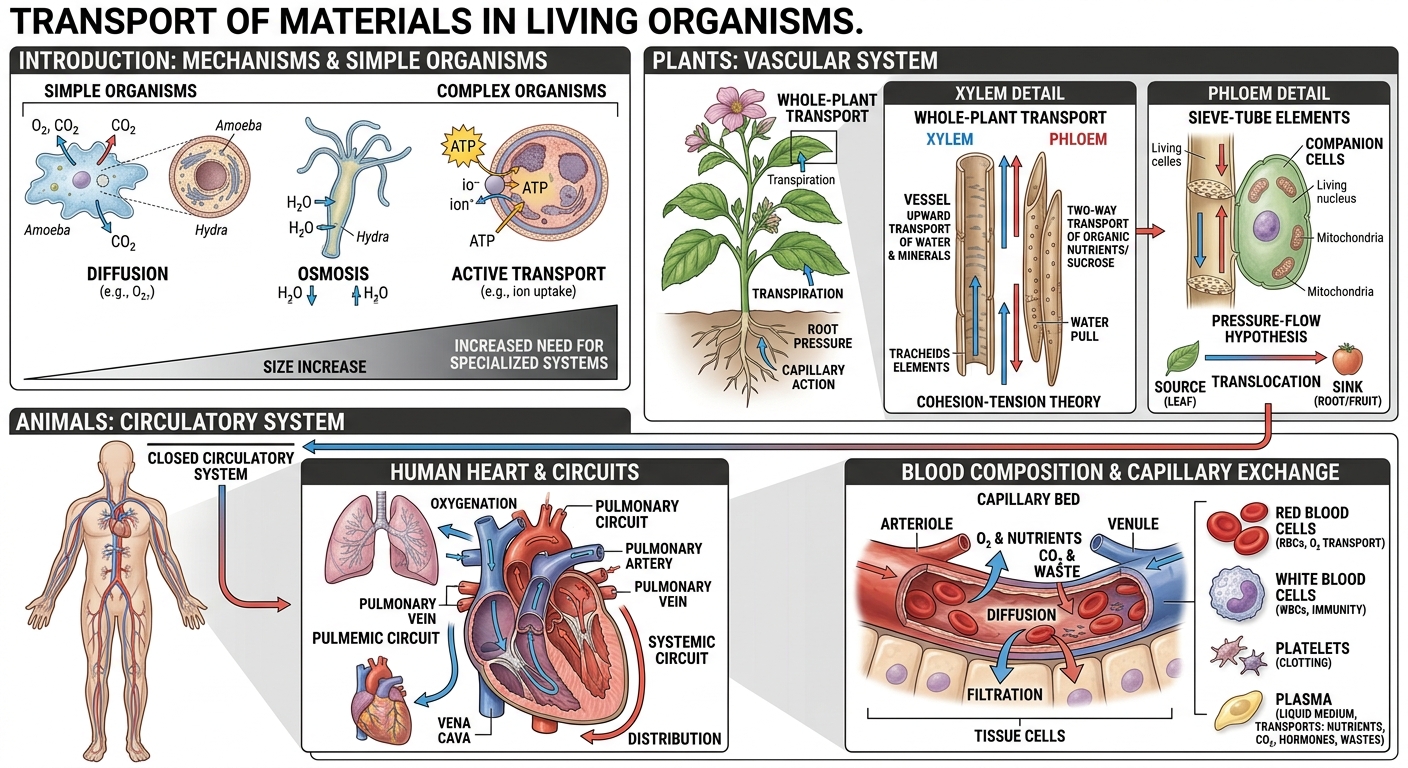
Description
TRANSPORT OF MATERIALS IN LIVING ORGANISMS — FORM 1 STUDY NOTES (PDF)
Master Transport in Living Organisms with This Complete, Exam-Ready Study Guide!
Are you a Form 1 student, teacher, or exam candidate looking for a clear, detailed, and well-organized resource on the Transport of Materials in Living Organisms? This professionally compiled PDF study guide, “03 TRANSPORT OF MATERIALS IN LIVING ORGANISMS F1,” is exactly what you need to understand every concept — from diffusion and osmosis to mass flow and transport systems.
📘 WHAT’S INSIDE?
This comprehensive resource covers the entire Form 1 Transport syllabus, including:
✅ Introduction to Transport in Living Organisms
Why organisms need transport
What needs to be transported (oxygen, carbon dioxide, glucose, nutrients, hormones, waste)
Definition of transport
Transport in different organism types — unicellular, simple multicellular, complex multicellular
Why complex organisms need specialized transport systems
✅ Movement of Materials Across Cell Membranes
The cell membrane (plasma membrane) — structure and function
Types of transport: Passive vs Active transport
✅ Passive Transport — Diffusion
Definition of diffusion
Key characteristics (no energy, high → low concentration, kinetic energy, equilibrium)
Concentration gradient explained
The process of diffusion step-by-step
Examples of Diffusion in Living Organisms:
Gas exchange in the lungs (alveoli)
Gas exchange in plant leaves
Absorption of digested food in the small intestine
Complete list of diffusion in animals, plants, and unicellular organisms
Factors Affecting the Rate of Diffusion:
Concentration gradient
Surface area to volume ratio
Distance
Temperature
Molecular size and mass
Medium (density/viscosity)
Fick’s Law of Diffusion explained
✅ Passive Transport — Osmosis
Definition of osmosis
Key characteristics (water only, semi-permeable membrane, water potential gradient)
Why osmosis is “special” diffusion
Terminology: hypotonic, hypertonic, isotonic solutions
Water potential explained
The osmosis process with clear diagrams
Examples of Osmosis in Living Organisms:
Water absorption by plant roots
Opening and closing of stomata
Water reabsorption in kidneys
Water absorption in the colon
Seed germination
Food preservation by salting
Effects of Osmosis on Cells:
Animal cells — haemolysis (bursting) and crenation (shrinking)
Plant cells — turgidity and plasmolysis
Osmosis in Unicellular Organisms — Amoeba and the contractile vacuole
Importance of Osmosis in plants, animals, and food preservation
Comparison: Diffusion vs Osmosis
✅ Mass Flow
Definition of mass flow
Key characteristics (pressure difference, bulk movement, fast)
Comparison: Mass Flow vs Diffusion
Examples of Mass Flow:
Blood circulatory system in animals
Lymphatic system in animals
Translocation in plants (phloem)
Water transport in plants (xylem)
Mass Flow in Detail:
The Source-Sink Model (phloem transport)
The Transpiration-Cohesion-Tension Model (xylem transport)
✅ Key Experiments and Activities
Activity 3.1: Demonstrate Diffusion in liquids (potassium permanganate)
Activity 3.2: Demonstrate Osmosis using a thistle funnel and cellophane membrane
Activity 3.3: Demonstrate Osmosis using a potato
Activity 3.4: Demonstrate Mass Flow in plants (ringing experiment)
✅ Comparison Summary Table — Diffusion vs Osmosis vs Mass Flow
✅ Chapter Summary — Key points at a glance
✅ Key Terms Quick Reference — Transport, Diffusion, Osmosis, Concentration gradient, Semi-permeable membrane, Hypotonic, Hypertonic, Isotonic, Turgid, Plasmolysis, Haemolysis and more
🎯 WHY CHOOSE THIS STUDY GUIDE?
✔ Exam-Focused — Aligned with the Form 1 Biology syllabus
✔ Comprehensive — Covers every subtopic in detail
✔ Easy to Understand — Clear explanations, tables, and diagrams
✔ Practical — Includes actual experiments and activities with procedures
✔ Time-Saving — All notes in one organized PDF
✔ Perfect for Revision — Quick reference tables and key term summaries
👥 WHO IS THIS FOR?
Form 1 students studying Biology
Teachers preparing lesson notes and practicals
Candidates revising for exams
Anyone interested in understanding transport mechanisms in living organisms
📥 GET YOUR COPY TODAY!
Don’t waste time searching through multiple textbooks. This all-in-one study guide gives you everything you need to master the Transport of Materials in Living Organisms — clearly, concisely, and completely.
Download now and start scoring higher in Biology!
MITIHANI POPOTE — Quality educational resources wherever you are.




Reviews
There are no reviews yet.