
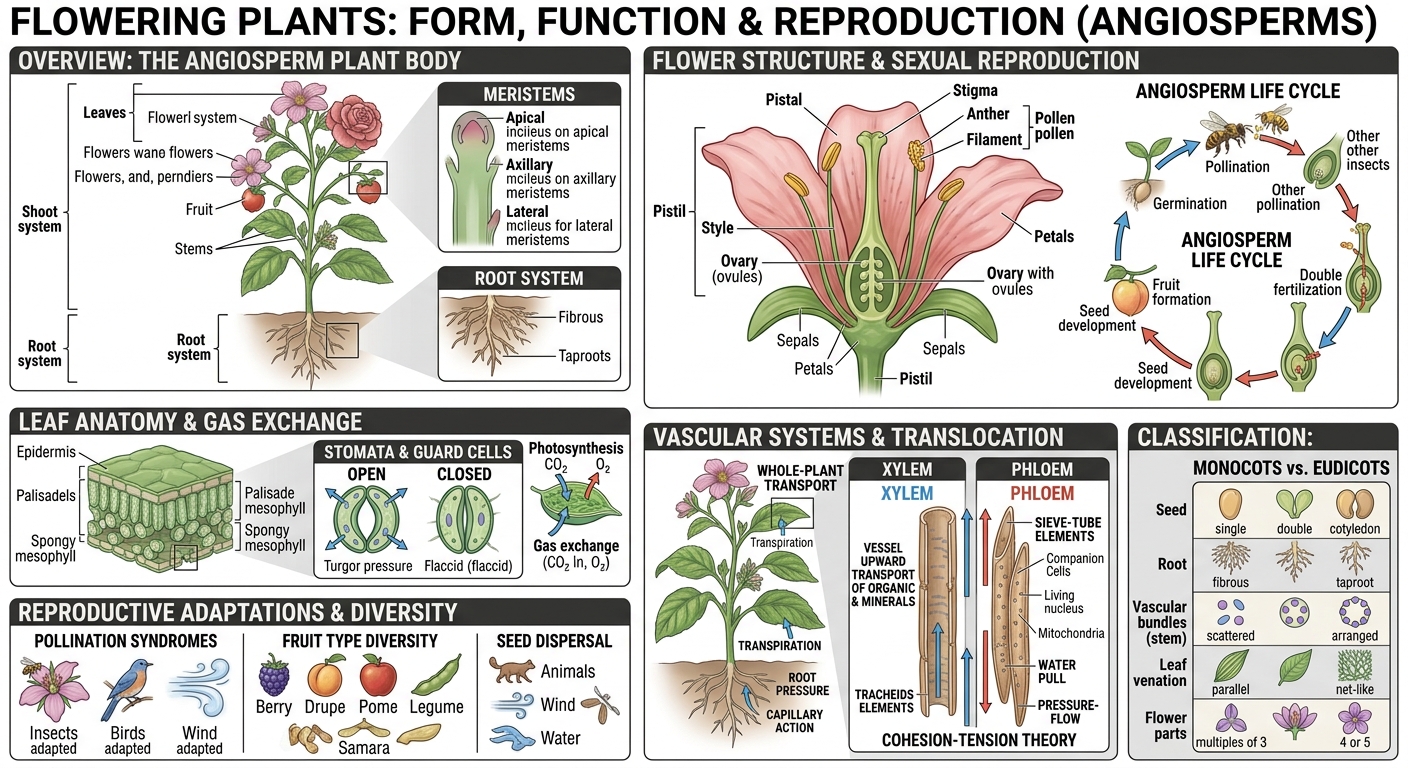
Description
TRANSPORT OF MATERIALS IN FLOWERING PLANTS — FORM 2 STUDY NOTES (PDF)
Master Transport in Flowering Plants with This Complete, Exam-Ready Study Guide!
Are you a Form 2 student, teacher, or exam candidate looking for a clear, detailed, and well-organized resource on the Transport of Materials in Flowering Plants? This professionally compiled PDF study guide, “004 TRANSPORT OF MATERIALS IN FLOWERING PLANTS F2,” is exactly what you need to understand every concept — from the vascular system and root absorption to transpiration, guttation, and translocation.
📘 WHAT’S INSIDE?
This comprehensive resource covers the entire Form 2 Transport in Flowering Plants syllabus, including:
✅ Introduction to Transport in Flowering Plants
Why plants need a transport system
The vascular system made of tiny tubes
Local Tanzanian examples (mango tree, maize, cassava, baobab)
✅ Subtopic 4.1: The Vascular System
Definition of the vascular system and vascular bundles
Xylem — transports water and minerals upward; provides mechanical strength
Phloem — transports manufactured food (translocation); movement upward and downward
Structure of Xylem Tissue — xylem vessel elements, tracheids, xylem fibres, xylem parenchyma
Structure of Phloem Tissue — sieve tubes, companion cells, phloem parenchyma, phloem fibres
Differences Between Xylem and Phloem — comparison table
Distribution of Vascular Bundles:
Monocot root (maize, grass) — circular arrangement
Dicot root (bean, sunflower) — star-shaped xylem
Monocot stem (maize) — scattered bundles
Dicot stem (sunflower, bean) — ring arrangement with vascular cambium
Revision questions included
✅ Subtopic 4.2: Absorption and Movement of Water and Mineral Salts
Structure and Function of Root Hairs
Adaptations of Root Hairs for Absorption (long, numerous, hypertonic vacuole, permeable wall, thin, replaced)
Tanzanian example: paddy rice in Mbarali (Mbeya)
Movement of Water from Soil to Xylem — osmosis through root hair → cortex → endodermis → pericycle → xylem
Transpiration Pull — cohesion-adhesion theory explained
Tanzanian example: baobab tree (Mbuyu)
Capillarity — why water rises higher in narrow tubes
Root Pressure — definition, how it works, evidence
Tanzanian example: coconut palm (Mnazi), banana plants (Migomba)
Revision questions included
✅ Subtopic 4.3: Transpiration
Definition of transpiration
Types of Transpiration:
Stomatal transpiration (~90%)
Cuticular transpiration
Lenticular transpiration
Pathway of Water Movement Through a Leaf — step by step
Factors Affecting the Rate of Transpiration — plant features and environmental factors
Importance of Transpiration — maintains transpiration pull, removes excess water, cools the plant, enables absorption, maintains turgidity, maintains water balance
Tanzanian example: trees shedding leaves in Tabora and Shinyanga during dry season
Revision questions included
✅ Subtopic 4.4: Guttation
Definition of guttation (TIE book 2024)
When Guttation Occurs — night/early morning, high soil moisture, high humidity
How root pressure forces water out through hydathodes
Differences Between Guttation and Transpiration — comparison table
Tanzanian example: water droplets on grass blades and banana leaves in the morning
Revision questions included
✅ Chapter Summary — Key points at a glance (xylem, phloem, root hairs, osmosis, transpiration pull, capillarity, root pressure, transpiration, guttation)
✅ Revision Questions
Section A: Multiple Choice / Short Answer Questions (10 Questions)
Section B: Structured Questions (10 Questions) — with mark allocations
Section C: Essay Questions (10 Questions) — with mark allocations
Practical scenario questions (e.g., farmer in Morogoro, potted plant in dark room, plant in windy area)
🎯 WHY CHOOSE THIS STUDY GUIDE?
✔ Exam-Focused — Aligned with the Form 2 Biology syllabus (TIE book 2024)
✔ Comprehensive — Covers every subtopic in detail
✔ Easy to Understand — Clear explanations, tables, and diagrams
✔ Locally Relevant — Uses Tanzanian examples (Mbuyu, Mnazi, Mihogo, Mahindi, Mbarali, Morogoro, etc.)
✔ Practical — Includes experiments and activities
✔ Time-Saving — All notes in one organized PDF
✔ Perfect for Revision — Quick reference tables, key term summaries, and exam-style questions with marks
👥 WHO IS THIS FOR?
Form 2 students studying Biology
Teachers preparing lesson notes, schemes of work, and examinations
Candidates revising for national exams (FTNA, CSEE)
Anyone interested in understanding how plants transport water, minerals, and food
📥 GET YOUR COPY TODAY!
Don’t waste time searching through multiple textbooks. This all-in-one study guide gives you everything you need to master the Transport of Materials in Flowering Plants — clearly, concisely, and completely.
Download now and start scoring higher in Biology!
MITIHANI POPOTE — Quality educational resources wherever you are.




Reviews
There are no reviews yet.