
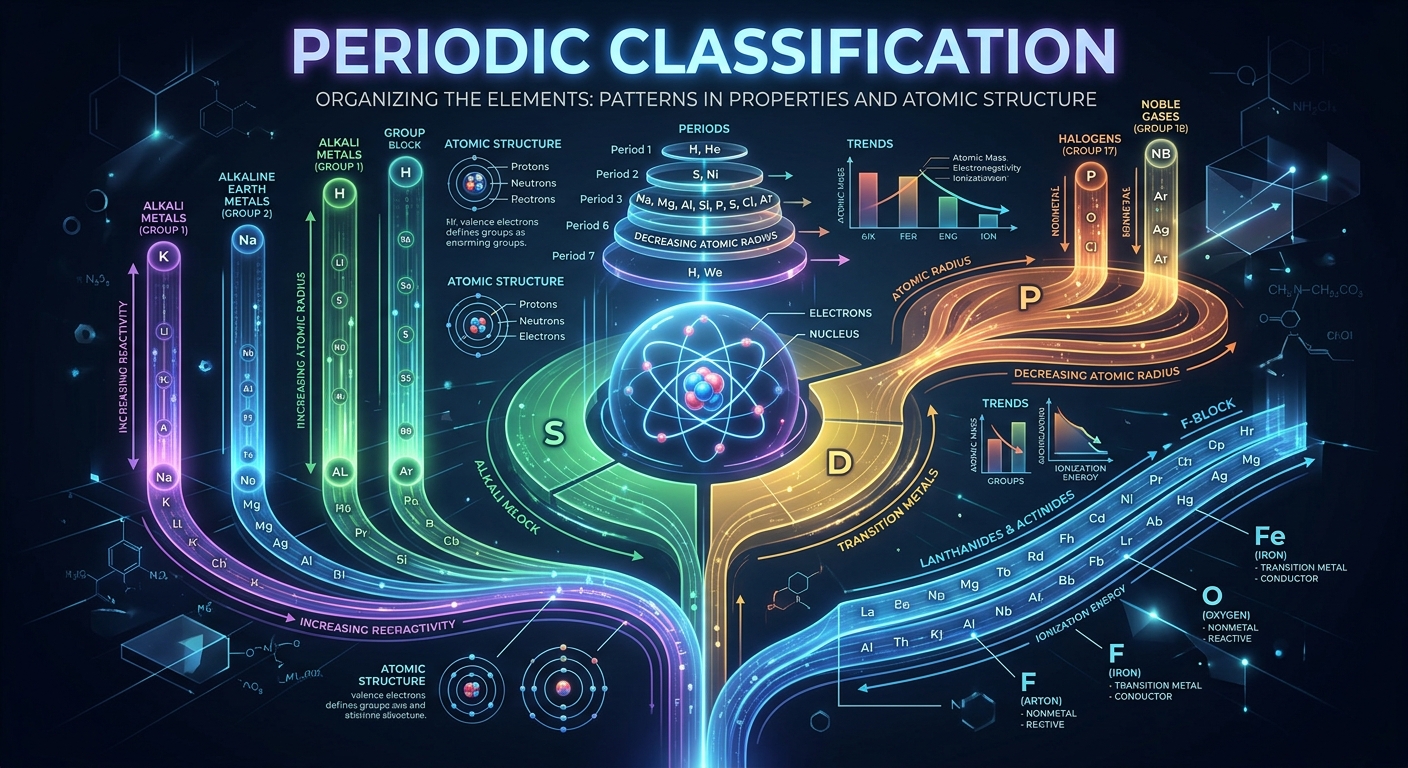
Description
PERIODIC CLASSIFICATION — FORM 2 STUDY NOTES (PDF)
Master the Periodic Table with This Complete, Exam-Ready Study Guide!
Are you a Form 2 student, teacher, or exam candidate looking for a clear, detailed, and well-organized resource on Periodic Classification? This professionally compiled PDF study guide, “CHAPTER TWO: PERIODIC CLASSIFICATION F2,” is exactly what you need to understand every concept — from the historical development of the periodic table and its modern layout to electronic configuration, periodic trends, and the properties of key element groups.
📘 WHAT’S INSIDE?
This comprehensive resource covers the entire Form 2 Periodic Classification syllabus, including:
✅ Development of the Periodic Table
Historical Timeline:
1866: Newlands — Law of Octaves (elements arranged by increasing atomic mass; 8th element has similar properties; problem: some elements grouped incorrectly)
1869: Mendeleev — Mendeleev’s Periodic Law (properties = periodic function of atomic mass; arranged in groups and periods; left gaps for undiscovered elements)
Modern: Modern Periodic Law (properties = periodic function of ATOMIC NUMBER; fixed problems with atomic mass arrangement)
✅ Modern Periodic Table
2D Layout of Periodic Table (Periods 1–4, transition elements between Group II and III)
Group Names and Characteristics:
Group I: Alkali Metals (1 valence electron, very reactive)
Group II: Alkaline Earth Metals (2 valence electrons, less reactive)
Group VII: Halogens (7 valence electrons, salt formers)
Group VIII: Noble Gases (8 valence electrons except He, unreactive)
✅ Electronic Configuration and Position
Relationship: Valence electrons → Group; Number of shells → Period
EXAMPLE: Sodium (Na) — 2:8:1 (Valence electrons = 1 → Group I; Number of shells = 3 → Period 3)
Electronic Configurations of First 20 Elements (table: Element, Symbol, Atomic #, Configuration, Period, Group)
✅ Trends in the Periodic Table
Trends Across Periods (Left to Right):
Atomic Radius — DECREASES
Metallic Character — DECREASES
Non-metallic Character — INCREASES
Ionisation Energy — INCREASES
Electronegativity — INCREASES
Reactivity (Metals) — DECREASES
Reactivity (Non-metals) — INCREASES
EXAMPLE: Na → Mg → Al → Si → P → S → Cl (Metal to Non-metal)
Trends Down Groups (Top to Bottom):
Atomic Size — INCREASES
Density — INCREASES
Metallic Character — INCREASES
Ionisation Energy — DECREASES
Electronegativity — DECREASES
Reactivity (Metals) — INCREASES
Reactivity (Non-metals) — DECREASES
EXAMPLE: Li → Na → K → Rb → Cs (Increasing reactivity)
3D Trend Visualization: Atomic Size Trends (Atoms get LARGER down a group: Cs largest)
✅ Group I: Alkali Metals
Elements: Li, Na, K, Rb, Cs, Fr
Physical Properties: Soft metals (can be cut with knife), low melting and boiling points, good conductors of heat and electricity, silvery when freshly cut (tarnish quickly), low density (Li, Na, K float on water)
Chemical Properties: 1 valence electron, very reactive (reactivity increases down group), react with water → alkali + hydrogen, react with oxygen → metal oxides, react with halogens → salts
Reaction with Water: 2Na(s) + 2H₂O(l) → 2NaOH(aq) + H₂(g)
2D Diagram of Sodium Atom (Na — 2:8:1)
✅ Group II: Alkaline Earth Metals
Elements: Be, Mg, Ca, Sr, Ba, Ra
Physical Properties: Harder and denser than Group I metals, higher melting and boiling points, silvery-white (tarnish in air)
Chemical Properties: 2 valence electrons, less reactive than Group I metals, react with water (slowly) → alkali + hydrogen, react with oxygen → metal oxides, react with acids → salt + hydrogen
Reaction with Oxygen: 2Mg(s) + O₂(g) → 2MgO(s) (Burns with bright white flame)
2D Diagram of Magnesium Atom (Mg — 2:8:2)
✅ Group VII: Halogens
Elements: F, Cl, Br, I, At
Physical Properties: F, Cl = Gases; Br = Liquid; I = Solid; Coloured (F = yellow-green, Cl = greenish-yellow, Br = red-brown, I = purple-black); Density increases down group; Melting and boiling points increase down group
Chemical Properties: 7 valence electrons, very reactive non-metals, reactivity DECREASES down group (F > Cl > Br > I), react with metals → salts (halides), react with hydrogen → hydrogen halides
Reaction with Metals: Metal + Halogen → Metal Halide (Salt); Examples: 2Na + Cl₂ → 2NaCl; Fe + Cl₂ → FeCl₂
Reaction with Hydrogen: Hydrogen + Halogen → Hydrogen Halide (Acid); Examples: H₂ + Cl₂ → 2HCl; H₂ + Br₂ → 2HBr
2D Diagram of Chlorine Atom
✅ Group VIII: Noble Gases
Elements: He, Ne, Ar, Kr, Xe, Rn
Physical Properties: Colourless, odourless gases, very low melting and boiling points, density increases down group
Chemical Properties: Full outer shell (8 electrons, He has 2), very unreactive (inert), exist as single atoms (monoatomic), do not readily form compounds
Uses: Helium — balloons, airships, deep-sea diving
2D Diagram of Neon Atom
🎯 WHY CHOOSE THIS STUDY GUIDE?
✔ Exam-Focused — Aligned with the Form 2 Chemistry syllabus
✔ Comprehensive — Covers every subtopic in detail
✔ Easy to Understand — Clear explanations, diagrams, and tables
✔ Practical — Includes chemical reactions, electronic configurations, and periodic trends
✔ Time-Saving — All notes in one organized PDF
✔ Perfect for Revision — Key trends, group properties, and examples clearly summarized
👥 WHO IS THIS FOR?
Form 2 students studying Chemistry
Teachers preparing lesson notes, schemes of work, and examinations
Candidates revising for national exams (FTNA, CSEE)
Anyone interested in understanding the periodic table and its trends
📥 GET YOUR COPY TODAY!
Don’t waste time searching through multiple textbooks. This all-in-one study guide gives you everything you need to master Periodic Classification — clearly, concisely, and completely.
Download now and start scoring higher in Chemistry!
MITIHANI POPOTE — Quality educational resources wherever you are.





Reviews
There are no reviews yet.