
Description
📘 Form One Physics Notes – Linear Motion: Distance & Displacement, Speed & Velocity, Acceleration, Equations of Motion & Motion Under Gravity | NECTA-Aligned Study Guide PDF
Master linear motion the simple, exam-ready way — from distance and displacement to the three equations of motion and motion under gravity.
Written specifically for Tanzanian Form One students, this Physics study guide covers the Linear Motion topic in clear, structured notes. From the concept of motion and relative motion to distance, displacement, speed, velocity, acceleration, the three equations of motion, and motion under gravity — every concept is explained with practical examples drawn from Tanzanian daily life, including a passenger on a moving bus, a cyclist, a train, a falling mango, and a skydiver reaching terminal velocity.
✨ What’s Inside
✅ Concept of Motion:
Clear definition — change in position with respect to surroundings over time
Motion is Relative — frame of reference (passenger inside a moving bus vs. observer on the roadside)
Diagram: Moving bus with passengers A and B, Observer C on roadside
Types of Motion:
Linear (Rectilinear) Motion
Circular Motion
Oscillatory Motion
Rotational Motion
✅ Distance and Displacement:
Distance — total length of actual path, scalar quantity, SI Unit: metre (m)
Displacement — straight-line distance from start to end, vector quantity, SI Unit: metre (m)
Diagram: Path taken vs. displacement (straight arrow)
Comparison Table: Distance vs. Displacement — quantity type, path taken, can it be zero, direction, examples
Step-by-Step Worked Example — 8 m East + 6 m North → Distance = 14 m, Displacement = 10 m North-East (using Pythagoras Theorem)
Diagram: Right-angled triangle ABC
✅ Speed and Velocity:
Speed — rate of distance covered, scalar, SI Unit: m/s
Velocity — rate of change of displacement, vector, SI Unit: m/s
Types of Speed and Velocity:
Average Speed, Instantaneous Speed, Uniform Speed
Uniform Velocity, Non-Uniform Velocity
Comparison Table: Speed vs. Velocity
Worked Examples:
Speed: cyclist covers 150 m in 30 s → 5 m/s
Velocity: runner moves 200 m East in 40 s → 5 m/s East
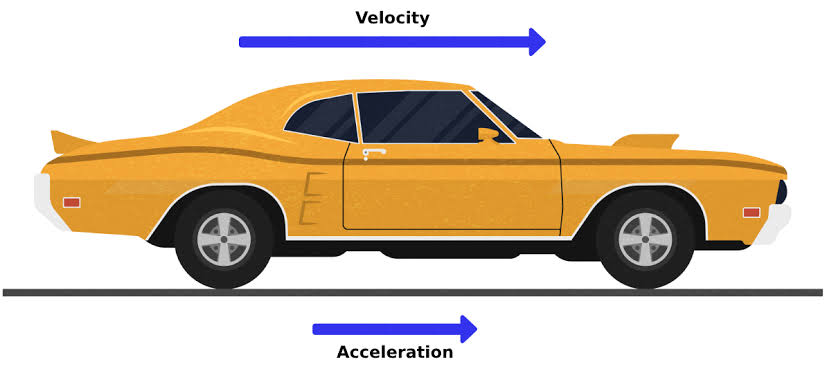
✅ Acceleration:
Clear definition — rate of change of velocity with respect to time
Formula: a = (v − u) / t
Types of Acceleration:
Positive Acceleration (+a): speeding up (sprinter from 0 to 10 m/s)
Negative Acceleration (Deceleration/Retardation) (−a): slowing down (car approaching red light)
Zero Acceleration (a = 0): constant speed (highway bus at 80 km/h)
Worked Examples:
Positive: car from rest to 20 m/s in 5 s → 4 m/s²
Deceleration: car from 30 m/s to stop in 6 s → −5 m/s² (deceleration = 5 m/s²)
✅ Equations of Linear Motion:
Three Fundamental Equations:
First Equation: v = u + at
Second Equation: s = ut + ½at²
Third Equation: v² = u² + 2as
Variable Legend — u, v, a, t, s (with units)
Conditions: constant acceleration and straight-line path
Step-by-Step Worked Examples (3):
Using v = u + at (train from 5 m/s to 15 m/s in 4 s → 2.5 m/s²)
Using s = ut + ½at² (car from rest, 3 m/s², 6 s → 54 m)
Using v² = u² + 2as (car from 10 m/s to 20 m/s over 75 m → 2 m/s²)
✅ Motion Under Gravity:
Clear definition — vertical motion under Earth’s gravitational pull
Worked Examples:
Falling (from rest): stone from a cliff, 3 s → final velocity 30 m/s, height 45 m
Rising (thrown upwards): ball thrown at 20 m/s → maximum height 20 m, time to top 2 s
Concept of Free Fall — heavy hammer and light feather hit the ground at the same instant in a vacuum
Concept of Terminal Velocity — maximum constant velocity when air resistance equals weight (skydiver at ~50 m/s / 180 km/h)
✅ Revision Exercise 8 — full practice set:
Part A: Multiple-Choice Questions (5)
Part B: Short-Answer Questions (5)
Part C: Calculation Questions (5 — distance & displacement, acceleration, equations of motion, falling, rising)
Part D: Application & Discussion Questions (2 — Distance vs. Displacement in Daily Life, Symmetry of Vertical Throw)
✅ Diagrams — Moving bus (relative motion), distance vs. displacement, right-angled triangle, acceleration types
🎯 Perfect For
Form One students studying Physics
NECTA exam preparation and revision
Teachers looking for ready-made teaching material
Parents helping their children study at home
Anyone who wants to understand motion, speed, velocity, acceleration, and gravity
📥 How It Works
Purchase the notes
Download instantly (PDF)
Print it or study on any phone, tablet, or computer
⚠️ Please Note
This is a digital product (PDF). No physical book will be shipped.
🔑 Keywords
Form One Physics, NECTA notes, Linear Motion, concept of motion, relative motion, frame of reference, types of motion, linear motion, circular motion, oscillatory motion, rotational motion, distance, displacement, scalar quantity, vector quantity, speed, velocity, average speed, instantaneous speed, uniform speed, uniform velocity, non-uniform velocity, acceleration, positive acceleration, negative acceleration, deceleration, retardation, equations of linear motion, v = u + at, s = ut + ½at², v² = u² + 2as, motion under gravity, free fall, terminal velocity, skydiver, Tanzanian secondary school notes, Form 1 study guide, Physics PDF, NECTA revision





Reviews
There are no reviews yet.