
Description
ATOMIC STRUCTURE — FORM 2 STUDY NOTES (PDF)
Master Atomic Structure with This Complete, Exam-Ready Study Guide!
Are you a Form 2 student, teacher, or exam candidate looking for a clear, detailed, and well-organized resource on Atomic Structure? This professionally compiled PDF study guide, “CHAPTER ONE: ATOMIC STRUCTURE F2,” is exactly what you need to understand every concept — from Dalton’s Atomic Theory and sub-atomic particles to electronic arrangement, isotopes, relative atomic mass, and the uses of isotopes.
📘 WHAT’S INSIDE?
This comprehensive resource covers the entire Form 2 Atomic Structure syllabus, including:
✅ Introduction to Atomic Structure
Atoms as the smallest particles of matter that carry an element’s properties
All substances made up of tiny particles called atoms
Key Point: Understanding atomic structure helps scientists predict the behaviour of substances and design new materials, cleaner energy, medicines, and more
✅ Dalton’s Atomic Theory (1803)
John Dalton’s four main points:
Matter is made up of tiny particles called atoms (Greek: “unsplittable”)
Atoms can neither be created nor destroyed
Atoms of the same element are identical; atoms of different elements are different
Compounds form by combination of atoms in simple whole number ratios
Limitations of Dalton’s Theory:
Atoms CAN be created/destroyed in nuclear reactions
Some elements have isotopes (different masses)
Atoms contain sub-atomic particles
Atoms can combine in many ratios
✅ Sub-atomic Particles
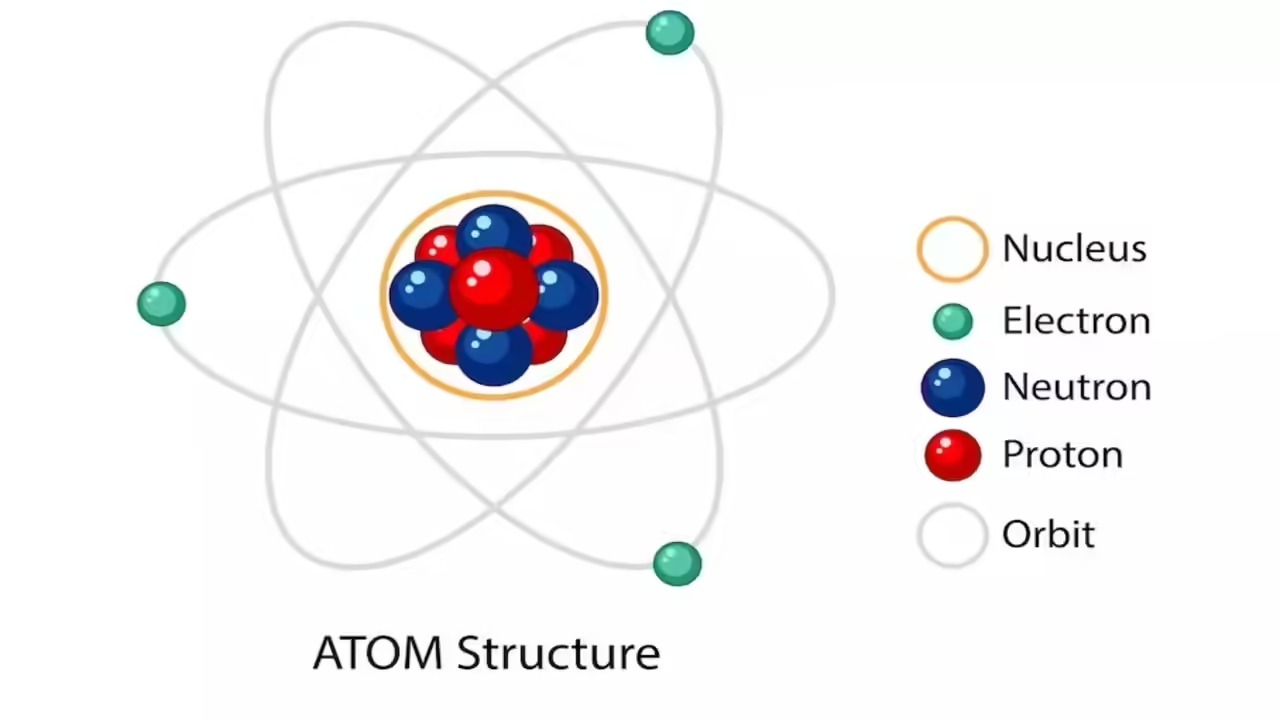
Three Sub-atomic Particles:
Protons (p⁺) — positively charged
Neutrons (n) — neutral (no charge)
Electrons (e⁻) — negatively charged
2D Diagram of an Atom (electron cloud, shells/orbits, nucleus, protons, neutrons)
Properties of Sub-atomic Particles
3D Representation of an Atom
✅ Atomic Models
Thomson’s Plum Pudding Model (1897) — positive sphere with electrons spread throughout
Rutherford’s Planetary Model (1911) — nucleus with electron orbits; most of atom is empty space
✅ Electronic Arrangement
Formula for Maximum Electrons per Shell: Maximum electrons = 2n²
Where n = shell number (1, 2, 3, 4…)
Shell Table:
1st shell (n=1): 2(1)² = 2 — K
2nd shell (n=2): 2(2)² = 8 — L
3rd shell (n=3): 2(3)² = 18 — M
4th shell (n=4): 2(4)² = 32 — N
3D Electronic Arrangement of Carbon (6 electrons) — Electronic Configuration: 2:4 (K shell: 2 electrons, L shell: 4 electrons)
✅ Atomic Number and Mass Number
Atomic Number (Z): Number of PROTONS; for neutral atom: Protons = Electrons
Mass Number (A): Protons + Neutrons
Formula: Number of Neutrons = Mass Number − Atomic Number
Nuclide Notation: X = Element symbol, Z = Atomic number (protons), A = Mass number (protons + neutrons)
Example: ²³Na₁₁ — Protons = 11, Electrons = 11
✅ Isotopes
Definition: Atoms of the same element with the SAME number of protons but DIFFERENT number of neutrons
3D Representation of Carbon Isotopes (Carbon-12, Carbon-13, Carbon-14)
Same: 6 protons, 6 electrons
Different: Number of neutrons (6, 7, 8)
Common Isotopes: Hydrogen (H-1, H-2, H-3) with abundance percentages
✅ Relative Atomic Mass (R.A.M.)
Definition: The average mass of one atom of an element relative to 1/12 the mass of one atom of carbon-12
Formula for Isotopic Elements: R.A.M. = Σ (Isotopic mass × Percentage abundance)
Calculation Examples:
Chlorine: R.A.M. = (35 × 75/100) + (37 × 25/100) = 26.25 + 9.25 = 35.5
Neon: R.A.M. = (20 × 90.5/100) + (21 × 0.3/100) + (22 × 9.2/100) = 18.10 + 0.063 + 2.024 = 20.187
✅ Uses of Isotopes
Carbon Dating (Carbon-14):
Plant/Animal alive: Takes in C-14
Organism dies: Stops taking C-14
C-14 decays slowly over time
Measure remaining C-14
Calculate age of fossil
Used by: Archaeologists, Historians
Medical Applications (Iodine-131):
Patient receives small dose of Iodine-131
Iodine absorbed by thyroid gland
Radiation creates images of thyroid
Diagnoses thyroid problems
Treats damaged thyroid cells
Agricultural Applications (Phosphorus-32 Tracer):
Tracks how plants absorb nutrients from soil
Helps improve fertilizers
Helps farmers grow healthier crops
🎯 WHY CHOOSE THIS STUDY GUIDE?
✔ Exam-Focused — Aligned with the Form 2 Chemistry syllabus
✔ Comprehensive — Covers every subtopic in detail
✔ Easy to Understand — Clear explanations, diagrams, and tables
✔ Practical — Includes calculation examples and real-life applications of isotopes
✔ Time-Saving — All notes in one organized PDF
✔ Perfect for Revision — Key formulas, tables, and examples clearly summarized
👥 WHO IS THIS FOR?
Form 2 students studying Chemistry
Teachers preparing lesson notes, schemes of work, and examinations
Candidates revising for national exams (FTNA, CSEE)
Anyone interested in understanding atomic structure and isotopes
📥 GET YOUR COPY TODAY!
Don’t waste time searching through multiple textbooks. This all-in-one study guide gives you everything you need to master Atomic Structure — clearly, concisely, and completely.
Download now and start scoring higher in Chemistry!
MITIHANI POPOTE — Quality educational resources wherever you are.




Reviews
There are no reviews yet.