
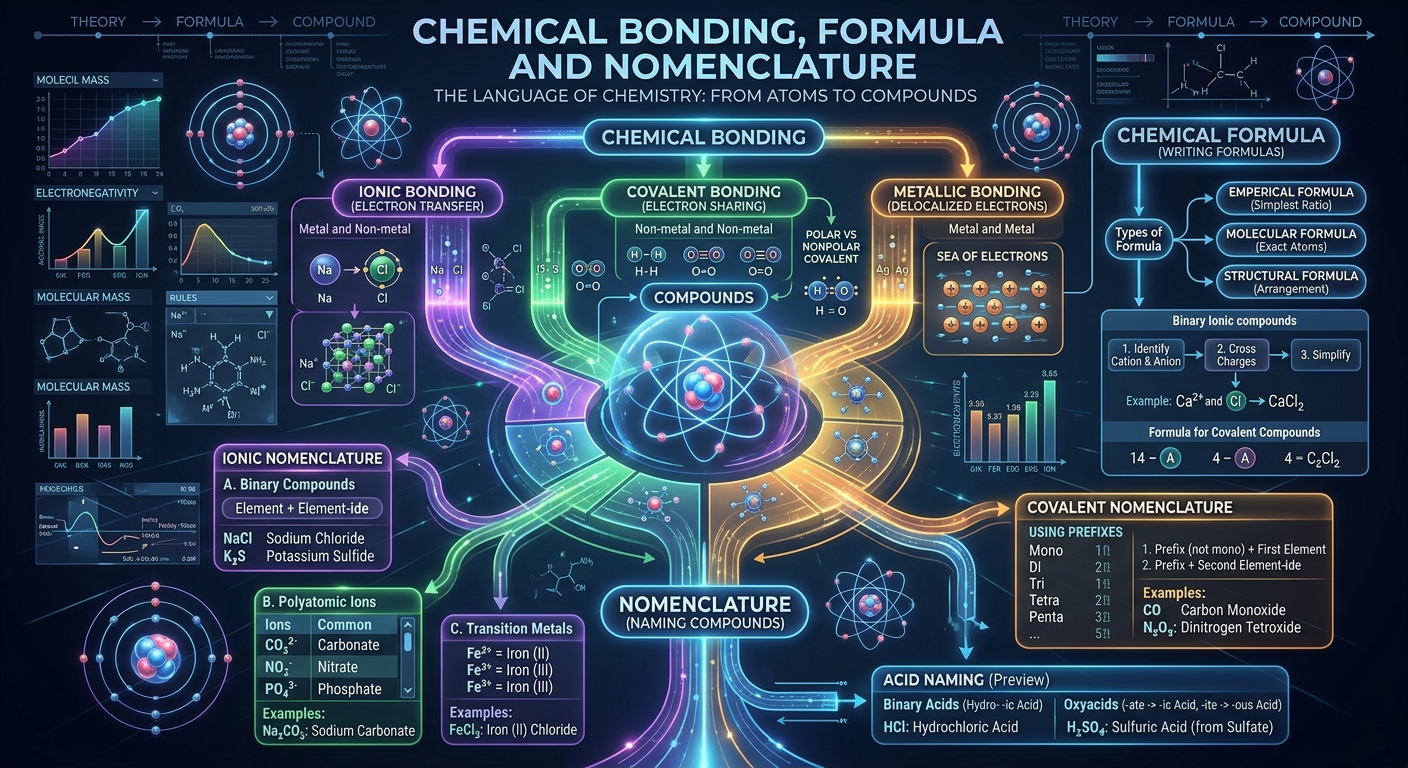
Description
CHEMICAL BONDING, FORMULA AND NOMENCLATURE — FORM 2 STUDY NOTES (PDF)
Master Chemical Bonding, Formulas, and IUPAC Nomenclature with This Complete, Exam-Ready Study Guide!
Are you a Form 2 student, teacher, or exam candidate looking for a clear, detailed, and well-organized resource on Chemical Bonding, Formula, and Nomenclature? This professionally compiled PDF study guide, “CHAPTER THREE: CHEMICAL BONDING, FORMULA AND NOMENCLATURE,” is exactly what you need to understand every concept — from the concept of chemical bonding and ion formation to electrovalent and covalent bonding, valency, oxidation state, chemical formulas, and IUPAC naming.
📘 WHAT’S INSIDE?
This comprehensive resource covers the entire Form 2 Chemical Bonding syllabus, including:
✅ Concept of Chemical Bonding
Definition: A force of attraction that holds atoms or ions together to form molecules or compounds
Why Atoms Bond: To achieve stable electronic configuration
Unstable atoms (incomplete outer shell) need to gain, lose, or share electrons
Stable atoms (full outer shell — like Noble Gases)
Octet Rule (except for Helium, which has 2 electrons in its outer shell)
✅ Formation of Ions
Cations: Positively charged ions (formed by losing electrons)
Anions: Negatively charged ions (formed by gaining electrons)
3D Ion Formation Diagram:
Sodium atom → Sodium ion (loses 1e⁻): 2:8:1 → 2:8 (Na⁺)
Chlorine atom → Chloride ion (gains 1e⁻): 2:8:7 → 2:8:8 (Cl⁻)
Note: Protons are NOT gained or lost in ion formation — only electrons are transferred!
Ion Size Comparison:
CATIONS (Positive Ions) — SMALLER than neutral atom (Na → Na⁺, smaller; reason: loses electron, more nuclear attraction)
ANIONS (Negative Ions) — LARGER than neutral atom (Cl → Cl⁻, larger; reason: gains electron, less nuclear attraction per electron)
✅ Electrovalent (Ionic) Bonding
Definition: A bond formed by the transfer of electrons from a metal atom to a non-metal atom
Conditions: Between a metal and a non-metal; large difference in electronegativity
3D Diagram of Sodium Chloride (NaCl) Formation:
Na atom (2:8:1) + Cl atom (2:8:7) → 1e⁻ transfer → Na⁺ ion (2:8) + Cl⁻ ion (2:8:8)
Electrostatic attraction between Na⁺ and Cl⁻ → NaCl (Ionic compound)
Na → Na⁺ + e⁻; Cl + e⁻ → Cl⁻; Na⁺ + Cl⁻ → NaCl
2D Lattice Structure of NaCl: Alternate Na⁺ and Cl⁻ ions in 3D arrangement; strong electrostatic forces of attraction
Properties of Ionic Compounds:
High melting and boiling points
Soluble in water (dissociate into ions)
Conduct electricity when molten or dissolved
Hard and brittle
Examples of Ionic Compounds:
Sodium chloride (NaCl) — Na⁺, Cl⁻
Magnesium oxide (MgO) — Mg²⁺, O²⁻
Calcium chloride (CaCl₂) — Ca²⁺, Cl⁻
Aluminium oxide (Al₂O₃) — Al³⁺, O²⁻
✅ Covalent Bonding
Definition: A bond formed by the sharing of electrons between non-metal atoms
Conditions: Between non-metals; similar electronegativities
2D Diagram of Hydrogen Molecule (H₂): Each H atom now has 2 electrons — Stable Helium configuration; Shared electron pair = Single covalent bond (–)
2D Diagram of Oxygen Molecule (O₂): O atom (needs 2e⁻) + O atom (needs 2e⁻) → Double bond (O=O)
Types of Covalent Bonds:
SINGLE BOND (–): One shared pair of electrons (Example: H–H, H–Cl, F–F)
DOUBLE BOND (=): Two shared pairs of electrons (Example: O=O, O=C=O)
TRIPLE BOND (≡): Three shared pairs of electrons (Example: N≡N)
Properties of Covalent Compounds:
Low melting and boiling points
Poor conductors of electricity
Generally insoluble in water, soluble in organics
✅ Valency
Definition: The combining power of an element or radical — the number of electrons an atom will donate, receive, or share to form a bond
Determining Valency from Periodic Table:
Group I elements — Valency = 1
Group II elements — Valency = 2
Group III elements — Valency = 3
Group IV elements — Valency = 4
Group V elements — Valency = 8 − 5 = 3
Group VI elements — Valency = 8 − 6 = 2
Group VII elements — Valency = 8 − 7 = 1
Group VIII elements — Valency = 0 (stable)
Examples:
Sodium (2:8:1) → 1 valence electron → Valency = 1
Chlorine (2:8:7) → 7 valence electrons → Valency = 1
Magnesium (2:8:2) → 2 valence electrons → Valency = 2
Oxygen (2:6) → 6 valence electrons → Valency = 2
Valency Table: H(1), Na(1), K(1), Mg(2), Ca(2), Al(3), C(4), N(3), O(2), S(2), Cl(1)
Radicals: A group of atoms that behaves as a single unit and has a charge
Ammonium (NH₄⁺) — Valency 1
Hydroxide (OH⁻) — Valency 1
Nitrate (NO₃⁻) — Valency 1
Carbonate (CO₃²⁻) — Valency 2
Sulfate (SO₄²⁻) — Valency 2
Phosphate (PO₄³⁻) — Valency 3
✅ Oxidation State
Definition: The total number of electrons that an atom either gains or loses to form a chemical bond
Rules for Assigning Oxidation States:
Free elements: Oxidation number = 0 (Example: Na, Cl₂, O₂, Fe)
Sum of oxidation states in a compound = 0 (Example: H₂O: (+1 × 2) + (−2) = 0)
Group I metals: Oxidation number = +1 (Example: Na in NaCl is +1)
Group II metals: Oxidation number = +2 (Example: Ca in CaO is +2)
Halogens: Oxidation number = −1 in compounds (Example: Cl in NaCl is −1)
Hydrogen: Usually +1, −1 in metal hydrides (Example: H in H₂O is +1, in LiH is −1)
Oxygen: Usually −2, −1 in peroxides, +2 in OF₂ (Example: O in H₂O is −2, in H₂O₂ is −1)
Example Calculations:
Find oxidation state of Cl in KClO₃: K = +1, O = −2 (×3 = −6); KClO₃ is neutral: +1 + Cl + (−6) = 0 → Cl = +5
Find oxidation state of S in SO₄²⁻: O = −2 (×4 = −8); Total charge = −2; S + (−8) = −2 → S = +6
✅ Chemical Formulas
Types of Formulas:
EMPIRICAL FORMULA — Shows simplest whole number ratio of atoms (Example: CH₂O for glucose)
MOLECULAR FORMULA — Shows actual number of atoms in a molecule (Example: C₆H₁₂O₆ for glucose)
STRUCTURAL FORMULA — Shows arrangement of atoms in a molecule (Example: H–O–H for water)
Molecular Formula = n × Empirical Formula (where n is a whole number)
Example: If empirical formula is CH₂O and molecular mass is 180
Formula mass of CH₂O = 12 + 2 + 16 = 30
n = 180 / 30 = 6
Molecular formula = C₆H₁₂O₆
Writing Chemical Formulas — Steps:
Step 1: Write symbols of elements/radicals
Step 2: Write valencies as superscripts
Step 3: Interchange valencies as subscripts
Step 4: Simplify if necessary
EXAMPLE: Calcium chloride — Ca Cl → Ca²⁺Cl⁻ → CaCl₂
EXAMPLE: Aluminium sulfate — Al SO₄ → Al³⁺SO₄²⁻ → Al₂(SO₄)₃
Calculating Empirical Formula from Percentage Composition:
Step 1: Get mass of each element
Step 2: Divide by relative atomic mass (RAM)
Step 3: Divide by smallest value
Step 4: Convert to whole numbers
EXAMPLE: Compound contains 69.59% Ba, 6.09% C, 24.32% O → BaCO₃
✅ Nomenclature (IUPAC Names)
Naming Ionic Compounds:
Name the cation (metal) first
Name the anion (non-metal) second with -ide ending
For variable valency metals, indicate charge in brackets
EXAMPLES:
NaCl — Sodium chloride
MgO — Magnesium oxide
CaCl₂ — Calcium chloride
FeCl₂ — Iron(II) chloride (Fe is +2)
Naming Covalent Compounds:
Name first element
Name second element with -ide ending
Use prefixes to show number of atoms
PREFIXES: 1 = mono, 2 = di, 3 = tri, 4 = tetra, 5 = penta, 6 = hexa, 7 = hepta, 8 = octa
EXAMPLES:
PCl₃ — Phosphorus trichloride
N₂O₄ — Dinitrogen tetraoxide
SO₂ — Sulfur dioxide
SO₃ — Sulfur trioxide
CO₂ — Carbon dioxide
🎯 WHY CHOOSE THIS STUDY GUIDE?
✔ Exam-Focused — Aligned with the Form 2 Chemistry syllabus
✔ Comprehensive — Covers every subtopic in detail
✔ Easy to Understand — Clear explanations, diagrams, and tables
✔ Practical — Includes ion formation, bonding diagrams, formula writing steps, and IUPAC naming rules
✔ Time-Saving — All notes in one organized PDF
✔ Perfect for Revision — Valency tables, radical tables, oxidation state rules, and nomenclature examples clearly summarized
👥 WHO IS THIS FOR?
Form 2 students studying Chemistry
Teachers preparing lesson notes, schemes of work, and examinations
Candidates revising for national exams (FTNA, CSEE)
Anyone interested in understanding chemical bonding, formula writing, and IUPAC nomenclature
📥 GET YOUR COPY TODAY!
Don’t waste time searching through multiple textbooks. This all-in-one study guide gives you everything you need to master Chemical Bonding, Formula, and Nomenclature — clearly, concisely, and completely.
Download now and start scoring higher in Chemistry!
MITIHANI POPOTE — Quality educational resources wherever you are.





Reviews
There are no reviews yet.