
Description
EXPONENTS AND RADICALS – MATHEMATICS F5
Topic 05: Exponents and Radicals
Form 5 Mathematics Notes | Comprehensive & Exam-Focused
📘 OVERVIEW
This comprehensive set of notes covers Exponents and Radicals – a core topic in Form 5 Mathematics. It is carefully structured to help students master the laws of exponents, exponential equations, fractional exponents, radicals, and rationalisation of denominators, with clear worked examples and practice questions for exam preparation.
✨ WHAT THIS DOCUMENT COVERS
1. Introduction to Exponents and Radicals
Understanding exponents and radicals
Real-life applications: population growth, earthquake magnitude, disease spread, bacteria growth/decay, electrical networks, scientific phenomena
2. Exponents
Definition: An exponent (or power) indicates how many times a number (the base) is multiplied by itself
Basic form: aⁿ (a = base, n = exponent)
Examples: 4 = 2², 8 = 2³, 81 = 3⁴
Reading exponential notation
Worked Examples:
Example 5.1: Write in exponential form
Example 5.2: Express in expanded form
Example 5.3: Identify base and exponent
Example 5.4: Evaluate
Example 5.5: Express in exponential form with given base
Key Rules for Signs: Even exponent (positive result), Odd exponent (negative result)
Exercise 5.1 Practice (Q1–Q6)
3. Laws of Exponents
Three groups: Positive exponents, Negative exponents, Zero exponents
Four Main Laws: Multiplication Law, Division Law, Power Law, Zero Power Law
3.1 Multiplication Law:
Statement: When multiplying exponential numbers with the same base, add the exponents
Formula: xᵐ × xⁿ = xᵐ⁺ⁿ
Derivation and worked examples (5.6)
3.2 Power Law:
Statement: When raising a power to another power, multiply the exponents
Formula: (xᵐ)ⁿ = xᵐⁿ
Power of a product: (a × b)ⁿ = aⁿ × bⁿ
Worked examples (5.7, 5.8)
Exercise 5.2 Practice (Q1–Q4)
3.3 Division Law:
Statement: When dividing exponential numbers with the same base, subtract the exponents
Formula: xᵐ ÷ xⁿ = xᵐ⁻ⁿ (x ≠ 0)
Power of a quotient: (x/y)ⁿ = xⁿ/yⁿ (y ≠ 0)
Worked examples (5.10, 5.11)
Exercise 5.3 Practice (Q1–Q16)
3.4 Zero Exponent:
Statement: Any non-zero number raised to the power of zero equals 1
Formula: x⁰ = 1 (x ≠ 0)
Note: 0⁰ is undefined
3.5 Negative Exponents:
Statement: A negative exponent means the reciprocal of the base raised to the positive exponent
Formula: x⁻ⁿ = 1/xⁿ (x ≠ 0)
General form: 1/x⁻ⁿ = xⁿ
Worked examples (5.12, 5.13, 5.14, 5.15)
Exercise 5.4 Practice
4. Exponential Equations
Definition: An equation where the variable appears in the exponent
Rules for solving:
Rule 1: If bases are equal, equate exponents (aˣ = aʸ → x = y)
Rule 2: If exponents are equal, equate bases (aⁿ = bⁿ → a = b, n ≠ 0)
Worked Examples:
Example 5.17: Find n
Example 5.18: Find b
Example 5.19: Solve for x and y (2ˣ × 3ʸ = 144)
Example 5.20: Given 4ˣ = 2ʸ and 3ˣ = 9ʸ⁻¹, find x and y
Example 5.21: Solve 5ˣ + 5ˣ⁻¹ = 30 and 4ˣ + 2ˣ − 20 = 0
Exercise 5.5 Practice (Q1–Q23)
5. Fractional Exponents
Definition: Fractional exponents represent roots
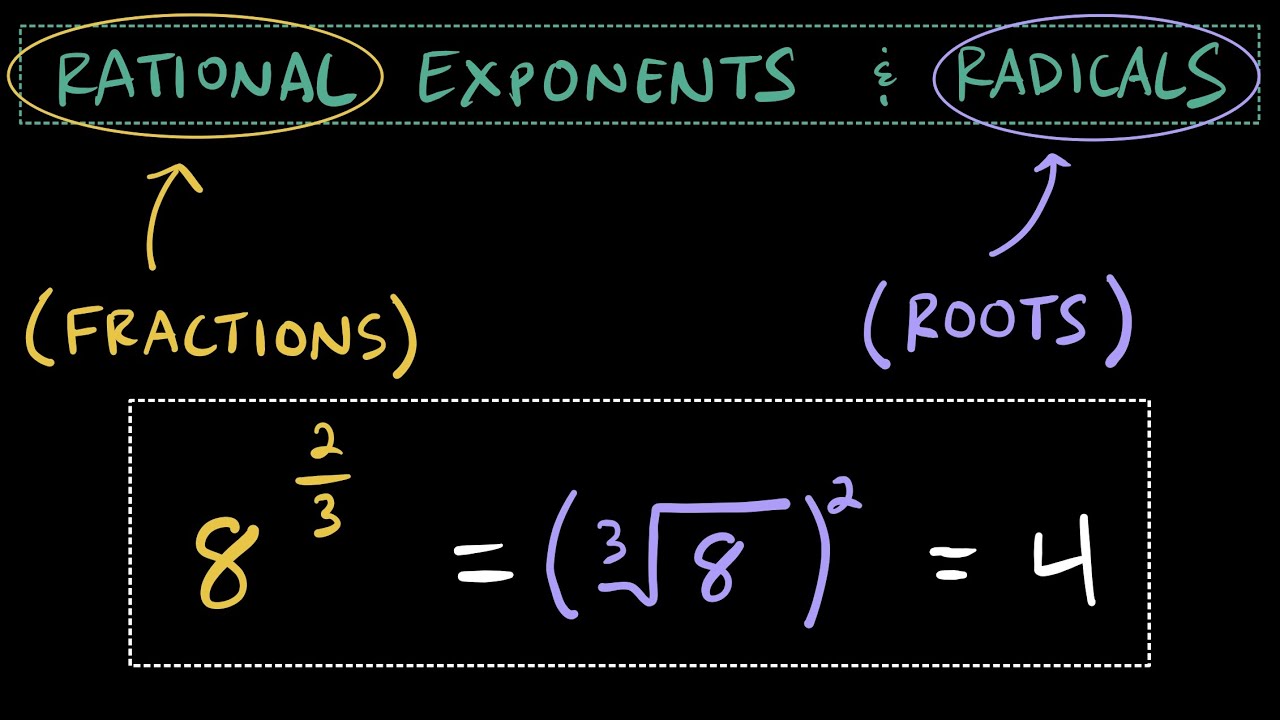
Key relationship: x^(1/n) = ⁿ√x
General form: x^(m/n) = (ⁿ√x)ᵐ = ⁿ√(xᵐ)
Examples: 5^(1/2) = √5, 27^(1/3) = 3, 16^(3/4) = 8
Worked Example 5.24
Exercise 5.6 Practice (Q1–Q14)
6. Radicals
Definition: A radical is a root of a number; the symbol √ is the radical sign (or surd)
Parts of a radical: index, radical sign, radicand
Examples: √4 = 2, ∛8 = 2, ⁴√16 = 2
Worked Examples:
Example 5.25: Find √196
Example 5.26: Find ∛216
Example 5.27: Simplify ⁵√1024
Example 5.28: Simplify √20, √54
Example 5.29: Express under a single radical
Exercise 5.7 Practice (Q1–Q3)
6.1 Addition and Subtraction of Radicals:
Rule: Only like radicals (same index and same radicand) can be added or subtracted
Worked examples (5.30, 5.31)
Exercise 5.8 Practice
6.2 Multiplication of Radicals:
Rule: Multiply numbers outside radicals together and numbers inside radicals together
Formula: ⁿ√a × ⁿ√b = ⁿ√(ab)
Worked example (5.32)
Exercise 5.9 Practice (Q1–Q28)
6.3 Division of Radicals:
Rule: Divide numbers outside radicals and numbers inside radicals
Formula: ⁿ√a ÷ ⁿ√b = ⁿ√(a/b)
Worked example (5.33)
Exercise 5.10 Practice (Q1–Q15)
Exercise 5.11 Practice (Q1–Q3, Q16–Q17)
7. Rationalisation of Denominators
Definition: The process of eliminating radicals from the denominator of a fraction
Case 1: Single radical denominator (1/√b = √b/b)
Case 2: Sum or difference of radicals (1/(√a + √b) = (√a − √b)/(a − b))
Rationalising factor
Worked Examples:
Example 5.34: Rationalise 1/√5, 1/√2
Example 5.35: Rationalise 1/(√3 + √2), 2/(√5 − √3)
Example 5.36: Rationalise (√3 + √2)/(√3 − √2)
Practice Questions (Q1–Q25)
8. Finding Roots Using Calculators
Activity 5.6: Use a calculator to find square roots and cube roots
Exercise 5.12 Practice (Q1–Q19)
9. Chapter Summary
Laws of exponents
Fractional exponents
Radical operations
Rationalisation
10. Revision Exercise 5: Selected Solutions
Q1–Q14 with detailed solutions
🎯 WHY THIS RESOURCE IS PERFECT FOR YOU
✅ Well-Organised – Content is broken down into clear, digestible sections
✅ Exam-Focused – Includes worked examples, practice questions, and revision exercises
✅ Comprehensive – Covers exponents, laws of exponents, exponential equations, fractional exponents, radicals, and rationalisation
✅ Student-Friendly – Simple language with detailed explanations and step-by-step solutions
✅ Revision-Ready – Summary points, formula references, and practice questions
✅ Teacher-Approved – Ideal for classroom use, homework, and exam preparation
📚 WHO IS THIS FOR?
Form 5 Students studying Mathematics
Teachers preparing lesson notes and assessments
Parents supporting their children’s learning
Anyone interested in exponents, radicals, and algebraic manipulation
🛒 GET YOUR COPY TODAY!
This is a must-have resource for anyone serious about mastering Form 5 Mathematics. Whether you’re revising for exams or teaching in class, these notes will save you time and help you achieve excellent results.
MITIHANI POPOTE — Quality educational resources wherever you are.





Reviews
There are no reviews yet.