
Description
CHAPTER ONE: COORDINATION IN PLANTS
Complete Study Notes & Revision Guide
📚 What This Document Covers
This comprehensive chapter breakdown covers everything you need to master plant coordination — from the fundamental concepts of stimuli and response to the intricate mechanisms of plant hormones and the fascinating world of plant movements.
🔬 SECTION 1: FOUNDATIONS OF PLANT COORDINATION
Understanding Coordination
Plants are complex organisms made of different parts working together in harmony. Coordination is the interaction of plant structures in response to both external and internal stimuli — enabling plants to adapt effectively to their environment.
The Sessile Challenge
Unlike animals that move their entire bodies via muscles and nerves (fast, reversible), plants are fixed in place. They solve this through:
Growth of curvature — differential growth on opposite sides of an organ causes bending
This allows leaves, stems, and roots to reach resources without moving the whole body
Why Irreversibility Matters
Tropic movements = permanent cell elongation → irreversible
Nastic movements = temporary turgor changes → reversible
🌱 SECTION 2: CLASSIFICATION OF PLANT MOVEMENTS
Two Major Categories
Type Description Examples
Autonomous (spontaneous) Not controlled by external factors Growth of shoots and roots
Paratonic (induced) Controlled by external factors Phototropism, geotropism, etc.
Paratonic Movement Breakdown
Tropic movements — directional, irreversible, slow
Nastic movements — non-directional, reversible, fast
The Conceptual Map
text
Plant Movement
├── Autonomous (spontaneous)
│ └── Growth of shoots and roots
└── Paratonic (induced by external stimuli)
├── Tropic (directional, irreversible, slow)
│ ├── Phototropism (light)
│ ├── Geotropism (gravity)
│ ├── Hydrotropism (water)
│ ├── Thigmotropism (touch)
│ ├── Chemotropism (chemicals)
│ └── Thermotropism (temperature)
└── Nastic (non-directional, reversible, fast)
├── Photonasty (light intensity)
├── Chemonasty (chemicals)
├── Thigmonasty (touch)
└── Thermonasty (temperature)
🧪 SECTION 3: PLANT HORMONES (PHYTOHORMONES)
General Principles
Plant hormones are chemical signal molecules produced in low concentrations that regulate growth and development.
The Five Major Classes:
Auxins (IAA)
Abscisic Acid (ABA)
Gibberellins (GA)
Cytokinin
Ethylene
⚠️ Critical Concept: Hormones act in concert, not isolation. The final growth response depends on the ratio and interaction between multiple hormones — not just absolute concentration.
Transport Mechanisms
Cell-to-cell (short distance)
Via phloem (long distance)
Auxin transport is polar — moves directionally via PIN proteins
🔑 SECTION 3.1: AUXIN (IAA) — THE MASTER REGULATOR
Production & Transport
Synthesized in: Shoot apical meristems, young leaves, developing seeds
Transported: Polarially (cell-to-cell via PIN efflux carriers)
Direction: From shoot apex downward to root
Energy-dependent (requires ATP)
Can be redirected by light/gravity → basis of tropisms
The Acid Growth Hypothesis
Auxin promotes cell elongation through this multi-step mechanism:
Auxin binds receptors (TIR1/AFB) → degrades repressor proteins (Aux/IAA) → activates transcription factors (ARFs) → gene expression
Rapid activation (within minutes) of plasma membrane H⁺-ATPase → protons pumped into cell wall → acidification
Acidification activates expansins and cell wall loosening enzymes → wall becomes extensible
Turgor pressure drives water uptake → irreversible cell expansion
Long-term: Auxin stimulates synthesis of cell wall materials
Key Roles
Function Details
Cell elongation Concentration-dependent — high in shoots promotes growth; low in roots promotes growth
Phototropism Lateral redistribution causes differential growth
Gravitropism Accumulation on lower side causes bending
Apical dominance Main stem grows more vigorously than side branches
Root formation Promotes adventitious roots (used in cuttings)
Fruit development Promotes fruit set and growth
Vascular differentiation Promotes xylem and phloem formation
Apical Dominance — A Deeper Look
Mechanism: Auxin from apical bud travels down → stimulates strigolactone synthesis → suppresses lateral bud activation
Practical application: Pruning removes auxin source → lateral buds released → bushier plant
Evolutionary logic: Ensures main shoot reaches light first
🌿 SECTION 3.2: CYTOKININ — THE DIVISION PROMOTER
Production & Transport
Synthesized in: Root tips (primarily), developing shoots, seeds
Transported: Via xylem (upward) — opposite direction to auxin
The two hormones meet in the shoot — their ratio determines outcomes
Mechanism
Binds receptors (CRE1/AHK) → signaling cascade → activates transcription factors (ARRs) → gene expression
Promotes cytokinesis (cell division) — stimulates G1→S and G2→M transitions
Delays senescence — promotes protein synthesis, inhibits chlorophyll breakdown
Key Roles
Function Details
Cell division Especially in shoots and roots
Organ development Regulates branch and leaf formation
Root/shoot balance Works with auxin (ratio determines outcome)
Delays senescence Commercial use: keeps cut flowers fresh
Nutrient mobilization Attracts nutrients to tissues
Flower/fruit development Promotes flower development
The Auxin:Cytokinin Ratio — Master Regulator
High auxin : low cytokinin → root formation
Low auxin : high cytokinin → shoot formation
Intermediate ratio → callus formation
💡 Why This Matters: This explains how plants coordinate root and shoot growth — roots signal size via cytokinin, shoots signal via auxin. A bidirectional communication system!
🌾 SECTION 3.3: GIBBERELLIN (GA) — THE GROWTH PROMOTER
Production & Transport
Synthesized in: Young leaves, shoot tips, root tips, developing seeds
Transported: Via xylem and phloem (both directions)
Mechanism
Binds receptor GID1 → triggers degradation of DELLA proteins (repressors) → activates transcription factors → gene expression
In seeds: Stimulates α-amylase production in aleurone layer → breaks down starch → sugars → energy for germination
Key Roles
Function Details
Stem elongation Promotes cell division and elongation
Seed germination Breaks dormancy via α-amylase
Bud dormancy Breaks bud dormancy
Fruit size Increases fruit size (e.g., grapes)
Seedless fruits Can induce parthenocarpy
Flowering Regulates flowering time
The ABA-GA Antagonism
ABA promotes dormancy; GA breaks it
ABA:GA ratio determines seed behavior
Environmental regulation: Cold/light shifts balance toward GA → germination; drought/heat shifts toward ABA → dormancy
🧠 Evolutionary Logic: This antagonism allows seeds to “decide” whether to germinate based on environmental conditions — a critical survival strategy.
💧 SECTION 3.4: ABSCISIC ACID (ABA) — THE STRESS HORMONE
Production & Transport
Synthesized in: Roots (especially under drought), leaves, developing seeds
Transported: Via xylem (roots to shoots) and phloem
Production stimulated by: Drought, salinity, cold, wounding
Mechanism
Binds receptors (PYR/PYL/RCAR) → inhibits PP2C phosphatases → activates SnRK2 kinases → phosphorylates targets:
Ion channels (SLAC1) → anion efflux → stomatal closure
Transcription factors (ABF/AREB) → drought-responsive genes
Aquaporins → altered water permeability
Key Roles
Function Details
Drought response Stomatal closure → reduces water loss
Salinity tolerance Modulates ion transport
Cold tolerance Induces cold-responsive genes
Seed dormancy Inhibits germination; counteracts GA
Growth regulation Inhibits cell division during stress
Leaf senescence Promotes nutrient remobilization
Stomatal Closure Mechanism
ABA → anion efflux (Cl⁻, malate) → membrane depolarization → K⁺ efflux → water efflux → guard cell turgor drops → stomata close
🛡️ Why ABA Is Essential: Without ABA, plants would continue growing and transpiring during drought → rapid dehydration → death. ABA is the brake that slows growth and water loss.
🍎 SECTION 3.5: ETHYLENE (C₂H₄) — THE GASEOUS HORMONE
Production & Transport
Gaseous hormone — diffuses freely through air spaces
Synthesized from: Methionine → SAM → ACC → ethylene
Key enzymes: ACC synthase (rate-limiting) and ACC oxidase
Stimulated by: Mechanical stress, wounding, ripening, high auxin
Inhibited by: Light, high CO₂, low temperatures
Mechanism
Binds receptors (ETR1) on ER membrane → inactivates CTR1 (negative regulator) → activates EIN2 → transcription factors (EIN3/EIL) → gene expression
Double-negative signaling pathway: Ethylene inhibits an inhibitor → net activation
Key Roles
Function Details
Shoot/root growth Affects growth and shape (context-dependent)
Triple response Inhibition of elongation, radial swelling, horizontal growth
Fruit ripening Triggers color change, softening, sweetness, aroma
Leaf abscission Promotes leaf drop
Root hair formation Promotes root hair development
Flooding response Epinasty (downward bending)
The Triple Response
When a growing shoot hits an obstacle underground:
Inhibition of stem elongation
Radial swelling (stem thickens)
Horizontal growth (curling)
🧠 Evolutionary Logic: This helps seedlings navigate around obstacles — it “feels” the obstacle, stops elongating, thickens, and grows sideways to bypass it.
Fruit Ripening
Autocatalytic: Ethylene stimulates its own production → self-perpetuating process
Commercial use: Ethylene gas ripens bananas, tomatoes, mangoes
Ethylene absorbers (e.g., potassium permanganate) delay ripening during storage
📊 SECTION 3.6: SUMMARY TABLE OF PLANT HORMONES
Hormone Main Site of Synthesis Transport Key Functions Interactions
Auxin (IAA) Shoot apex, young leaves, seeds Polar (cell-to-cell via PIN), basipetal Cell elongation, apical dominance, root formation, tropisms, vascular differentiation Synergistic with cytokinin (ratio determines root/shoot); stimulates ethylene
Cytokinin Root tips, developing shoots, seeds Xylem (acropetal) Cell division, shoot formation, delays senescence, nutrient mobilization Antagonistic to auxin in root/shoot balance; promotes bud outgrowth
Gibberellin (GA) Young leaves, shoot tips, root tips, seeds Xylem and phloem Stem elongation, seed germination, fruit development, breaks dormancy Antagonistic to ABA (seed germination); synergizes with auxin (elongation)
Abscisic Acid (ABA) Roots (drought), leaves, seeds Xylem (root to shoot), phloem Stomatal closure, seed dormancy, stress responses, inhibits growth Antagonistic to GA (dormancy/germination); triggers ethylene (ripening)
Ethylene (C₂H₄) All tissues (especially ripening fruit, wounded tissues) Gas (diffuses) Fruit ripening, triple response, leaf abscission, stress responses Stimulated by auxin; triggers ABA (senescence); autocatalytic
🔄 SECTION 4: PARATONIC MOVEMENTS — TROPIC VS. NASTIC
Definition
Paratonic movements are plant movements stimulated by external factors (light, chemicals, etc.). They include tropic and nastic movements.
Comparison Table
Feature Tropic Movement Nastic Movement
Direction Directional — towards or away from stimulus Non-directional — not related to stimulus direction
Control Plant hormones Plant hormones
Rate Slower Much faster
Reversibility Irreversible Reversible
Change type Growth of curvature (permanent cell elongation) Turgor pressure changes (temporary water movement)
Mechanism Differential growth on opposite sides Differential turgor pressure in specific cells (e.g., pulvinus)
Examples Phototropism, geotropism, hydrotropism, thigmotropism, chemotropism, thermotropism Photonasty, chemonasty, thigmonasty, thermonasty
Why the Difference?
Tropic movements involve permanent growth — cells on one side elongate more → organ bends → cannot unbend
Nastic movements involve temporary turgor changes — water moves in/out of pulvinus cells → organ moves → water can move back → organ returns
⏱️ Why nastic is faster: Turgor changes are rapid (seconds to minutes); growth is slow (hours to days).
☀️ SECTION 5: TROPIC RESPONSES (TROPISM)
General Principles
Tropic movement = unidirectional growth movement towards or away from a stimulus
Positive (+) = toward stimulus
Negative (−) = away from stimulus
Mechanistic basis: All tropisms involve lateral redistribution of auxin → differential growth → bending
5.1 PHOTOTROPISM (Light)
Definition: Growth movement in response to unidirectional light.
The Cholodny-Went Hypothesis:
Light perception: Phototropins (blue light receptors) in shoot tip detect light direction
Auxin redistribution: Light causes auxin to move laterally from illuminated to shaded side
Differential growth: Shaded side accumulates higher auxin → cells elongate more → shaded side grows faster
Bending: Shoot bends toward light
🔑 Key Point: It’s not that the illuminated side grows slower — it’s that the shaded side grows faster. The difference causes curvature.
Experimental Evidence (Experiment 1.1):
Box A (experimental): One-side window → shoot bends toward light
Box B (control): Clinostat rotates plant → equal light → shoot grows straight
Conclusion: Light causes lateral auxin redistribution → differential growth → bending
Why the clinostat is critical: It eliminates directional light stimulus while keeping all other variables constant — proving it’s the direction of light, not just light itself, that causes bending.
Phototropism in Roots (Experiment 1.2):
Roots grow away from light (negative phototropism)
Mechanism: Light causes auxin to accumulate on shaded side → high auxin inhibits root growth → shaded side grows slower → root bends away from light
🌱 Adaptive significance: Roots should grow into soil (dark) to find water and nutrients, not toward surface (light).
Importance of Phototropism:
Drives shoots toward light for photosynthesis
Influences stomatal opening for gas exchange
Allows shoots to reach light before competitors in dense vegetation
5.2 GEOTROPISM (Gravity)
Definition: Movement of plant parts in response to gravity.
Roots: Positive geotropism (grow downward)
Shoots: Negative geotropism (grow upward)
Mechanism:
Gravity perception: Statoliths (starch-filled amyloplasts) in statocytes (root cap, shoot endodermis) settle to lowest part of cell
Auxin redistribution: Statolith settling → signaling cascade → alters PIN protein localization → auxin transported to lower side
Differential growth:
Shoots: Higher auxin on lower side → promotes growth → lower side grows faster → shoot bends upward
Roots: Higher auxin on lower side → inhibits growth → lower side grows slower → root bends downward
🔑 Key Point: Same auxin redistribution (to lower side) causes opposite bending in shoots and roots — due to opposite growth responses to auxin.
Experimental Evidence (Experiment 1.3):
Box A (stationary): Gravity acts → shoot grows up, root grows down
Box B (clinostat): Gravity neutralized → both grow horizontally
Conclusion: Gravity causes lateral auxin redistribution → differential growth → bending
Importance of Geotropism:
Roots extend into ground → anchoring + water/mineral absorption
Shoots grow upward → leaves exposed to sunlight for photosynthesis
Fundamental adaptation for life on land
5.3 HYDROTROPISM (Water)
Definition: Growth movement in response to water source.
Roots: Positively hydrotropic (grow toward moisture)
Shoots: Negatively hydrotropic
Mechanism:
Roots detect water potential gradients → grow toward higher water potential (moister areas)
Auxin involved in lateral redistribution
ABA may modify root growth direction under drought
Root cap is the site of water perception
Experimental Evidence (Activity 1.1):
Bean seedling on wire gauze with wet cotton wool above
Result: Roots grow upward toward wet cotton wool (positive hydrotropism)
Significance: Hydrotropism can override geotropism when water gradient is strong enough
💧 Why This Matters: Water is necessary for photosynthesis, physiological reactions, turgor pressure, and mineral transport. Hydrotropism allows roots to forage for water in patchy environments.
5.4 THIGMOTROPISM (Touch)
Definition: Growth movement in response to touch or mechanical contact.
Found in climbing and twining plants
Tendrils bend around objects they contact (positive thigmotropism)
Mechanism:
Upon contact, auxin redistributes away from touched side
Cells on opposite side receive more auxin → grow faster → tendril curls around object
Mechanoreceptors (stretch-activated ion channels) → calcium signaling → auxin redistribution → differential growth
Rapid response: Tendrils can curl within minutes to hours
Importance:
Enables twining plants to climb and expose leaves to sunlight
Provides structural support — plant “borrows” support, investing less energy in stem thickening
🌿 Ecological significance: Energy-efficient strategy — climbing plants compete for light without thick, self-supporting stems.
5.5 CHEMOTROPISM (Chemicals)
Definition: Growth movement toward chemicals.
Examples:
Pollen tube growth: From stigma through style toward ovary and ovule — induced by sugary substances in stigma
Root growth toward fertilizer: Roots grow toward nutrient patches
Mechanism:
Chemical gradients detected by receptor proteins on cell surface
Pollen tube: Stigma secretes sugars (sucrose, amino acids) → chemical gradient → pollen tube tip receptors detect → grow toward higher concentrations (calcium signaling, GABA involved)
Roots: Detect nutrient gradients (nitrate, phosphate) → grow toward higher concentrations (auxin involved)
Importance:
Pollen tube growth: Essential for fertilization — delivers sperm cells to ovule
Root growth toward fertilizer: Allows roots to forage for nutrients (N, P, K) in patchy soil
🌱 Ecological significance: Roots proliferate in nutrient-rich zones (fertilizer, decomposing organic matter) — key adaptation for nutrient acquisition.
5.6 THERMOTROPISM (Temperature)
Definition: Movement of plant parts in response to temperature.
Examples:
Some flowers close when temperature drops
Maize leaves curl when diurnal temperature rises
Tulip petals close at low temperature, re-open at high temperature
Mechanism:
Temperature changes affect membrane fluidity and ion channel activity → altered turgor pressure → movement
Auxin redistribution may be involved in some cases
Importance:
Protection: Flower closure at low temperature protects reproductive organs from cold damage; leaf curling at high temperature reduces water loss and heat load
Optimizes reproduction: Tulip flowers open at warm temperatures (pollinators active) and close at cool temperatures (pollinators inactive)
🌸 SECTION 6: NASTIC RESPONSES
General Principles
Nastic movements = non-directional movements of plant parts in response to external stimuli
Mechanism: Changes in turgor pressure in specific cells (e.g., pulvinus cells)
Key features:
Reversible — occur repeatedly
Fast — seconds to minutes (vs. hours to days for tropisms)
Non-directional — response same regardless of stimulus direction
Based on stimuli: Photonasty, Chemonasty, Thigmonasty, Thermonasty
Mechanistic basis: Rapid changes in turgor pressure in motor cells (pulvinus) — ion channels (K⁺, Cl⁻) and aquaporins control water movement. Reversible because water can move back.
6.1 PHOTONASTY (Light Intensity)
Definition: Movement in response to light intensity (not direction).
Examples:
Prayer Plant (Maranta leuconeura): Petals open horizontally during day, fold vertically at night
Dandelion: Opens morning, closes evening
Moon flower: Opens at night, closes during day
Night-blooming jasmine: Opens at night
Mechanism:
Light intensity detected by phytochrome and cryptochrome photoreceptors → signaling cascade → turgor changes in pulvinus cells → movement
Evolutionary significance:
Flowers open when specific pollinators are active (day vs. night) → maximizes pollination efficiency
Closing petals at night reduces water loss and heat loss
6.2 CHEMONASTY (Chemicals)
Definition: Plant response to chemical stimuli.
Examples:
Ethylene inhibits growth of certain crops (keeps them short and bushy)
Venus flytrap: Two-step process — thigmonasty (touch) to trap insect, chemonasty (chemical) to digest it
Venus Flytrap Mechanism:
Insect lands on leaf
Touches sensitive trigger hairs → signals rapidly change turgor pressure → leaf closes (thigmonasty)
Organic nitrogen compounds from trapped insect stimulate digestive enzyme secretion (chemonasty)
Enzymes break down insect body → nutrients absorbed
Importance:
Trapping insects and digesting them to obtain nitrogen, phosphorus, sulfur
Plant defense (insectivorous plants)
Ecological significance: Insectivorous plants grow in nutrient-poor soils (bogs, wetlands) — chemonasty allows them to supplement nutrient intake
6.3 THIGMONASTY (Touch)
Definition: Response to touch stimulus.
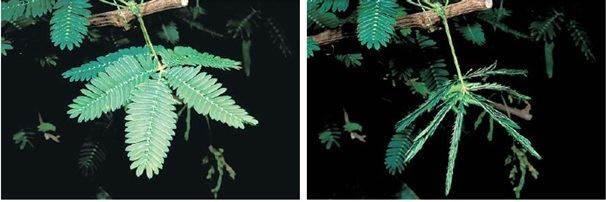
Example: Sensitive Plant / Shy Plant (Mimosa pudica)
Leaves fold when touched
Leaves also fold when swayed by wind
Mechanism:
Touch stimulates mechanoreceptors on leaf surface
Action potentials travel through leaf
Ion channels open in pulvinus cells → K⁺ and Cl⁻ efflux → water efflux → turgor loss → leaflets fold
Recovery: After minutes, ions pumped back in → water re-enters → turgor restored → leaflets open
Speed: Leaflets can fold within 1–2 seconds — one of the fastest plant movements known.
Why does Mimosa fold?
Defense: Sudden movement startles/dislodges insects and small herbivores
Reduces surface area: Folding reduces wind exposure and water loss
Warning signal: Wave of folding can spread through the plant
Importance:
Defense against external stimuli
Survival of the plant
Ecological significance: Rapid defense mechanism — responds within seconds, before herbivore causes significant damage
6.4 THERMONASTY (Temperature)
Definition: Movement in response to temperature.
Examples:
Sunflowers close when temperature drops
Some leaves fold when temperature rises
Tulip and crocus flowers open with warmth, close when cooler
Mechanism:
Temperature changes affect membrane fluidity and ion channel activity → altered turgor pressure in pulvinus cells → movement
Reversible — flowers reopen when temperature returns to optimal
Evolutionary significance:
Flowers open when pollinators are active (warm) and close when inactive (cool) → maximizes pollination efficiency while protecting reproductive organs
Difference from thermotropism:
Thermotropism: Directional growth response to temperature gradients
Thermonasty: Non-directional turgor-driven response to temperature changes
📝 SECTION 7: CHAPTER SUMMARY (EXPANDED)
Plants detect environmental changes and respond using hormones. This is coordination — interaction of plant structures in response to external and internal stimuli.
Plant hormones (phytohormones/growth regulators) are chemical substances regulating growth. Examples: Auxins, ABA, gibberellins, cytokinin, ethylene. They act in concert — ratio and interaction determine final response.
Auxin — key role in growth regulation. Higher concentration promotes shoot growth; low concentration promotes root growth. Involved in phototropism, geotropism, apical dominance, root formation, vascular differentiation. Transported polarly via PIN proteins.
Gibberellins — promote growth by stimulating cell elongation (stem growth). Promote seed germination by breaking dormancy (via α-amylase). Antagonistic to ABA.
Abscisic acid (ABA) — stress hormone. During drought, produced in roots → transported to leaves → stomatal closure → reduces water loss. Essential for survival under harsh conditions and regulating growth/dormancy. Antagonistic to GA.
Cytokinins — promote cell division and growth in shoots and roots. Regulate development of new tissues/organs by stimulating cytokinesis. Works with auxins (ratio determines root/shoot balance). Delays senescence.
Ethylene — promotes growth (in some contexts). Accelerates fruit ripening, coloring, sweetness. Mediates triple response when seedlings encounter obstacles. Stimulated by auxin; triggers ABA in some contexts.
Plants are fixed on ground — incapable of moving from place to place. However, parts show growth responses away from or towards stimuli (water, light, gravity). This is movement of curvature.
Two common types of movements: Nastic and tropic. Tropisms are growth responses resulting in curvatures toward or away from specific stimuli. Nastic movements are non-directional turgor-driven responses.
Important tropisms: Phototropism (light), geotropism (gravity), hydrotropism (water), chemotropism (chemicals), thigmotropism (touch), thermotropism (temperature). All involve lateral auxin redistribution → differential growth → bending.
Nastic movements are non-directional movements in response to external stimuli. Based on stimuli: thigmonasty (touch), chemonasty (chemicals), thermonasty (temperature), photonasty (light intensity). All involve turgor pressure changes in motor cells (e.g., pulvinus).
Key difference: Tropic movements are slow, irreversible, growth-based; nastic movements are fast, reversible, turgor-based.
Hormone interactions are critical:
Auxin : Cytokinin ratio determines root vs. shoot formation
ABA : GA ratio determines seed dormancy vs. germination
Auxin → Ethylene interaction regulates root growth and stress responses
ABA → Ethylene interaction regulates fruit ripening and senescence
Real-world applications:
Auxin — rooting hormones for cuttings, herbicides (2,4-D) at high concentrations
Gibberellin — increasing fruit size (grapes), breaking dormancy in seeds
Cytokinin — tissue culture (shoot induction), delaying senescence in cut flowers
Ethylene — fruit ripening (bananas, tomatoes), degreening citrus
ABA — drought tolerance research, ABA analogs as stress protectants
🎯 EXAMINATION TIPS
Key Definitions to Memorize
Coordination: Interaction of different plant structures in response to external and internal stimuli
Tropism: Unidirectional growth movement towards or away from a stimulus
Nastic movement: Non-directional movement in response to external stimuli
Apical dominance: Main stem grows more vigorously than side branches due to auxin from apical bud
Triple response: Inhibition of elongation, radial swelling, horizontal growth (ethylene)
Common Exam Questions
Explain the mechanism of phototropism (Cholodny-Went hypothesis)
Compare tropic and nastic movements (table format)
Describe the role of auxin in plant growth (acid growth hypothesis)
Explain how ABA helps plants survive drought (stomatal closure mechanism)
Distinguish between positive and negative geotropism (roots vs. shoots)
Describe the triple response in seedlings (ethylene role)
Explain the auxin-cytokinin interaction in root/shoot formation
Diagram Practice
Phototropism experimental setup (Box A vs. Box B with clinostat)
Geotropism in shoots and roots (auxin distribution)
Stomatal closure mechanism (ABA signaling)
Venus flytrap trapping mechanism
Mimosa leaf folding mechanism
📚 GLOSSARY OF KEY TERMS
Term Definition
Auxin Plant hormone promoting cell elongation; involved in tropisms and apical dominance
Cytokinin Plant hormone promoting cell division; delays senescence
Gibberellin Plant hormone promoting stem elongation and seed germination
Abscisic acid (ABA) Stress hormone; promotes dormancy and stomatal closure
Ethylene Gaseous hormone; promotes fruit ripening and triple response
Phototropism Growth response to light direction
Geotropism Growth response to gravity
Hydrotropism Growth response to water
Thigmotropism Growth response to touch
Chemotropism Growth response to chemicals
Thermotropism Growth response to temperature
Photonasty Non-directional response to light intensity
Thigmonasty Non-directional response to touch
Chemonasty Non-directional response to chemicals
Thermonasty Non-directional response to temperature
Pulvinus Swollen motor cells at base of leaves/leaflets; mediate nastic movements
Statoliths Starch-filled amyloplasts; gravity perception
Clinostat Device rotating plants to neutralize directional stimuli (control in experiments)
Apical dominance Inhibition of lateral bud growth by apical bud auxin
Triple response Ethylene-induced: inhibited elongation, radial swelling, horizontal growth
Acid growth hypothesis Auxin-induced cell wall acidification → expansin activation → cell elongation
✅ QUICK REVISION CHECKLIST
□ I can define coordination and explain why plants need it
□ I can classify plant movements (autonomous vs. paratonic)
□ I can name the five major plant hormones and their functions
□ I can explain the acid growth hypothesis
□ I can describe apical dominance and its practical applications
□ I can explain the auxin:cytokinin ratio in tissue culture
□ I can describe the ABA-GA antagonism in seed germination
□ I can explain stomatal closure mechanism (ABA)
□ I can describe the triple response (ethylene)
□ I can compare tropic and nastic movements
□ I can explain the Cholodny-Went hypothesis
□ I can describe geotropism in shoots and roots
□ I can explain hydrotropism and its significance
□ I can describe thigmotropism in climbing plants
□ I can explain chemotropism in pollen tube growth
□ I can describe photonasty using the prayer plant example
□ I can explain thigmonasty in Mimosa pudica
□ I can describe chemonasty in the Venus flytrap
□ I can explain thermonasty in tulip flowers
□ I can identify real-world applications of plant hormones
MITIHANI POPOTE — Quality educational resources wherever you are.




Reviews
There are no reviews yet.