
Description
THE POLICY AND REGULATORY ENVIRONMENT GOVERNING SMALL BUSINESSES IN TANZANIA – BUSINESS STUDIES F3
Chapter Two: The Policy and Regulatory Environment Governing Small Businesses in Tanzania
Form 3 Business Studies Notes | Comprehensive & Exam-Focused
📘 OVERVIEW
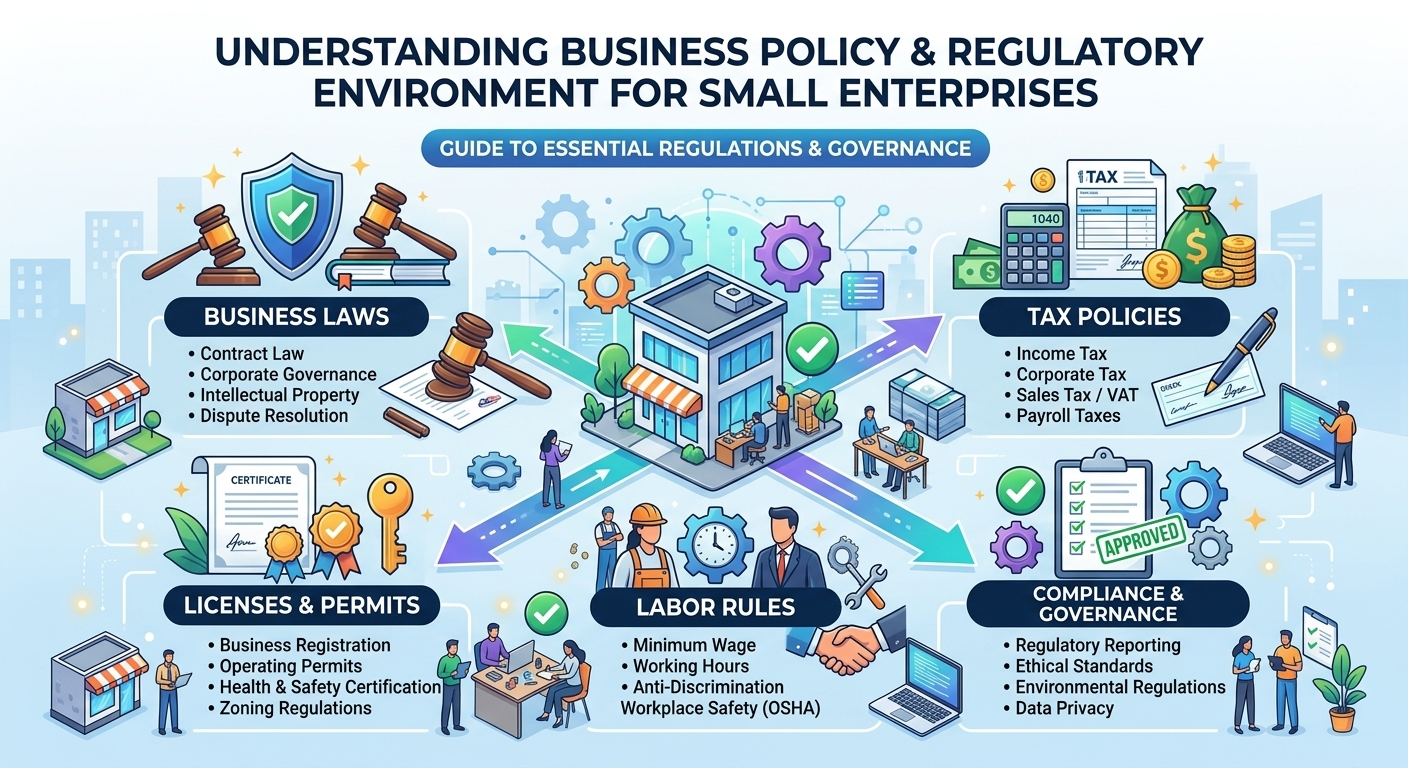
This comprehensive set of notes covers The Policy and Regulatory Environment Governing Small Businesses in Tanzania – a core topic in Form 3 Business Studies. It is carefully structured to help students understand the roles of government and non-government agencies, key policies, national laws, and local by-laws that support and regulate small businesses, and the importance of compliance.
✨ WHAT THIS DOCUMENT COVERS
1. Introduction to the Regulatory Environment
The big picture: Why businesses need rules and regulations
Why rules and regulations matter (fair play, safety, sustainability)
The affirmation for business owners: Understanding policies helps access opportunities and run businesses confidently
2. Roles of Government Agencies
What Government Agencies Do: Worker protection, consumer protection, environmental safeguarding, general business conduct
Key Government Agencies in Tanzania:
SIDO (Small Industries Development Organisation) – Tanzania Mainland
SMIDA (Micro, Small and Medium Industry Development Agency) – Zanzibar
BRELA (Business Registrations and Licensing Agency) – Tanzania Mainland
BPRA (Zanzibar Business and Property Registration Agency) – Zanzibar
TBS (Tanzania Bureau of Standards)
TMDA (Tanzania Medicines and Medical Devices Authority)
FCC (Fair Competition Commission)
Detailed Roles of Each Government Agency:
SIDO: Capacity Building, Access to Finance (NEDF), Market Access
SMIDA: Capacity Building, Access to Finance (SMIDF), Market Access
TBS: Ensuring Product Standards
TMDA: Ensuring Product Standards (medicines, medical devices, food, drugs, cosmetics)
FCC: Ensuring Fair Competition (prevents fake labels, predatory pricing)
BRELA: Business and Property Registration (online registration, licensing, intellectual property)
BPRA: Business and Property Registration (business names, land/property as collateral)
3. Roles of Non-Government Agencies
TCCIA (Tanzania Chamber of Commerce, Industry, and Agriculture):
Advocacy, Capacity Building, Networking, Market Access
ZNCC (Zanzibar National Chamber of Commerce):
Advocacy, Capacity Building, Networking, Market Access
TAMFI (Tanzania Association of Micro-Finance Institutions):
Capacity Building (strengthens microfinance institutions)
TPSF (Tanzania Private Sector Foundation):
Networking, Advocacy (high-level advocate for the private sector)
Summary Table: Government vs Non-Government Agencies
4. Policies That Promote Small Businesses
Definition: Formal sets of rules and actions created by governments or organisations to guide decisions and achieve desired outcomes
Key Policies in Tanzania:
(A) National Microfinance Policy (2017)
(B) SME Development Policy (2003)
(C) National Trade Policy (2003, Edition 2023)
(D) Zanzibar Blue Economy Policy (2020)
(E) Micro, Small and Medium Enterprises Policy (2020) – Zanzibar
Importance of Policies:
Creating an enabling environment
Addressing market failures
Facilitating access to resources
Stimulating economic growth and development
5. Laws and By-Laws Guiding Small Businesses
Definition: Laws (national/regional government) vs By-laws (local authorities)
National Laws:
(A) The Companies Act (Revised Edition 2002)
(B) Business Activities Registration Act (Act No. 12 of 2007) and Business Registration and Licensing Reforms (2023)
(C) National Industries Licensing and Registration Act (2002)
(D) Microfinance Act Cap. 407 (Act No. 10 of 2018) and Regulations (2019)
(E) Employment and Labour Relations Act (2004)
(F) Occupational Safety and Health Act (Act No. 5 of 2003)
(G) Fair Competition Act (Act No. 8 of 2003)
(H) Food, Drugs and Cosmetics Act (Cap 219 of 2003)
(I) The Environmental Management Act (Cap 191 of 2004)
Local Government By-Laws:
Business licensing by-laws
Market by-laws
Land use planning by-laws
Waste management by-laws
Public health by-laws
6. Importance of Compliance with Laws and By-Laws
Building trust and credibility
Avoiding legal penalties and disruptions
Accessing resources and opportunities
Enhancing business efficiency and sustainability
7. Chapter Summary (Key Points to Remember)
11 concise summary points for quick recall
8. Quick Revision: Matching Concepts
A table matching key regulatory concepts with their meanings (SIDO, SMIDA, BRELA, BPRA, TBS, TMDA, FCC, etc.)
🎯 WHY THIS RESOURCE IS PERFECT FOR YOU
✅ Well-Organised – Content is broken down into clear, digestible sections
✅ Exam-Focused – Includes matching concepts and summary points for revision
✅ Comprehensive – Covers government agencies, non-government agencies, policies, laws, by-laws, and compliance
✅ Student-Friendly – Simple language with detailed explanations and real-life Tanzanian examples
✅ Revision-Ready – Summary points and matching concepts for self-testing
✅ Teacher-Approved – Ideal for classroom use, homework, and exam preparation
📚 WHO IS THIS FOR?
Form 3 Students studying Business Studies
Teachers preparing lesson notes and assessments
Parents supporting their children’s learning
Anyone interested in business regulation, policy, and compliance in Tanzania
🛒 GET YOUR COPY TODAY!
This is a must-have resource for anyone serious about mastering Form 3 Business Studies. Whether you’re revising for exams or teaching in class, these notes will save you time and help you achieve excellent results.
MITIHANI POPOTE — Quality educational resources wherever you are.





Reviews
There are no reviews yet.