
Description
CHAPTER THREE: ENDOCRINE SYSTEM
Complete Study Notes & Revision Guide
📚 What This Document Covers
This comprehensive chapter breakdown covers everything you need to master the endocrine system — from the fundamental concepts of hormones and glands to the intricate interactions between the nervous and endocrine systems, the hormones produced by each endocrine gland, their functions, and the disorders that arise when glands malfunction.
🔬 SECTION 1: FOUNDATIONS OF THE ENDOCRINE SYSTEM
Understanding the Endocrine System
The endocrine system is one of the body’s primary regulatory systems, responsible for maintaining homeostasis by releasing hormones — chemical messengers that control metabolism, growth, reproduction, and stress response.
Key Distinction from the Nervous System
Feature Nervous System Endocrine System
Signal type Electrical impulses Chemical messengers (hormones)
Transmission Along neurones Through bloodstream
Speed Fast (milliseconds) Slow (seconds to hours)
Duration Short-lived Long-lasting
Target Specific (synapse) Widespread (all cells with receptors)
Endocrine vs. Exocrine Glands
Feature Endocrine Glands Exocrine Glands
Ducts Ductless Have ducts
Secretion Hormones directly into bloodstream Secretions through ducts
Examples Pituitary, thyroid, adrenal, gonads Sweat, salivary, lacrimal glands
Target Distant target cells Local effects
Speed Slow Fast (local)
🔑 The Pancreas is unique — it serves both endocrine (insulin, glucagon) and exocrine (digestive enzymes) functions.
Hormone Characteristics
Chemical nature: Proteins, peptides, steroids, or amino acid derivatives
Low concentration: Act at nanomolar to picomolar levels
Specificity: Bind to specific receptors on target cells
Amplification: Small amount triggers large cellular response
Regulation: Negative feedback (most common) or positive feedback (rare)
Metabolism: Broken down in liver, excreted by kidneys
The Role of Receptors
Membrane receptors — for protein/peptide hormones (e.g., insulin, adrenaline); trigger intracellular signaling cascades
Intracellular receptors — for steroid hormones (e.g., cortisol, testosterone); enter nucleus and alter gene expression
💡 Why this matters: The same hormone can have different effects on different tissues because different tissues have different receptors.
🔗 SECTION 2: INTERACTION BETWEEN ENDOCRINE AND NERVOUS SYSTEMS
The Hypothalamus — The Bridge
The hypothalamus integrates the nervous and endocrine systems.
Key functions:
Thermoregulation — detects blood temperature, triggers sweating/shivering
Osmoregulation — detects blood osmotic pressure, triggers ADH release
Hunger and thirst — regulates appetite and water intake
Sleep-wake cycles — controls circadian rhythms
Stress response — activates the HPA axis
Control of pituitary — secretes releasing/inhibiting hormones
The Hypothalamus-Pituitary Axis
Hypothalamic Hormone Pituitary Hormone Target Gland Effect
TRH TSH Thyroid Releases thyroid hormones → regulates metabolism
CRH ACTH Adrenal cortex Releases cortisol → stress adaptation
GnRH FSH and LH Gonads Regulates reproductive function
Neuroendocrine Function
Hormone Produced in Stored/Released from Function
Oxytocin Hypothalamus Posterior pituitary Uterine contractions; milk ejection; social bonding
ADH (Vasopressin) Hypothalamus Posterior pituitary Water reabsorption in kidneys; vasoconstriction
Rapid and Sustained Responses
Feature Nervous System Endocrine System
Speed Fast (milliseconds) Slow (seconds to hours)
Duration Short-lived (seconds) Long-lasting (minutes to days)
Example Sympathetic activation — increased heart rate Growth hormone — influences height over years
The “Fight or Flight” Response — A Coordinated Effort
Nervous system (fast): Hypothalamus → sympathetic nervous system → adrenal medulla releases adrenaline → immediate increase in heart rate, blood pressure, blood glucose
Endocrine system (slow): Hypothalamus → HPA axis → CRH → ACTH → adrenal cortex releases cortisol → prolonged stress adaptation
Stress Response and System Integration
Pathway 1 — Immediate (Sympathetic Nervous System):
Hypothalamus → sympathetic nerves → adrenal medulla → adrenaline release
Effects: Increased heart rate, dilated pupils, increased blood glucose
Time course: Seconds
Pathway 2 — Prolonged (HPA Axis):
Hypothalamus → CRH → anterior pituitary → ACTH → adrenal cortex → cortisol release
Effects: Mobilizes energy reserves, suppresses inflammation, modulates immune function
Time course: Minutes to hours
⚠️ Chronic stress → prolonged cortisol elevation → immunosuppression, hypertension, insulin resistance, abdominal obesity, depression.
🧪 SECTION 3: HORMONES PRODUCED BY ENDOCRINE GLANDS
Overview Table
Gland Location Hormones Main Functions
Pituitary (anterior) Base of brain TSH, ACTH, FSH, LH, GH, Prolactin, MSH Controls other endocrine glands; growth; reproduction
Pituitary (posterior) Base of brain ADH, Oxytocin Water balance; childbirth; milk ejection
Thyroid Neck (below larynx) Thyroxine (T4), Calcitonin Metabolism; calcium regulation
Parathyroid Behind thyroid Parathyroid hormone (PTH) Calcium regulation
Pancreas (Islets of Langerhans) Abdominal cavity Insulin, Glucagon Blood glucose regulation
Adrenal (medulla) Above kidneys Adrenaline “Fight or flight” response
Adrenal (cortex) Above kidneys Cortisol, Aldosterone Stress; salt/water balance
Gonads (ovaries/testes) Pelvis/scrotum Estrogen, Progesterone / Testosterone Reproduction; secondary sexual characteristics
3.1 PITUITARY GLAND — THE “MASTER GLAND”
Location: At the base of the brain, beneath the hypothalamus (in the sella turcica).
Structure: Two distinct parts:
Anterior pituitary (adenohypophysis) — produces and secretes its own hormones
Posterior pituitary (neurohypophysis) — stores and releases hormones produced by the hypothalamus
Anterior Pituitary Hormones
(a) Tropic Hormones — regulate other endocrine glands:
Hormone Target Function
TSH Thyroid gland Stimulates thyroid to produce T3, T4 → regulates metabolism
ACTH Adrenal cortex Stimulates cortisol production → stress response
FSH Gonads Females: ovarian follicle growth. Males: sperm production
LH Gonads Females: ovulation. Males: testosterone production
(b) Growth Hormone (GH) — Somatotropin
Functions: Stimulates growth (bones and muscles); promotes protein synthesis; increases fat breakdown; raises blood glucose
Mechanism: GH binds receptors on liver → stimulates IGF-1 production → mediates growth-promoting effects
Imbalance:
Deficiency in childhood → dwarfism
Excess in childhood → gigantism
Excess in adulthood → acromegaly
(c) Prolactin (PRL)
Primary function: Stimulates milk production after childbirth
Regulation: Dopamine inhibits; TRH stimulates
Clinical note: Elevated prolactin → infertility (inhibits GnRH)
Posterior Pituitary Hormones
(a) Antidiuretic Hormone (ADH) — Vasopressin
Function: Acts on kidneys → increases water reabsorption → reduces water loss; constricts blood vessels → raises blood pressure
Regulation: Released when dehydration detected by osmoreceptors
Clinical note:
Diabetes insipidus: ADH deficiency → excessive urine, extreme thirst
SIADH: Excess ADH → water retention, hyponatremia
(b) Oxytocin — “Love Hormone”
Functions: Uterine contractions during childbirth; milk ejection; social bonding
Regulation: Positive feedback during childbirth
Clinical use: Synthetic oxytocin (Pitocin) to induce labor
3.2 THYROID GLAND
Location: Neck region, below the larynx.
Hormones produced:
(a) Thyroxine (T4) and Triiodothyronine (T3)
Functions: Regulate basal metabolic rate (BMR); promote normal skeletal growth; essential for brain development; increase heart rate, breathing rate, body temperature
Regulation: TRH → TSH → thyroid hormones; negative feedback
Imbalance:
Deficiency in infancy → cretinism (stunted growth, mental retardation)
Undersecretion in adulthood → myxoedema (low metabolic rate, fatigue, weight gain)
Excess secretion → hyperthyroidism (Graves’ disease) — weight loss, rapid heartbeat, exophthalmic goitre
Iodine deficiency → goitre (enlarged thyroid)
💡 Why iodine matters: Iodine is essential for thyroxine synthesis. Iodized salt is a public health measure to prevent iodine deficiency.
(b) Calcitonin
Function: Lowers blood calcium (inhibits osteoclasts, increases calcium excretion)
Antagonistic to PTH
3.3 PARATHYROID GLANDS
Location: Four small glands on the posterior surface of the thyroid.
Hormone: Parathyroid hormone (PTH)
Function: Raises blood calcium (stimulates bone resorption, increases kidney reabsorption, activates vitamin D)
Regulation: Negative feedback — low calcium → PTH release → calcium rises → PTH inhibited
Clinical note:
Hypoparathyroidism: Low calcium → tetany (muscle spasms)
Hyperparathyroidism: High calcium → osteoporosis, kidney stones
3.4 PANCREATIC HORMONES
Location: Abdominal cavity.
Islets of Langerhans:
Beta (β) cells → secrete insulin
Alpha (α) cells → secrete glucagon
Delta (δ) cells → secrete somatostatin
(a) Insulin
Released when: Blood sugar is high
Functions: Lowers blood glucose by promoting glucose uptake, glycogen synthesis, protein synthesis, fat synthesis; inhibits gluconeogenesis
Mechanism: Binds receptors → activates GLUT4 transporters → glucose enters cells
Clinical note:
Type 1 diabetes: Autoimmune destruction of beta cells → no insulin
Type 2 diabetes: Insulin resistance → cells don’t respond to insulin
(b) Glucagon
Released when: Blood sugar falls
Functions: Raises blood glucose by promoting glycogenolysis and gluconeogenesis
Clinical note: Glucagon injections used for severe hypoglycemia
🔄 The insulin-glucagon antagonism is a classic example of negative feedback — maintaining blood glucose within a narrow range (70–99 mg/dL fasting).
3.5 ADRENAL GLANDS
Location: Above each kidney.
Structure: Two distinct regions:
Adrenal medulla (inner) — produces adrenaline and noradrenaline
Adrenal cortex (outer) — produces cortisol, aldosterone, androgens
(a) Adrenaline (Epinephrine) — from medulla
“Fight or flight” hormone
Functions: Increases heart rate and blood pressure; increases blood sugar; increases blood supply to muscles; dilates pupils and bronchioles; inhibits digestion
Clinical note: Anaphylaxis → adrenaline injection (EpiPen) saves life
(b) Cortisol — from cortex
Stress hormone
Functions: Stimulates gluconeogenesis; promotes protein breakdown; anti-inflammatory and immunosuppressive; maintains blood pressure
Clinical note:
Cushing’s syndrome: Excess cortisol → weight gain (moon face, buffalo hump), hypertension, diabetes, osteoporosis
Addison’s disease: Deficient cortisol → fatigue, low blood pressure, skin pigmentation
(c) Aldosterone — from cortex
Mineralocorticoid — regulates salt and water balance
Functions: Increases sodium reabsorption (water follows); increases potassium excretion; maintains blood volume and pressure
Regulation: Renin-angiotensin-aldosterone system (RAAS)
Clinical note:
Hyperaldosteronism (Conn’s syndrome): Hypertension, low potassium
Hypoaldosteronism: Low sodium, high potassium, low blood pressure
3.6 GONADAL HORMONES
(a) Testosterone — from testes (Leydig cells)
Functions: Male secondary sexual characteristics (deep voice, beard growth, muscle mass); sperm production; sex drive; anabolic effects
Regulation: GnRH → LH → testosterone; negative feedback
Clinical note: Anabolic steroid abuse → liver damage, heart disease, infertility, aggression
(b) Oestrogens — from ovaries (follicles)
Functions: Female secondary sexual characteristics (breast development, hip broadening); thickening of uterine lining; regulation of menstrual cycle; bone health; cardiovascular protection
Clinical note: Menopause → declining oestrogen → hot flashes, osteoporosis
(c) Progesterone — from ovaries (corpus luteum)
“Pregnancy hormone”
Functions: Prepares uterine lining for implantation; maintains pregnancy (prevents contractions); regulates menstrual cycle; inhibits lactation during pregnancy
Clinical note: Progesterone deficiency → recurrent miscarriage
📊 SECTION 4: SUMMARY TABLE OF ENDOCRINE GLANDS
Gland Position Hormone Role Deficiency Excess
Pituitary (anterior) Below hypothalamus GH Controls growth Dwarfism Gigantism (child), Acromegaly (adult)
TSH Controls thyroxine production Hypothyroidism Hyperthyroidism
ACTH Stimulates adrenal cortex Low cortisol High cortisol
FSH Follicle development/sperm production Poor ovarian/testicular function Ovarian/testicular failure
LH Ovulation/testosterone production Infertility Infertility
Prolactin Milk production Poor milk secretion Infertility
Pituitary (posterior) Below hypothalamus ADH Water reabsorption Diabetes insipidus Water retention
Oxytocin Uterine contractions; milk ejection Delayed birth; poor milk secretion Premature birth
Thyroid Below larynx Thyroxine Regulates metabolic rate Cretinism (infant), Myxoedema (adult) Exophthalmic goitre
Parathyroid Associated with thyroid PTH Regulates calcium Bone thinning (low calcium) Kidney stones (high calcium)
Pancreas Abdominal cavity Insulin Converts glucose to glycogen Diabetes mellitus Hypoglycaemia
Glucagon Converts glycogen to glucose Hypoglycaemia Hyperglycaemia
Adrenal (medulla) Above kidney Adrenaline Increased heartbeat; glycogen to glucose Slow response to emergency Overreaction to emergency
Adrenal (cortex) Above kidney Cortisol Stress response; metabolism Addison’s disease Cushing’s syndrome
Aldosterone Sodium retention; potassium excretion Low blood pressure; dehydration Hypertension; hypokalemia
Gonads (ovaries) Pelvis Oestrogen Female secondary sexual characteristics Menopausal symptoms —
Gonads (testes) Scrotum Testosterone Male secondary sexual characteristics Low libido, fatigue Aggression, liver damage
🎯 SECTION 5: IMPORTANCE OF THE ENDOCRINE SYSTEM
Controlling metabolism — insulin and thyroxine maintain blood sugar and metabolic rates
Growth and development — growth hormone influences bone and muscle formation
Maintaining homeostasis — regulates water/electrolyte balance, blood pressure, immune responses, body temperature
Sexual development and fertility — regulates menstrual cycle, sperm production, pregnancy, secondary sexual characteristics
Stress response — coordinates immediate (adrenaline) and prolonged (cortisol) responses
Coordination between organ systems — enables the body to adapt to internal and external changes
⚠️ SECTION 6: COMPLICATIONS AND DISORDERS
6.1 Hypothyroidism
Definition: Insufficient thyroid hormones
Causes: Autoimmune (Hashimoto’s), iodine deficiency, thyroid damage
Symptoms: Fatigue, weight gain, sensitivity to cold, dry skin, depression
Treatment: Synthetic thyroxine (levothyroxine)
6.2 Hyperthyroidism
Definition: Overproduction of thyroid hormones
Causes: Graves’ disease (most common), toxic nodules, thyroiditis
Symptoms: Weight loss, rapid heartbeat, sweating, tremors, anxiety, exophthalmic goitre
Treatment: Anti-thyroid drugs, radioactive iodine, surgery
6.3 Hyperparathyroidism
Definition: Excess PTH → high blood calcium
Causes: Tumour in parathyroid; secondary to kidney disease
Symptoms: Fatigue, muscle weakness, bone pain, kidney stones
Treatment: Surgery, medications (cinacalcet)
6.4 Goitre
Definition: Enlarged thyroid due to iodine deficiency
Cause: Low thyroxine → high TSH → thyroid enlarges
Symptoms: Visible lump in neck, difficulty swallowing
Prevention: Iodized salt
Treatment: Iodine supplements, thyroid hormone replacement, surgery
6.5 Gigantism
Definition: Excessive growth in children due to excess GH
Cause: Pituitary tumour
Symptoms: Abnormal height, enlarged hands/feet, enlarged facial features
Treatment: Surgery, medication (somatostatin analogs), radiation
6.6 Dwarfism
Definition: Shorter-than-average height due to GH deficiency or genetic factors
Causes: GH deficiency, achondroplasia, malnutrition
Treatment: Synthetic GH injections during childhood
6.7 Cushing’s Syndrome
Definition: Prolonged exposure to high cortisol
Causes: Corticosteroid medications (most common), pituitary tumour, adrenal tumour
Symptoms: Weight gain (moon face, buffalo hump), thinning skin, hypertension, purple stretch marks
Treatment: Surgery, medication, gradual steroid withdrawal
6.8 Addison’s Disease
Definition: Insufficient cortisol and aldosterone
Cause: Autoimmune destruction of adrenal cortex
Symptoms: Fatigue, low blood pressure, skin pigmentation, salt craving, weight loss
Treatment: Cortisol replacement (hydrocortisone), aldosterone replacement (fludrocortisone)
📝 SECTION 7: CHAPTER SUMMARY (EXPANDED)
The endocrine system is composed of ductless glands — secretions (hormones) pass directly into the bloodstream.
A hormone is a chemical substance produced in one part of the body but has an effect in another part. Hormones act on target cells with specific receptors.
Coordination is achieved by the nervous and endocrine systems acting together.
The hypothalamus is the link between the nervous and endocrine systems — produces neurohormones that control the pituitary gland.
The pituitary gland is the “master gland” — anterior lobe secretes trophic hormones, GH, and prolactin; posterior lobe stores and releases ADH and oxytocin.
The thyroid gland produces thyroxine (regulates metabolism) and calcitonin (lowers blood calcium). Iodine is essential. Deficiency → goitre, cretinism, myxoedema.
The parathyroid glands produce PTH (raises blood calcium). Antagonistic to calcitonin.
The pancreas has both exocrine and endocrine functions. Insulin lowers blood glucose; glucagon raises it. Imbalance → diabetes mellitus.
The adrenal glands — medulla produces adrenaline (“fight or flight”); cortex produces cortisol (stress) and aldosterone (salt/water balance). Imbalance → Cushing’s syndrome, Addison’s disease.
The gonads — testes produce testosterone; ovaries produce oestrogen and progesterone.
Disorders of the endocrine system can have significant impacts on health. Early diagnosis and treatment can mitigate severity.
Preventive measures — balanced diet, regular exercise, stress management, routine check-ups — are essential for maintaining endocrine health.
🎯 EXAMINATION TIPS
Key Definitions to Memorize
Endocrine system: Network of ductless glands that produce and release hormones
Hormone: Chemical messenger that triggers specific physiological responses
Target cells: Cells with specific receptors for a particular hormone
Negative feedback: Response counteracts the initial change (most common)
Positive feedback: Response amplifies the initial change (rare — e.g., oxytocin during childbirth)
Common Exam Questions
Compare nervous and endocrine systems (table format)
Explain how the hypothalamus links the nervous and endocrine systems
Describe the functions of anterior and posterior pituitary hormones
Explain the role of insulin and glucagon in blood glucose regulation
Describe the “fight or flight” response (adrenaline and cortisol)
Explain the causes and symptoms of diabetes mellitus
Describe the disorders of the thyroid gland (hypothyroidism, hyperthyroidism, goitre)
Explain Cushing’s syndrome and Addison’s disease
Describe the role of testosterone, oestrogen, and progesterone
Explain how negative feedback regulates hormone levels
Diagram Practice
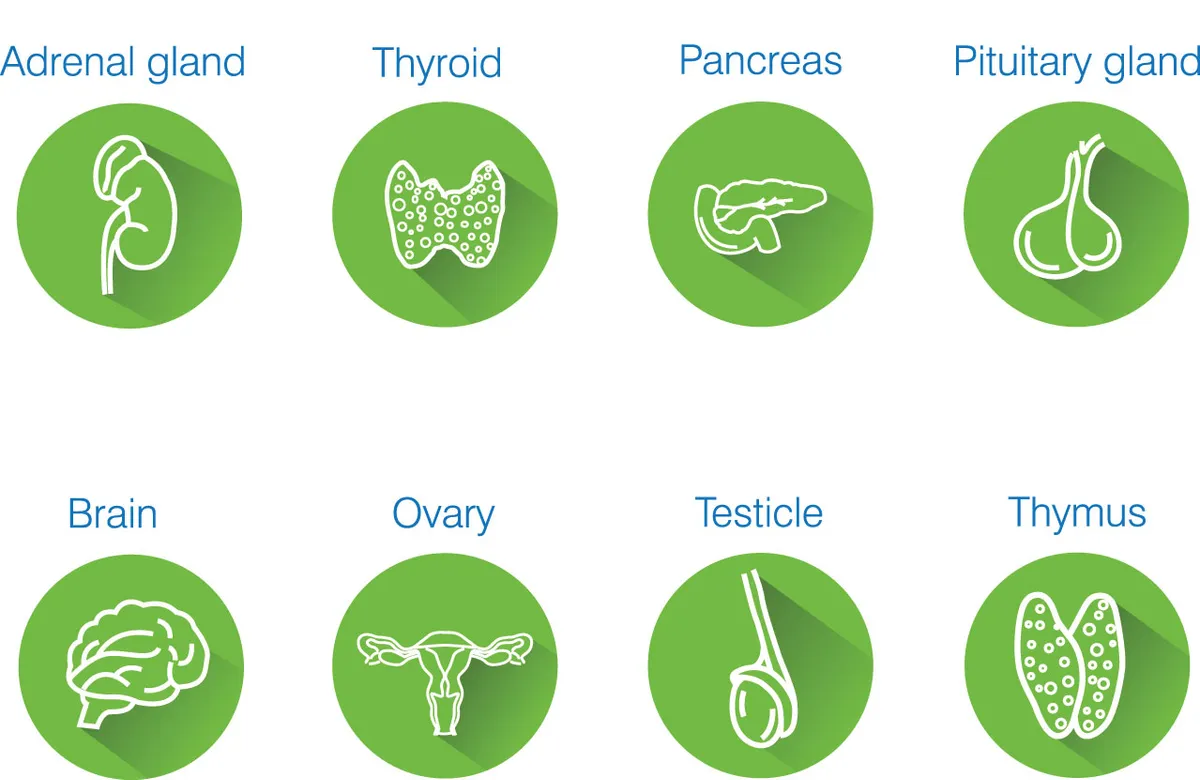
Location of endocrine glands in the body
Hypothalamus-pituitary axis
Insulin-glucagon feedback loop
RAAS (renin-angiotensin-aldosterone system)
Stress response pathways (sympathetic vs. HPA axis)
📚 GLOSSARY OF KEY TERMS
Term Definition
Endocrine gland Ductless gland that secretes hormones directly into bloodstream
Exocrine gland Gland with ducts that secretes through ducts to body surfaces
Hormone Chemical messenger that regulates physiological processes
Target cell Cell with specific receptors for a hormone
Hypothalamus Brain region that links nervous and endocrine systems
Pituitary gland “Master gland” — controls other endocrine glands
Thyroxine Thyroid hormone that regulates metabolic rate
Insulin Pancreatic hormone that lowers blood glucose
Glucagon Pancreatic hormone that raises blood glucose
Adrenaline “Fight or flight” hormone from adrenal medulla
Cortisol Stress hormone from adrenal cortex
Aldosterone Hormone that regulates salt and water balance
Testosterone Male sex hormone
Oestrogen Female sex hormone
Progesterone “Pregnancy hormone”
Negative feedback Response counteracts the initial change
Positive feedback Response amplifies the initial change
Diabetes mellitus Disorder of insulin deficiency or resistance
Goitre Enlarged thyroid due to iodine deficiency
Cushing’s syndrome Excess cortisol
Addison’s disease Deficient cortisol and aldosterone
✅ QUICK REVISION CHECKLIST
□ I can define the endocrine system and hormones
□ I can compare endocrine and exocrine glands
□ I can compare nervous and endocrine systems
□ I can explain how the hypothalamus links the two systems
□ I can describe the hormones of the anterior pituitary
□ I can describe the hormones of the posterior pituitary
□ I can explain the functions of thyroid hormones
□ I can explain the role of calcitonin and PTH in calcium regulation
□ I can explain the insulin-glucagon feedback loop
□ I can describe the functions of adrenaline and cortisol
□ I can explain the role of aldosterone in salt/water balance
□ I can describe the functions of testosterone, oestrogen, and progesterone
□ I can explain the causes and symptoms of diabetes mellitus
□ I can describe thyroid disorders (hypothyroidism, hyperthyroidism, goitre)
□ I can explain Cushing’s syndrome and Addison’s disease
□ I can describe gigantism and dwarfism
□ I can explain the importance of negative feedback in hormone regulation
□ I can identify preventive measures for endocrine health
MITIHANI POPOTE — Quality educational resources wherever you are.



Reviews
There are no reviews yet.