
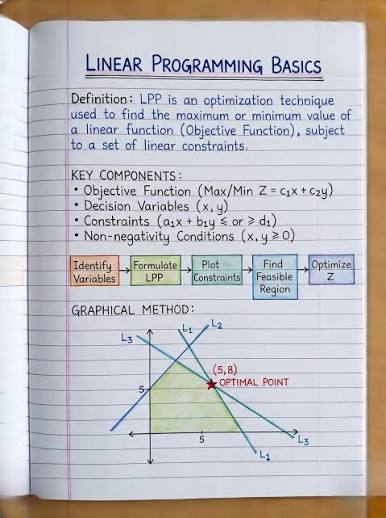
Description
CHAPTER THREE: LINEAR PROGRAMMING — Complete Study Guide
From Formulating Constraints to Finding Optimal Solutions — Master Linear Programming Step by Step
📘 What This Chapter Covers
Linear programming is one of the most powerful mathematical tools used in business, agriculture, engineering, manufacturing, and logistics. This chapter provides a complete, structured guide to understanding and solving linear programming problems — from translating real-world word problems into mathematical models to finding optimal solutions using the graphical method.
Whether you’re a student preparing for national examinations or a teacher seeking a clear reference, this chapter is designed to build both conceptual understanding and problem-solving confidence.
🎯 Key Topics Covered
1. Introduction to Linear Programming
What linear programming is and why it matters
Real-world applications in profit maximization and cost minimization
The role of linear equations and inequalities in modelling
2. Formulation of Linear Programming Problems
Decision Variables — Identifying the unknown quantities that determine output
Objective Function — Writing the linear function to be maximized or minimized
Constraints — Translating resource limitations into inequalities
Non-negativity Constraints — Why decision variables must be ≥ 0
Worked example: Two-product manufacturing with machine and labour hours
3. Graphical Solution of Linear Programming Problems
Step-by-step procedure:
Formulate the problem
Replace inequalities with equations to find boundary lines
Draw boundary lines (solid for ≤/≥, dotted for )
Identify the feasible region using test points
Locate corner points of the feasible region
Evaluate the objective function at each corner point
Corner Point Theorem — Why the optimum occurs at a vertex
Worked examples: Maximization and minimization problems with full graphs
4. Maximization Problems
Manufacturing profit maximization (Example 3.1, 3.4, 3.7)
Product mix decisions (Exercise 3.2, Revision problems)
Determining maximum gross income from limited resources
5. Minimization Problems
Diet and nutrition planning (Example 3.6, 3.8)
Cost minimization with vitamin and chemical requirements
Least-cost feed blending and resource purchasing
6. Real-World Applications
Agriculture — Optimal land allocation for crops (wheat, barley, maize, beans)
Manufacturing — Machine scheduling, labour allocation, production limits
Business — Product mix, purchasing decisions, profit optimization
Health & Nutrition — Diet formulation, vitamin requirements
Education — Resource purchasing for schools
7. Comprehensive Practice
Exercise 3.1 — 10 formulation problems covering paint, furniture, circuits, garden chairs, fruit packages, diet planning, and more
Exercise 3.2 — 15 graphical solution problems including tents, fertilizers, carpentry, and manufacturing
Revision Exercise 3 — 20 complete problems from formulation to optimal solution
8. Chapter Summary
Clear definitions of decision variables, objective function, constraints, feasible region, and optimal solution
Quick-reference guide for exam preparation
✨ Features That Make This Guide Stand Out
✅ Step-by-step worked examples — Every concept illustrated with fully solved problems
✅ Clear graphical illustrations — Feasible regions, boundary lines, and corner points shown visually
✅ Tabular summaries — Data organized in tables for easy formulation
✅ Progressive difficulty — From basic formulation to complex multi-constraint problems
✅ Real-world context — Problems drawn from agriculture, manufacturing, business, and health
✅ Comprehensive exercises — Over 40 practice problems with varying complexity
✅ Exam-focused revision — 20 end-of-chapter problems covering all skill levels
✅ Clear summary section — Key definitions and concepts condensed for quick review
📝 Who Is This For?
Secondary school students studying linear programming for the first time
Examination candidates preparing for national exams (NECTA and similar)
Teachers seeking a structured, ready-to-use teaching resource
Anyone needing practical skills in optimization and resource allocation
🧠 What You’ll Be Able to Do After This Chapter
By the end of this chapter, you will be able to:
Formulate linear programming problems from verbal descriptions
Identify decision variables, objective functions, and constraints
Graph linear inequalities and identify feasible regions
Apply the corner point method to find optimal solutions
Solve maximization problems (profit, income, production)
Solve minimization problems (cost, resource use, diet planning)
Interpret optimal solutions in real-world contexts
Tackle examination-style problems with confidence
📖 How to Use This Guide
Start with the formulation section — Learn to translate words into mathematics
Study each worked example carefully — Follow the graphical steps
Practice with Exercise 3.1 — Build formulation skills
Move to Exercise 3.2 — Develop graphical solution techniques
Attempt the Revision Exercise — Test yourself under exam conditions
Review the summary — Consolidate key definitions and methods
🔑 Why Linear Programming Matters
Linear programming is not just a mathematical exercise — it is a decision-making tool used daily in:
Business — Determining product mixes that maximize profit
Agriculture — Allocating land and resources for optimal yield
Manufacturing — Scheduling production to meet demand efficiently
Health — Designing cost-effective diets and nutrient blends
Logistics — Minimizing transportation and storage costs
Mastering this chapter gives you a practical skill that extends far beyond the classroom.
Start your journey to optimization mastery today. Every concept is explained, every example is worked out, and every exercise is designed to build your confidence.
MITIHANI POPOTE — Quality educational resources wherever you are.





Reviews
There are no reviews yet.