
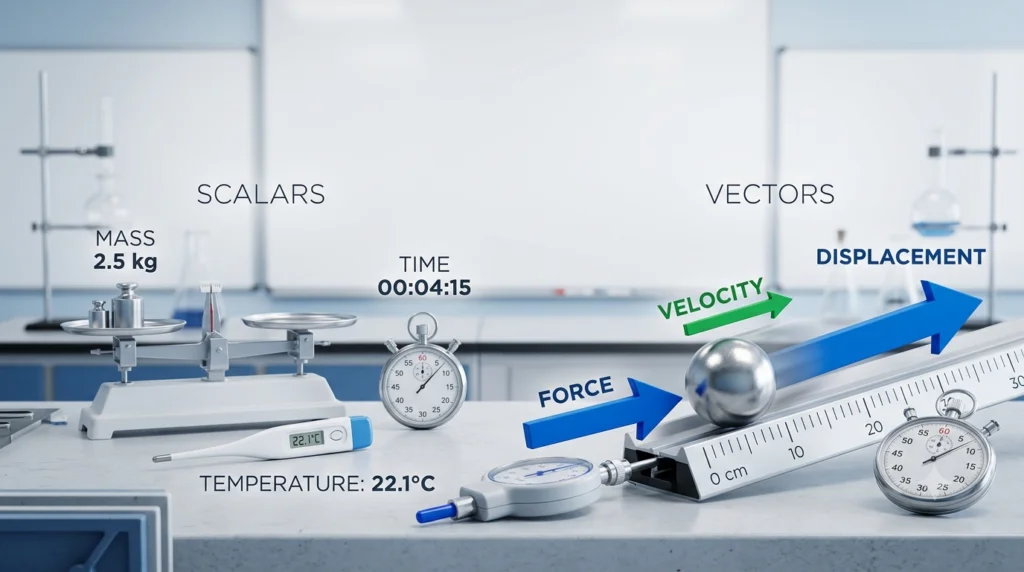
Description
📘 Form One Physics Notes – Measurement in Physics: Physical Quantities, SI Units, Measuring Instruments, Volume & Density | NECTA-Aligned Study Guide PDF
Master measurement the simple, exam-ready way — from fundamental quantities and SI units to vernier callipers, micrometers, and density calculations.
Written specifically for Tanzanian Form One students, this Physics study guide covers the Measurement in Physics topic in clear, structured notes. From the concept of measurement and physical quantities to measuring instruments, volume of solids and liquids, and density — every concept is explained with practical examples drawn from Tanzanian daily life, including buying rice at the market, measuring medicine doses, and construction work.
✨ What’s Inside
✅ Concept of Measurement:
Clear definition of measurement
Why measurement is important in Daily Life (trade, health, construction)
Why measurement is important in Science (experiments, replication)
✅ Standard Units and the Need for Standardization:
Ancient non-standard units — Handspan, Foot, Cubit
Why ancient units failed (body sizes differ)
The need for Standard Units
✅ Physical Quantity:
Definition and formula: Physical Quantity = Value × Unit
Fundamental (Base) Quantities — full table of 7 quantities with SI units and symbols:
Length (metre, m), Mass (kilogram, kg), Time (second, s)
Electric Current (ampere, A), Temperature (kelvin, K)
Amount of Substance (mole, mol), Luminous Intensity (candela, cd)
Derived Quantities — Area, Volume, Speed, Density (with formulas and units)
✅ Basic Measuring Apparatus and Their Uses:
1. Metre Rule and Measuring Tape — units, main parts, how to use, parallax error
2. Vernier Callipers — measures internal/external diameters and depths, accuracy 0.01 cm, main parts, how to use, zero error precaution
3. Micrometer Screw Gauge — measures extremely small thicknesses, accuracy 0.001 cm, main parts (anvil, spindle, sleeve, thimble, ratchet), how to use, precaution
4. Beam Balance & Electronic Balance — measures mass, main parts, TARE button, precautions
5. Stopwatch and Stopclock — measures time intervals, human reaction time (0.2 s), pendulum tip
6. Thermometer — measures temperature, main parts, how to use, safety precautions
✅ Measuring Volume of Liquids and Solids:
Volume of Liquids — Measuring Cylinder, Burette, Pipette; meniscus (concave for water, convex for mercury); parallax error
Volume of Regular Solids — Rectangular Block, Cube, Cylinder (with formulas)
Volume of Irregular Solids — Water Displacement Method (Archimedes)
Diagram: Before and after displacement
Step-by-step procedure with formula: V = V₂ − V₁
Precaution: no air bubbles, thin thread
✅ Measuring Density:
Definition: ρ = m/V
SI Unit: kg/m³; Common unit: g/cm³
Conversion factor: 1 g/cm³ = 1000 kg/m³
How to Find Density in 3 Steps — measure mass, determine volume, divide
Real-Life Applications of Density:
Why oil floats on water
Why steel ships float (hollow + air)
Hot air balloons
✅ Revision Exercise 2 — full practice set:
Part A: Multiple-Choice Questions (5)
Part B: Short-Answer Questions (5)
Part C: Calculation Questions (3, with volume, density, and unit conversion)
Part D: Diagram-Based Error Identification (2 scenarios — parallax error, zero error)
✅ Diagrams — Vernier callipers, micrometer, meniscus, water displacement method
🎯 Perfect For
Form One students studying Physics
NECTA exam preparation and revision
Teachers looking for ready-made teaching material
Parents helping their children study at home
Anyone who wants to understand measurement, instruments, and density calculations
📥 How It Works
Purchase the notes
Download instantly (PDF)
Print it or study on any phone, tablet, or computer
⚠️ Please Note
This is a digital product (PDF). No physical book will be shipped.
🔑 Keywords
Form One Physics, NECTA notes, Measurement in Physics, physical quantity, fundamental quantities, derived quantities, SI units, metre rule, measuring tape, vernier callipers, micrometer screw gauge, beam balance, electronic balance, stopwatch, thermometer, measuring cylinder, burette, pipette, meniscus, parallax error, zero error, volume of solids, volume of liquids, water displacement method, Archimedes, density, mass, volume, g/cm³, kg/m³, Tanzanian secondary school notes, Form 1 study guide, Physics PDF, NECTA revision




Reviews
There are no reviews yet.