
Description
THE INTERNAL STRUCTURE OF THE EARTH AND ITS MOVEMENTS — STUDY NOTES (PDF)
Master the Earth’s Interior and Its Dynamic Processes with This Complete, Exam-Ready Study Guide!
Are you a Geography student, teacher, or exam candidate looking for a clear, detailed, and well-organized resource on The Internal Structure of the Earth and Its Movements? This professionally compiled PDF study guide, “Topic 1: The Internal Structure of the Earth and Its Movements,” is exactly what you need to understand every concept — from the Earth’s concentric layers and rock formation to endogenic forces, folding, faulting, vulcanicity, and earthquakes.
📘 WHAT’S INSIDE?
This comprehensive resource covers the entire Internal Structure of the Earth syllabus, including:
✅ The Internal Structure of the Earth
The Concept of the Internal Structure of the Earth:
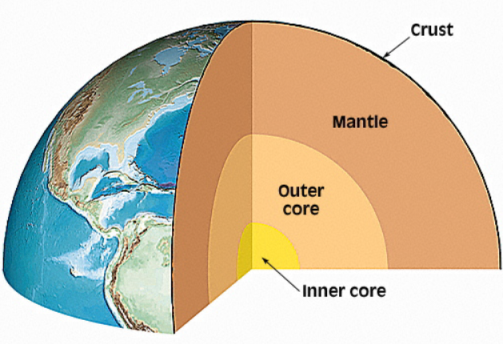
Arrangement of the planet’s concentric layers
Classified based on density and chemical composition
Three layers: CRUST, MANTLE, and CORE
Less dense rocks float on denser rocks
Heavier elements like IRON and NICKEL concentrated in the core
The Three Main Layers of the Earth:
1. The Crust:
Definition: Outermost and thinnest layer
Composition: SIAL (continental crust — Silica and Aluminium), SIMA (ocean floor — Silica and Magnesium)
Thickness: 8 km (under oceans) to 50 km (under continents)
Discontinuity: CONRAD DISCONTINUITY (between SIAL and SIMA), discovered by Victor Conrad in 1925
2. The Mantle:
Definition: Middle layer between crust and core
Composition: Dense igneous rocks rich in iron, silicon, oxygen, aluminium, and magnesium
Structure: Upper Mantle (solid, combines with crust to form LITHOSPHERE; below it is the semi-molten ASTHENOSPHERE), Lower Mantle (rigid and solid; generates CONVECTION CURRENTS)
Discontinuity: MOHOROVICIC DISCONTINUITY (MOHO) (between crust and mantle), discovered by Andrija Mohorovicic in 1909
3. The Core (Barysphere):
Definition: Innermost and hottest part
Composition: NICKEL and IRON (NIFE)
Structure: Outer Core (about 2300 km thick, liquid/molten; generates EARTH’S MAGNETIC FIELD), Inner Core (highest temperature ~5500°C, SOLID due to immense pressure)
Discontinuity: GUTENBERG DISCONTINUITY (between mantle and core), discovered by Beno Gutenberg in 1912
✅ The Role of Internal Structure in Rock Formation
The rock cycle: CRUST (rocks formed, weathered, deposited), MANTLE (source of magma for igneous rocks), MANTLE and CORE (heat and pressure for metamorphic rocks)
Three Main Types of Rocks:
2.1 Igneous Rocks:
Definition: Formed by cooling and solidification of molten rock material (magma or lava)
Formation: INTRUSIVE IGNEOUS ROCKS (magma cools within crust), EXTRUSIVE IGNEOUS ROCKS (lava cools on surface)
Examples in Tanzania: Intrusive — Granite (Mwanza region); Extrusive — Basalt and pumice (Kilimanjaro, Mbeya, Arusha regions)
Characteristics: Hard and crystalline, non-stratified, no fossils
2.2 Sedimentary Rocks:
Definition: Formed by deposition, compaction, and cementation of sediments
Formation: Weathering, erosion, transportation, deposition, lithification
Types & Examples: Mechanically Formed (Sandstone, mudstone), Organically Formed (Limestone, coal), Chemically Formed (Rock salt, gypsum)
Characteristics: Found in layers (STRATA), generally soft, often contain fossils, can be non-crystalline
2.3 Metamorphic Rocks:
Definition: Formed when existing rocks are subjected to intense heat and pressure
Formation: Metamorphism
Types & Examples in Tanzania: Thermal (Marble — Morogoro, Mwanza), Dynamic (Slate), Thermal-Dynamic (Graphite)
Characteristics: Generally harder than original rock, can be crystalline, formed from other rock types
✅ The Internal Forces of the Earth (Endogenic Forces)
Definition: Movements originating from within the Earth’s crust
Responsible for mountains, valleys, and continents
Types of Earth Movements:
Vertical (Radial) Movements: Upward or downward (subsidence or uplift)
Horizontal (Lateral) Movements: Sideways (COMPRESSIONAL — pushing together; TENSIONAL — pulling apart)
3.2 Folding:
Definition: Bending of the Earth’s crust caused by COMPRESSIONAL FORCES
Process: Folding into upward arches (ANTICLINES) and downward troughs (SYNCLINES); sides called LIMBS
Resulting Landforms: FOLD MOUNTAINS
Examples: World — Himalayas, Alps, Andes, Rockies; Africa — Atlas Mountains, Drakensberg Mountains
Types of Folds: Simple Fold (symmetrical), Asymmetrical Fold (one limb steeper), Overfold (Recumbent Fold), Overthrust Fold
3.3 Faulting:
Definition: Geological process where rocks crack and move along a fracture due to tectonic forces
Process: Break or fracture called a FAULT; displacement can be vertical, horizontal, or both
Types of Faults: Normal Fault (TENSIONAL FORCES; hanging wall moves downward), Reverse Fault (COMPRESSIONAL FORCES; hanging wall pushed upward)
Resulting Landforms: Rift Valley (East African Rift Valley — Lakes Tanganyika, Nyasa, Rukwa), Block Mountain/Horst (Usambara and Uluguru Mountains), Plateau, Basin (Lake Victoria Basin)
✅ Vulcanicity
Definition: All processes through which molten rock material (magma) is forced from the Earth’s interior into or onto the crust
Causes: Plate Tectonics, Fissures and Cracks, Surface Water
4.1 Intrusive Volcanic Features (Plutonism):
Dyke: Wall-like feature cutting across bedding planes
Sill: Sheet-like feature parallel to bedding planes (Natural Bridge in Kiwira, Mbeya)
Laccolith: Dome-shaped intrusive feature
Lopolith: Large, saucer-shaped intrusive feature
Batholith: Largest intrusive body, forming the core of mountains
4.2 Extrusive Volcanic Features (Volcanism):
Volcano: Cone-shaped mountain formed from lava and ash around a vent
Active Volcano: Regularly erupts (Mount Oldonyo Lengai)
Dormant Volcano: Has not erupted recently but has potential (Mount Kilimanjaro, Mount Meru)
Extinct Volcano: No record of eruption (Mpoli)
Types of Volcanoes: Ash and Cinder Cone, Composite Cone (Strato-volcano — Mount Kilimanjaro), Volcanic Plug (Spine), Crater (Ngorongoro Crater), Shield Volcano (Kitumbine in Longido District, Arusha)
4.3 Economic Importance and Negative Effects of Volcanic Activity:
Economic Importance: Fertile Soil (Kilimanjaro slopes for coffee and bananas), Minerals (Gold in Geita, diamonds), Geothermal Energy (Iceland; Tanzania potential in Ngozi Crater, Mbeya), Building Materials (basalt, pumice), Tourism (snow-capped mountains, craters, hot springs)
Negative Effects: Loss of Life and Property, Destruction of Land, Poisonous Gases, Climate Change
✅ Earthquakes
Definition: Sudden vibration, shaking, or tremor of the Earth’s crust caused by natural forces
Key Terms: Focus (Hypocenter), Epicentre, Seismograph (Seismometer)
Causes: Tectonic Movements, Volcanicity, Isostatic Adjustment, Human Activities
Effects: Ground Shaking and Rupture (2016 Bukoba earthquake), Tsunamis (2004 Indian Ocean Tsunami), Landslides and Avalanches, Loss of Life and Property
Minimising Risks:
Before: Do not build in high-risk zones, construct earthquake-resistant buildings, have emergency drills
During: Drop, cover, and hold on; stay away from windows; move to open area
After: Expect aftershocks, check for gas leaks, listen to media
✅ Chapter Summary — Key points at a glance
✅ Revision Questions
Section A: Short Answer Questions (5 Questions)
Section B: Structured Questions (5 Questions) — with mark allocations
Section C: Essay Questions (5 Questions) — with mark allocations (20 marks each)
🎯 WHY CHOOSE THIS STUDY GUIDE?
✔ Exam-Focused — Aligned with the Geography syllabus
✔ Comprehensive — Covers every subtopic in detail
✔ Easy to Understand — Clear explanations, diagrams, and tables
✔ Practical — Includes Tanzanian examples (Kilimanjaro, Oldonyo Lengai, East African Rift Valley, Usambara Mountains, Ngorongoro Crater, Geita gold, etc.)
✔ Time-Saving — All notes in one organized PDF
✔ Perfect for Revision — Layers, discontinuities, rock types, folding, faulting, vulcanicity, and earthquakes clearly summarized with exam-style questions
👥 WHO IS THIS FOR?
Secondary school students studying Geography
Teachers preparing lesson notes, schemes of work, and examinations
Candidates revising for national exams (FTNA, CSEE)
Anyone interested in understanding the Earth’s internal structure and dynamic processes
📥 GET YOUR COPY TODAY!
Don’t waste time searching through multiple textbooks. This all-in-one study guide gives you everything you need to master The Internal Structure of the Earth and Its Movements — clearly, concisely, and completely.
Download now and start scoring higher in Geography!
MITIHANI POPOTE — Quality educational resources wherever you are.



Reviews
There are no reviews yet.