
Description
CHAPTER 2: WARS AND CONFLICTS FROM THE LATE 19TH CENTURY TO THE 1940s
📚 Complete Study Guide — Comprehensive, Exam-Focused Notes
🔥 WHY THIS GUIDE IS ESSENTIAL
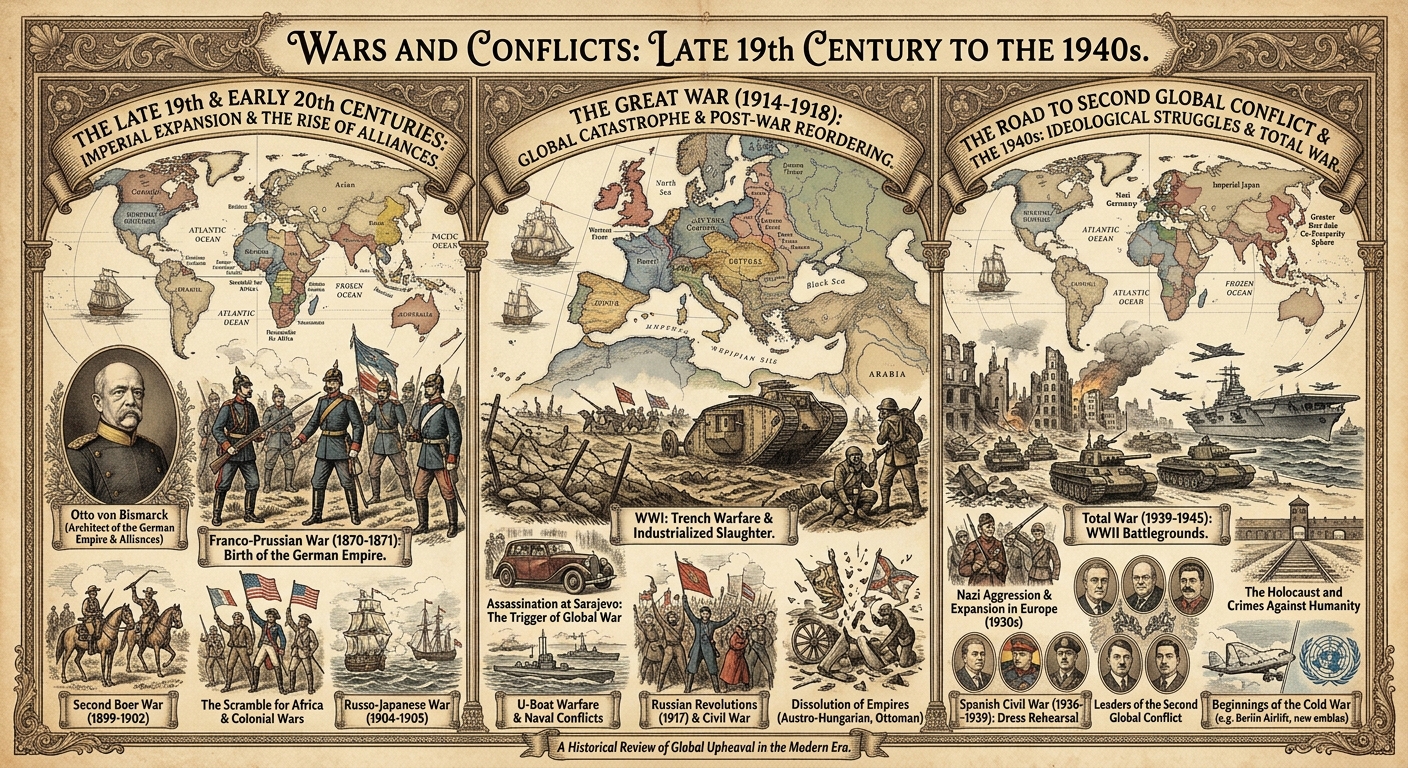
From the scramble for Africa to the ashes of Hiroshima, this chapter captures the most turbulent era in human history — an age of empire, revolution, world war, and the desperate quest for peace. This guide transforms a complex, densely packed chapter into a clear, structured, and exam-ready study companion. Whether you are a student aiming for top grades, a teacher building lesson content, or a curious mind seeking to understand how the modern world was forged in conflict — this guide is your definitive resource.
🎯 WHAT THIS GUIDE COVERS
Introduction: The Road to War
Clear learning objectives and the central theme: A world without wars and conflicts
The background of conflicts from the late 19th century to the 1940s
Background of Wars and Conflicts
Consolidation of nation-states and the rise of monopoly capitalism — from competitive to monopoly capitalism, the economic crises of overproduction and underconsumption, and the consequences that drove European expansion
The Scramble for Colonies — European competition in Africa and Asia, the Berlin Conference (1884–1885), colonial expansion by 1914 (Britain, France, Belgium), and conflicts in Asia (Sino-Japanese War, Russo-Japanese War)
Wars and Tensions Undermining World Peace
🌍 Colonial Rivalries
The Scramble for Africa and its diplomatic crises
The Fashoda Incident (1898) — Britain and France on the brink of war
The Moroccan Crises (1905 and 1911) — Franco-German hostility
The impact of colonial conflicts on Africa and the world
The Berlin Conference as a watershed in African marginalization
⚔️ The First World War (1914–1918)
Overview — the Great War, modernization of military technology, unprecedented carnage
The two alliances: Triple Entente vs. Central Powers
The immediate trigger: Assassination of Archduke Franz Ferdinand (28th June 1914, Sarajevo) by Gavrilo Princip
The three ultimatums to Serbia and Serbia’s response
Long-term causes explored in depth:
Imperialism — colonial rivalries, critical points in Africa (Fashoda, Anglo-Boer War, Moroccan Crises), exploration and colonization (Livingstone, Stanley), British, French, German, and Portuguese interests, the Principle of Effective Occupation
Militarism — the arms race, the naval race (Mahan’s writings, Tirpitz’s Navy Law, the Dreadnought), and the Anglo-German naval rivalry
Secret Alliances — the Triple Alliance (1882) and Triple Entente (1907), and their effects
Nationalism — Balkan nationalism, the Balkan League, the Balkan Wars (1912 and 1913), superpower involvement, and the “Black Hand” movement
German Millenarian Spirit (1914) — the “Spirit of 1914” and its outcomes
The chain of events from Sarajevo to the Treaty of Versailles
💥 Impact of the First World War
Damage to world peace and security
Collapse of empires (Austro-Hungarian, Ottoman, Russian)
Treaty of Versailles consequences
Economic devastation — the shift of global financial power from London to New York
The League of Nations (1920) — aims and limitations
🀄 The Manchuria Crisis (1931–1933)
Background — Japan’s rise after the Meiji Restoration, Japanese victories, the importance of Manchuria
The Mukden Incident (18th September 1931)
International response — the Lytton Commission and the League’s weak response
Factors in the conflict — Japan’s perspective vs. China’s perspective
Consequences — Manchukuo, loss of League credibility, Japan’s full-scale invasion of China (1937), and global impact
🔥 The Second World War (1939–1945)
Overview — the deadliest war in history, 70–85 million casualties, first and only use of nuclear weapons
Complete timeline from the invasion of Poland (1st September 1939) to Japan’s surrender (15th August 1945)
The two alliances: Axis Powers vs. Allied Powers
Causes examined in full:
Treaty of Versailles (1919) — harsh terms, Hitler’s rise, Mein Kampf, Hitler’s aggression
Aggressive behavior of dictators — Adolf Hitler and Benito Mussolini (invasion of Ethiopia, Spanish Civil War)
Military alliances and security — secret alliances, the Berlin-Rome Axis (1936), the Berlin-Rome-Tokyo Axis
Militant and chauvinistic ideologies — extreme nationalism in Germany, Italy, and Japan
Spanish Civil War (1936–1939) — testing ground for new weapons, the road to the Axis
Weaknesses of the League of Nations — failures and encouragement of militarism
Great Economic Depression — the rise of dictators
Policy of appeasement — Britain and France’s concessions and their consequences
🌐 Impact of the Second World War
Human cost — 70–85 million deaths, the Holocaust (6 million Jews)
Political consequences — two superpowers emerge, empires collapse, the United Nations is established
Economic consequences — Marshall Plan, Bretton Woods institutions (IMF, World Bank)
Technological and scientific advances — nuclear weapons, radar, jet aircraft, antibiotics
Social consequences — displacement, expanded women’s roles, civil rights movements
Cold War — Iron Curtain, division of Germany, Berlin Wall, NATO, Warsaw Pact, arms race
United Nations — establishment, Universal Declaration of Human Rights, decolonization support
War crime tribunals — Nuremberg and Tokyo Trials
African participation and impact — inspiration for independence movements and decolonization
Middle East — creation of Israel, Palestinian displacement, Arab-Israeli conflict, oil as a strategic resource
Efforts to Overcome Threats to World Peace
🕊️ The Berlin Conference (1884–1885)
Overview, purpose, and key articles (Sphere of Influence, Effective Occupation)
Features, legacy, and weaknesses of the Berlin Agreements
📜 The Versailles Peace Treaty (1919)
Overview and the Big Four (Wilson, Clemenceau, Lloyd George, Orlando) with their objectives
Woodrow Wilson’s Fourteen Points — all fourteen fully listed
Key provisions — territorial losses, demilitarization, reparations, war guilt clause
The League of Nations — goals, achievements, weaknesses, failures, and legacy
🌐 The United Nations Organisation (1945)
Overview and founding vision (Roosevelt, Churchill, Stalin)
Key conferences — Yalta and San Francisco
UN objectives — all six clearly stated
UN structure — Security Council (P5 veto power), General Assembly, Secretariat, ECOSOC, International Court of Justice, Trusteeship Council
UN agencies and programs — UNDP, WHO, UNICEF, UNHCR, World Bank, IMF, FAO, UNESCO
Comparison table: League of Nations vs. United Nations
UN successes, challenges, post-Cold War role, and continuing relevance
📝 Summary Sections
Causes of the First World War
Causes of the Second World War
Efforts to overcome threats
Impact of the wars
📝 Revision Exercise 2 — 21 Complete Questions
A comprehensive set of exam-style questions covering:
The Berlin Conference’s dual role — peace in Europe, chaos in Africa
Long-term political and social consequences of the Berlin Conference
The Versailles Treaty’s role in causing WWII
Structural weaknesses of the League of Nations
The Manchurian Crisis as a prelude to global conflict
The Manchurian Crisis as the first step toward WWII
The Versailles Treaty — source of conflict or solution?
Effectiveness of the League of Nations (1920–1939)
Successes and limitations of the UN since 1945
Comparing the intentions of the Berlin Conference and the Versailles Treaty
How both defended powerful states at the expense of weaker nations
Lessons from the League and the UN
Weaknesses of UN peacekeeping — three case studies
Innovative strategies for strengthening peacekeeping
The Berlin Conference — preventing war among Europeans, precipitating war with African chiefs
African forced participation in WWII and independent movements
Defend or dismiss: WWII emerged from unresolved WWI tensions
Major global outcomes of WWII and the transformation of international relations
Comparing causes of WWI and WWII
The impact of WWII on African nationalism
WWII’s contribution to the rise of the US and USSR as superpowers
✨ WHY THIS GUIDE STANDS OUT
Feature Benefit
Complete chapter coverage Every section, cause, event, treaty, and consequence is included
Structured for revision Clear headings, numbered lists, tables, and bullet points
Exam-focused 21 revision questions that mirror real examination formats
Historical depth Dates, battles, treaties, key figures, and statistics all precisely recorded
Conceptual clarity Complex ideas — imperialism, militarism, appeasement, collective security — broken down into digestible explanations
Comparative analysis League vs. UN comparison table; WWI vs. WWII causes
Global perspective Covers Europe, Africa, Asia, the Middle East, and the Americas
Ready to use Perfect for students, teachers, and independent learners alike
📖 WHO IS THIS FOR?
Students preparing for history examinations at secondary and tertiary levels
Teachers looking for well-organized, comprehensive teaching material
Researchers needing a quick yet thorough reference on late 19th and early 20th century conflicts
Lifelong learners curious about the wars and treaties that shaped the modern world
🚀 HOW TO USE THIS GUIDE
Start with the Introduction to understand the scope and objectives
Read each section sequentially — the guide builds knowledge progressively
Use the summary sections for quick revision before exams
Work through the 21 revision questions to test your understanding
Refer back to specific sections when you need quick revision on a particular topic
Compare and contrast WWI and WWII to understand patterns in conflict and diplomacy
💡 KEY TAKEAWAYS YOU WILL MASTER
How monopoly capitalism and the Scramble for Africa set the stage for global conflict
How the Berlin Conference simultaneously prevented war among Europeans and created instability in Africa
How imperialism, militarism, secret alliances, and nationalism combined to ignite the First World War
How the Treaty of Versailles sowed the seeds of the Second World War
How the League of Nations failed — and why the United Nations was designed differently
How the Manchurian Crisis exposed the League’s weakness and encouraged further aggression
How appeasement failed and led to the deadliest war in history
How WWII transformed the global order — creating superpowers, the Cold War, decolonization, and the modern international system
How African participation in WWII inspired independence movements and accelerated decolonization
How to analyze and answer exam-style questions with confidence
📌 FINAL WORD
This guide is your complete companion to understanding the most destructive — and transformative — period in modern history. From the scramble for Africa to the founding of the United Nations, from the trenches of the Western Front to the halls of San Francisco — everything you need is here, organized, explained, and ready for your success.
MITIHANI POPOTE — Quality educational resources wherever you are.


Reviews
There are no reviews yet.