
Description
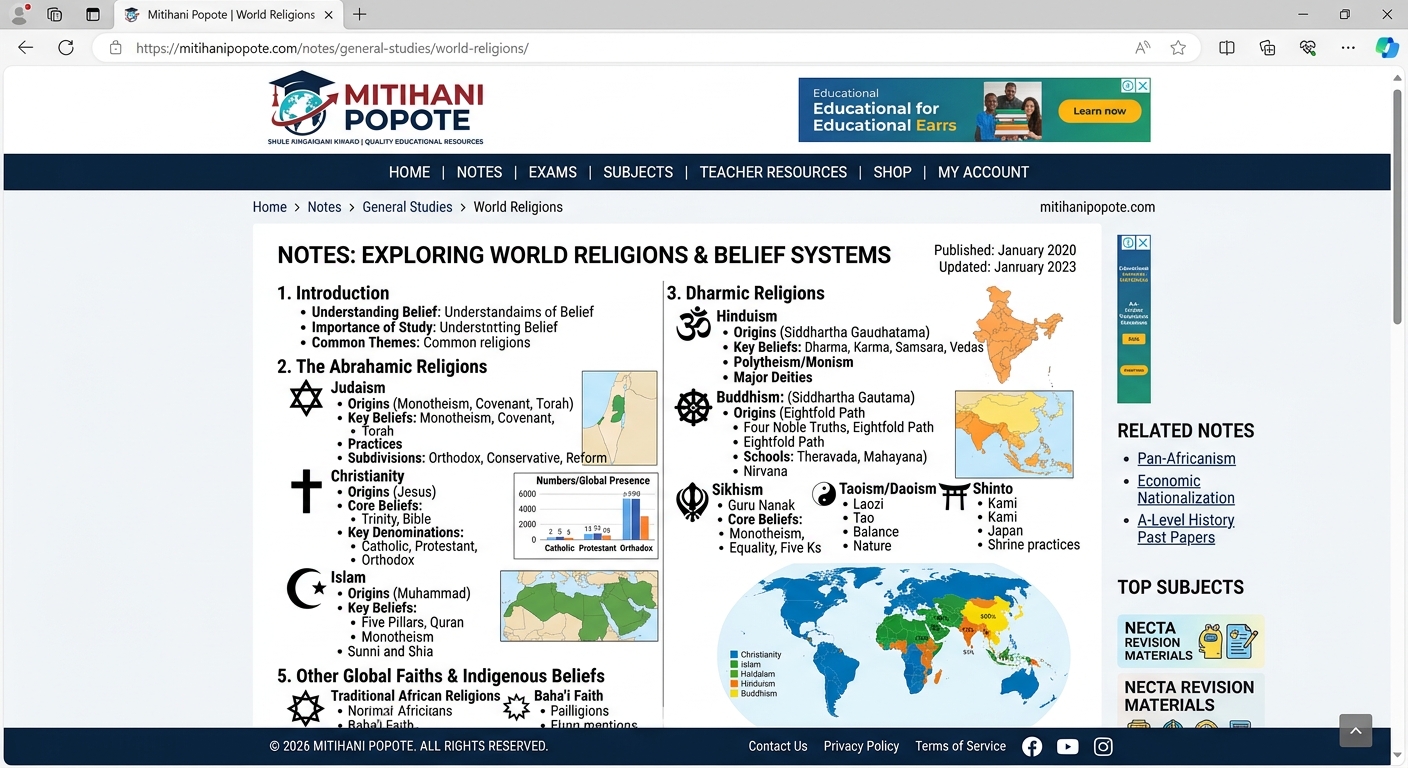
World Religions and Their Influence on Administrative Systems – Comprehensive Study Guide (Form Five History)
Master the Relationship Between Faith and Governance — From Ancient Mesopotamia and the Papal States to Islamic Empires, Confucian China, and the Rise of Secularism
This expertly structured study guide breaks down one of the most profound and examinable topics in world history into clear, organized, and highly digestible sections. Whether you are preparing for national examinations, revising for class tests, or seeking a deeper understanding of how religious beliefs shaped — and continue to shape — administrative systems across civilizations, this guide is your essential companion.
📖 What’s Inside
5.1 Historical Background of Religions on Administrative Systems
How religion and governance intertwined across civilizations:
Ancient Mesopotamia: priesthood held power; temples served as administrative centres
Ancient Egypt: the Pharaoh’s divine authority shaped hierarchical structures
India: Hinduism and Buddhism influenced the caste system and equitable governance under Emperor Ashoka
Graeco-Roman world: polytheistic beliefs infused civic life
Medieval Europe: Christianity exerted remarkable political power through the Catholic Church
Islamic world: Islamic principles guided administration through justice, civic responsibilities, and consultation
Religions as sources of authority, purpose, responsibilities, and rights
Religion and state as a complex, dynamic relationship marked by cooperation, conflict, and struggles for authority and wealth
Traditional beliefs: Confucianism and Taoism in China and Japan; Hinduism and Buddhism in India and South Asia; Islam in the Middle East, Asia, North Africa, and Western Sudan
Examples of tensions: Christian priests vs. Roman rulers on military recruitment and war; conflicts over the caliphate
5.2 The Influence of Religion on Administrative Systems from the Middle Ages to the 18th Century
5.2.1 Administration and Administrative Systems in Europe
Traditional religious principles in Greek city-states and the Roman Empire
Rise of Christianity (30s CE): challenges to Roman administrative systems
Persecutions by Caesars (Claudius, Nero, Vespasian, Domitian, Trajan, Marcus Aurelius)
Nero’s severe persecution; killing of Peter and Paul
Emperor Aurelius: feared Christians could not be loyal to both Church and emperor
Emperor Diocletian (284–305 CE): insisted on worship as a god, outlawed Christian services, imprisoned clergy, removed Christians from public offices
Christians refused to join the army, claiming killing is like killing a brother in Christ
Central question: conflicting views between traditional religious beliefs and Christian principles on how to govern citizens
Emperor Constantine I (313 CE): issued the Decree of Milan with Licinius, legalized Christian worship, ended persecution; baptized emperor; all Roman emperors after Constantine (except Julian) were Christians
Growth of converts (3rd–4th centuries CE); Christianity became the majority religion by the mid-fourth century
The Catholic Pope achieved special status over spiritual and political leadership
5.2.2 The Byzantine Empire
Rose in 565 CE as a continuation of the Roman Empire; a bridge between East and West
Emperor as powerful but servant of the Christian God; people did not worship him as god
Prominent emperors: Justinian, Heraclius, Leo III, Basil I, Basil II
Monarchy not hereditary by law; future emperor chosen by reigning ruler with the army, Senate, people, and Church
Byzantine Church: supported emperors; Orthodox Church became official religion; Church was an arm of government
Christianity dominated political life; religion influenced every aspect of life: birth, death, political, legal courts, artistic and intellectual life
Collapse: 1453 CE after Ottoman Turks captured Constantinople
5.2.3 The Frank Empire
Middle Ages (500–1100 CE): Franks created an empire under the Carolingian dynasty
Clovis (481 CE): first king to unite all Frankish groups; conversion to Christianity enabled cooperation between King and Pope
King Pepin (747–768 CE):
Became king with the help of Pope Zacharia
Proclaimed King of the Franks in 751 CE
Anointed first in 751 CE by Boniface and second in 754 CE by Pope Stephen II at the Basilica of St. Denis
Pope bestowed the title of Patricius Romanorum (Patrician of the Romans)
Pope forbade Franks from electing a king not of the sacred race of Pepin
First recorded crowning of a civil ruler by a Pope
Beginning of the Divine Right theory of European monarchical administration
Donation of Pepin: gave several cities to the Pope, forming the legal basis for the Papal States
Charlemagne III (Charles the Great):
Reigned 768–814 CE
Crowned Emperor by Pope on Christmas Day 800 CE
Accepted the Pope as spiritual leader; made the Pope more powerful in political decisions than the emperor
The Pope could make and unmake monarchy and influenced the executive, parliament, and legal system
Alliance between Popes and Frank Kings built Christendom in Europe; created the tradition of religious leaders attending swearing-in ceremonies of newly elected leaders
5.2.4 Papal States
Series of territories on the Apennine Peninsula in central Italy under the direct sovereign rule of the Pope (756 until Italian unification in 1870)
Included Lazio, Umbria, Marche, and part of Emilia-Romagna
Patrimony of St. Peter: popes acquired considerable property around Rome as early as the 4th century
King Pepin’s intervention (754 and 756): defeated the Arian Lombards, took control of northern Italy, and gave lands to the Pope (Donation of Pepin, 756)
Reasons for turning away from Byzantine emperors: increased imperial taxes, iconoclasm disputes, failure to protect Rome from barbarian invasion
Charlemagne’s organisation (781): Duchy of Rome, Ravenna, Pentapolis, parts of Benevento, Tuscany, Corsica, Lombardy, and Italian cities
Cooperation between papacy and Carolingian dynasty climaxed in 800 when Pope Leo III crowned Charlemagne Emperor of the Romans
Church as government:
Remained the most powerful force of administration throughout the Middle Ages
Stronger than any monarchy, noble, or Holy Roman Empire
Had power to tax believers (tithe: one-tenth of income)
Land and titles necessary for monarchy to rule held only with the consent of the Pope
Church became the largest landowner through tithing
Church had law courts administered by the Pope; Christian laws applied in Papal States and throughout Western Europe
Excommunication: cut off from the Church’s protection; barred from marrying, receiving sacraments, and Church rites at death
Pope’s power to declare war: 1095, Pope Urban II called upon monarchs, nobles, and people to help the Church drive out Muslims from Palestine (the Crusades, 1000–1250 CE)
Church in the Medieval feudal economy: owned large tracts of land; forbade usury; urged merchants to charge just prices
Conflict between King Henry IV and Pope Gregory VII (1075): Henry refused to obey the Pope, was excommunicated, and travelled to Canossa, Italy, in 1077 dressed in rags in the cold winter, waiting three days for the Pope’s pardon
Education and scholasticism: Pope encouraged scholasticism; Thomas Aquinas taught that Christian teachings did not disagree with reasoning
Summary: Popes’ administration played a major role in creating and developing Western European civilisation; the Papal States provided a unique type of administrative system — a spiritual state whose head was also an ecclesiastical leader
5.3 Islam and the Administrative System
Rise of Islam (610 CE) in Saudi Arabia; a strong force influencing political, economic, and social life in North Africa, the Middle East, Asia, southern Europe, and Western Sudan
Prophet Mohammed SAW (570–632): religious and political leader; wanted all Muslims to live in a single community (Ummah) ruled by Islamic laws and traditions (Sharia and Sunna)
First Islamic Empire: governed by Prophet Mohammed himself; after his death, followed by successors (Khalifa/Caliph)
First successor: Abu Bakr (632–634); Islamic expansion began
Umar (634–644) and Uthman (644–656): Muslim forces expanded north; conquered Persian and Byzantine Empires
Islam spread in North Africa from 639 following the Arab conquest of Egypt; by 698, Arabs conquered most Byzantine provinces of North Africa
Umayyad dynasty: founded by Muawiya (661–680); modelled on the Byzantine system; capital moved from Medina to Damascus; Sharia applied in all government administrations; Arabic became the official administrative language; Islam became the state religion; non-Muslims paid a tax
Abbasid Empire: ruled from Baghdad; by the 9th century, Islam became a new force in political administration in the Middle East, North Africa, and Asia through Jihads
Sharia: ethical principles set down in the Quran and examples of actions set out by Prophet Muhammed (Sunna); Islamic jurisprudence (fiqh); offered moral and legal guidance for nearly all aspects of life
Islam in Mali and Songhay Empires (Western Sudan):
Sundiata (founder of Mali Empire): divided the empire into provinces; placed one general in charge of each
Mansa Musa (1312–1337): made Islam a state religion; Sharia became the law of the Empire; established a strong army to control gold mines and protect caravan routes; improved administrative machinery with at least fourteen provinces; governors (emirs) ruled most provinces; all provincial administrators responsible to the Mansa (King); instituted national honours (highest was the National Honour of the Trousers); established good diplomatic relations with Morocco and Egypt
Askia Mohammed (1492): developed an effective system of government; built a Muslim state; developed Timbuktu as a centre of Islamic scholarship; appointed devout Muslims as advisers and courtiers; after Hajj to Mecca, began to purify Islam; appointed the first qadi of Jenne; established courts; encouraged higher education at Timbuktu University; appointed governors for main towns; grouped provinces into regions under Regional Commissioners
Islam as a social formation: created Islamic civilisation; through Sharia, political and social institutions were established; conquests motivated by religious and economic interests; military development an important aspect of administration
Islamic theocratic states: Persian Empire, Umayyads, Abbasid Empire, Ottoman Empire, and Iran after the 1979 revolution
Islam and state separation: did not occur in the Islamic world; Islam became the state religion in the Ottoman Empire and continued to guide civic administration
5.4 Religious Influence on Pre-Colonial African Administrative Systems
Medieval Age: most African societies were in communal form; administration organised on the basis of family, clanship, and kinship; traditional religious beliefs, practices, taboos, and norms regulated societies
Centralised states: Ancient Egypt, Ethiopia, Ghana, Mwene Mutapa, Kongo Kingdom
Ghana Empire:
Religion played an important role in unifying the people of Metropolitan Ghana
Capital city: Kumbi Saleh; title of king: Kaya-Magha or Tunkka
Before the 10th century: traditional beliefs and practices played an important role in political life; involved in the coronation of the Emperor and led national prayers for eliminating misfortunes
People regarded the King as divine; others regarded kings as a medium between the real and eternal world
King assisted by a council of ministers and governor of the capital city; Emperor administered law in his court of justice; provincial administration left in the hands of kings of conquered states
Developed civil service, strong monarchy, cabinet, army, effective system of administering justice, and a regular source of income
Introduction of Islam (10th century): divided the royal family between traditionalists and Muslims; the Emperor began hiring Muslims as scribes, recording daily administrative tasks in Arabic; the King’s interpreter, official in charge of the treasury, and majority of ministers became Muslims; kings allowed freedom of religion and worship to Muslims
Kongo Kingdom:
Traditional religious beliefs and practices played an important role in administration
Elaborate government structure from central government to provinces; arrangements for electing the King, royal council, electors, bureaucratic posts, and matrons
Kings used traditional religion as a unifying force; legitimised kings and royal advisors
Penetration of Catholic missionaries (15th century): Portuguese explorer Diogo Cao reached the Kongo Kingdom in 1483; took some Congolese to Portugal to study Christianity; returned with Roman Catholic priests and soldiers in 1491; ruling king Nzinga Nkuwu and principal nobles baptised; Nzinga Nkuwu took the Christian name Joao I; succeeded by son Afonso Mvemba Nzinga, who established Christianity as the state religion; Afonso I worked to create a Catholic Church in Kongo; created a syncretic version of Christianity
Complex religious history: ancestor and spirit cults; syncretism of indigenous traditions and Roman Catholicism
Catholic Church played an important role in administration; led to constant conflicts between traditionalists and Christians
Kingdom established highly centralised administration
5.5 Confucianism and Administration in China
Founder: Confucius, born during the Spring and Autumn Period (770–481 BCE), in Lu (now Shandong Province); died 479 BCE; China’s most famous teacher, philosopher, and political theorist
Four important principles of Confucius’s political philosophy:
The state is an extended family: mutual obligations between father and sons, sovereign and subjects; governing one’s family correctly is a precondition to governing the state
Government exists for the benefit of the people: people are the most important element of the state; government described as a loving parent; “To centralise wealth is to disperse the people and to distribute wealth is to collect the people”
The ruler was to set a moral example: government must lead by moral example; when the Prince’s personal conduct was good, government was effective without using force; duty of ministers to speak out against the ruler and even depose him if engaged in wrong conduct
Government exists by the will of the governed: people are the foundation of the state and government authority; Confucius opposed hereditary monarchy and put forth a theory of government based on a social contract; against the Divine Theory and other forms of assuming powers in government
Influence of Confucianism: shaped policies and ideas of ancient Chinese political life; great influence on the Han Empire; later influence on Ming, Tang, Qing, and Sung dynasties; the Mongol Empire also observed Confucianism; influence on the way China was administered remained preeminent up to 1949
5.6 Transition from Religious-Based to Secular Administrative Systems from the 15th to the 19th Centuries
Secularism: the principle and practice of separating religion from civil and state matters; drawing from human experiences and natural principles
Factors for the transition:
Rise of capitalism in Western Europe: merchants, artisans, and usurers rose in emerging urban centres; feudalism entered into crisis; the rising merchant class challenged European monarchies based on the Divine Theory and the alliance between Church and monarchy
Rise of the Renaissance: began in Italian city-states of Florence and Venice in the 15th century; growth of finance, banking, and trade; the Church did not allow money lending and charging interest; principles of merchant capitalism (buying cheaply, selling dearly) were not compatible with Christian trade ethics; the Netherlands grew and challenged the Spanish Catholic Empire; Calvinism penetrated the Low Countries; the Dutch East India Company established in 1602; the British East India Company and British West Indies Company facilitated trade
Reformation: Martin Luther articulated the Doctrine of Two Kingdoms and posted the 95 theses at Wittenberg in 1517; Anabaptists (Michael Sattler) argued the two kingdoms should be separate; the Catholic Reformation (Counter-Reformation) convened the Council of Trent (1545–1563); the Reformation in England: the Act of Supremacy (1534) made the Church of England independent of the Catholic Church in Rome; King Henry VIII established himself as head of the Church of England; Queen Elizabeth I shaped Anglicanism
Rise of the Enlightenment (Age of Reason): French scholars (Voltaire, Jean-Jacques Rousseau, Baron de Montesquieu) influenced government administrative systems; began with the publication of Principia by Isaac Newton in 1687 and ended with the outbreak of the French Revolution in 1789; Montesquieu: The Spirit of the Laws (1748), urged the separation of the three branches of government; Rousseau: advocated a “civil religion” to create links necessary for political unity around the state; John Locke: argued government lacked authority in the realm of individual conscience; in A Letter Concerning Toleration, defended religious toleration and the separation of ecclesiastical authority from the authority of the state; Pierre Bayle: supported the separation of Church and State
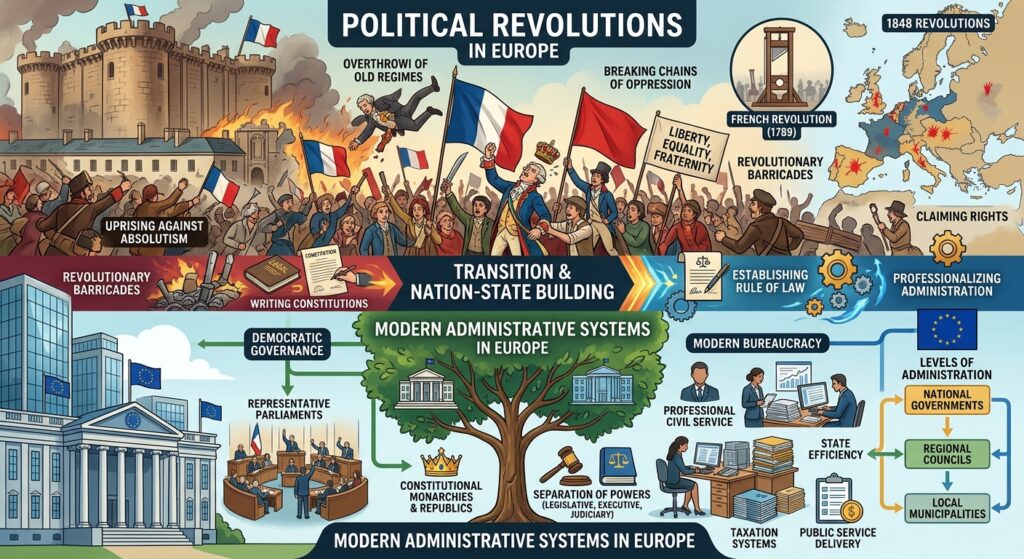
Political revolutions in Europe and America: the English Glorious Revolution transformed absolute monarchy into constitutional monarchy; the French Revolution of 1789 ended the monarchy and established a republic; French revolutionaries were noted for being the first state to reject religion altogether
Need for religious freedom in many European countries: the alliance between monarchies and the Catholic Church; the rise of Protestantism divided Europe; the Thirty Years’ War (1618–1648) was largely ended by the Peace of Westphalia (1648), establishing a new political order (Westphalian sovereignty); the Anglican Church as the state religion in England led to the persecution of non-Anglicans; some fled England as religious refugees to the Americas in search of religious freedom
19th century: the degree of actual separation between government and religion varied widely; determined by legal structures and prevalent legal views
England: the Constitution established Anglicanism as the state religion; the British monarch became the supreme governor of the Church of England; 26 bishops (Lords Spiritual) sat in the House of Lords
France: the signing of the Concordat of 1801 between France and the Holy See provided a legal separation between church and state
By the 19th century, many European modern states (France, Italy, Britain, Belgium, Spain, Portugal, Germany) separated state and church; facilitated freedom of worship, speech, and association
Christianity continued to influence political life in Europe: inclusion of religious festivals in the national calendar; use of religious rites in the coronation of kings and presidents; burial rites for funerals
Islamic world: separation between Islam and state did not occur; Islam became the state religion in the Ottoman Empire and continued to guide civic administration; Islamic theocratic states (Abbasid, Umayyad, Turkish, Ottoman Empires, Mali and Songhay Empires) ruled through Sharia
✨ Key Features
Concise and Structured — Every topic broken down into clear sub-topics with detailed notes
Comparative Analysis — Christianity, Islam, Confucianism, and traditional African religions compared side by side
Historical Depth — From ancient Mesopotamia and the Roman Empire to the Papal States, Islamic Empires, and the rise of secularism
Exam-Focused Content — Exercises and revision questions after every section to test and reinforce understanding
Clear Definitions — Key concepts explained: Ummah, Sharia, Sunna, fiqh, theocracy, secularism, Divine Right, excommunication, and more
Real Historical Examples — King Henry IV at Canossa (1077), the Donation of Pepin (756), Mansa Musa’s Mali, Askia Mohammed’s Songhai, and the Kongo Kingdom
Contemporary Relevance — Connects historical religion-state relations to modern debates on secularism, religious freedom, and governance
📝 Comprehensive Assessment Section
Exercise 5.1
Analyse administrative structures that modern governments can draw from Graeco-Roman civilisations
Exercise 5.2
Lessons for world diplomats from the Papal States as a model for diplomatic relations
How the collapse of the Roman Empire in 476 CE influenced the status and practice of Christianity
Exercise 5.3
How Sharia influenced governance and administration in Islamic states
Exercise 5.4
Appraise the role of traditional religions in shaping administrative systems in pre-colonial African societies
Exercise 5.5
Lessons African countries can learn from Confucian ideals in promoting socio-economic development
How traditional religious beliefs and practices shaped pre-colonial African administrative systems
Revision Exercise 5 (11 Questions)
The role of traditional religious beliefs in pre-colonial African administrative systems
The impact of Islam and Christianity on pre-colonial African administrative systems
The dominance of Christianity and Islam in Europe, Africa, Asia, and the Americas from the 3rd to the 15th century
Factors for the transition from religious-based to secularised administration in Europe from the 16th to the 19th century
The roles of Martin Luther, John Locke, and Thomas Jefferson in advocating for the separation of church and state
The evolution of governance in early Islamic Empires after the death of Prophet Muhammed
How Confucianism shaped bureaucratic structures and administrative policies in Imperial China
The role of Sharia law in Islamic administrative systems throughout history
How Christianity influenced administrative systems in Medieval Europe
The impact of the separation between church and state on modern administrative systems
The influence of Islamic legal principles (Sharia) on administrative systems in historic Islamic empires like the Ottoman Empire
Activities
Composing an article offering guidance to present-day African leaders on integrating religious norms and values into administrative functions
Studying the Byzantine and Frankish Empires and writing a journal article on administrative traits as models for contemporary governance
Designing a poster on administrative traits in Islamic governance
Preparing a newspaper article urging African leaders to adopt Confucian ideals
Debating the motion: “Separation between religion and government promotes social cohesion, human rights, and inclusive society”
🎯 Who This Guide Is For
Form Five and Form Six History students preparing for national examinations
Teachers seeking a well-organized reference and teaching resource
Anyone interested in understanding the historical relationship between religion and governance
Students preparing for regional and international examinations on world history and comparative religion
Readers fascinated by the evolution of theocratic states, secularism, and the separation of church and state
⭐ Why Choose This Guide
✅ Curriculum-Aligned — Follows the official History syllabus structure
✅ Exam-Focused — Revision questions and exercises mirror real examination formats
✅ Clear and Concise — Complex religious and political concepts explained in simple, accessible language
✅ Comprehensive Coverage — From ancient Mesopotamia and the Papal States to Islamic Empires, Confucian China, and the rise of secularism
✅ Comparative Approach — Enables cross-religion and cross-civilization analysis
✅ Historical Depth — Traces the origins of theocracy, the Divine Right theory, and the separation of church and state
✅ Contemporary Relevance — Connects historical religion-state relations to modern debates on secularism, religious freedom, and inclusive governance
Order your copy today and take control of your success!
MITIHANI POPOTE — Quality educational resources wherever you are.



Reviews
There are no reviews yet.