
Description
⚡ TWO — CURRENT ELECTRICITY | Complete Physics Study Guide
Master Electric Circuits with Confidence — From Charge Flow to Ohm’s Law!
Are you preparing for exams and finding current electricity challenging? This comprehensive, well-structured study guide breaks down everything you need to know about electric current, circuits, and resistance — with clear diagrams, worked examples, and practice questions.
📘 What’s Inside?
This complete chapter (65 pages) covers everything you need to master current electricity, carefully arranged in a logical, easy-to-follow format:
✅ 2.0 Introduction to Current Electricity
Clear learning objectives to guide your study
Key terms defined for quick reference
The water-pipe analogy made simple
✅ 2.1 Concept of Current Electricity
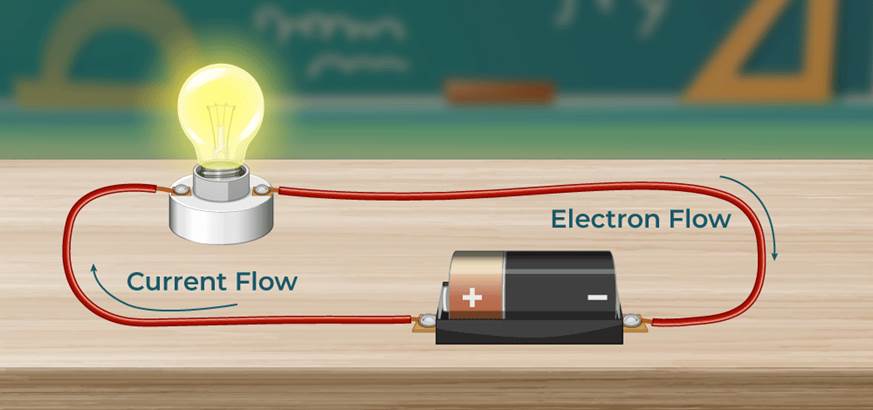
What current electricity really is
2D and 3D circuit diagrams for visual learning
Electron flow vs. conventional current — the critical difference explained
✅ 2.2 Electric Current
Definition and formula: I = Q/t
The ampere — SI unit explained
Unit conversions (mA, μA, kA)
Worked examples with step-by-step solutions
Activity 2.1: Measuring current with ammeter setup
✅ 2.3 Sources of Electricity
Chemical sources — Dry cells, car batteries (with 3D structure diagrams)
Mechanical sources — Hydroelectric, wind, diesel generators
Solar and other sources — Energy conversion table
Complete with cross-section views and 3D representations
✅ 2.4 Electric Circuits
What makes a complete circuit
Circuit requirements: Source, load, conductors, complete path
Open vs. closed circuits — 3D comparison diagrams
Series circuits — Current same, voltage divided
Parallel circuits — Voltage same, current divided
3D side-by-side comparison of series and parallel
✅ 2.5 Circuit Components and Symbols
All standard circuit symbols
Rules for drawing circuit diagrams
3D labelled diagrams of cells, batteries, bulbs, switches, ammeters, voltmeters
✅ 2.6 Voltage (Potential Difference)
Definition and formula: V = W/Q
The volt — SI unit explained
Voltage in series vs. parallel circuits
Water pressure analogy for easy understanding
3D voltmeter connection diagram with rules
✅ 2.7 Resistance
Definition and formula: R = V/I
The ohm (Ω) — SI unit explained
Fixed vs. variable resistors (rheostats) with 3D diagrams
Resistance as opposition to flow — water pipe analogy
✅ 2.8 Ohm’s Law
Complete statement with mathematical form: V = IR
3D graph showing V ∝ I relationship
Conditions for Ohm’s Law
Ohmic vs. non-ohmic conductors
Activity 2.4: Verifying Ohm’s Law with results table
Worked examples with full solutions
✅ 2.9 Factors Affecting Resistance
Four key factors with 3D diagrams:
Length — R ∝ L (longer = higher resistance)
Cross-sectional area — R ∝ 1/A (thicker = lower resistance)
Material — Copper vs. Nichrome comparison
Temperature — R increases with temperature
3D comparison: Copper wire (low R) vs. Nichrome wire (high R)
Activity 2.5: Investigating factors affecting resistance
✅ 2.10 Resistors in Series and Parallel
Series connection — Formula: R_T = R₁ + R₂ + R₃ + …
Parallel connection — Formula: 1/R_T = 1/R₁ + 1/R₂ + …
Special case for two resistors: R_T = (R₁ × R₂)/(R₁ + R₂)
3D diagrams for both configurations
Worked examples with complete solutions
TIP: Total parallel resistance is always LESS than the smallest resistor
✅ 2.11 Measurement of Current and Voltage
Ammeter connection rules — In series, low resistance
Voltmeter connection rules — In parallel, high resistance
Why these connections? — Explained with 3D diagrams
Complete circuit with both meters — 3D representation
✅ 2.12 Chapter Summary
All key points condensed for quick revision
3D summary diagram of electrical concepts
✅ 2.13 Formula Sheet
Formula Description Units
I = Q/t Electric current A
Q = It Electric charge C
V = W/Q Voltage V
R = V/I Resistance Ω
V = IR Ohm’s law V
R_T = R₁ + R₂ + … Series resistors Ω
1/R_T = 1/R₁ + 1/R₂ + … Parallel resistors Ω
R_T = (R₁ × R₂)/(R₁ + R₂) Two parallel resistors Ω
Unit conversions included: mA, μA, kA, kΩ, MΩ
✅ 2.14 Revision Questions
20 Multiple Choice Questions — Test your understanding
20 Short Answer Questions — Deepen your knowledge
10 Structured Questions — Exam-style practice with calculations
✅ 2.15 Answers and Marking Scheme
Complete answers to all MCQs
Detailed answers to short answer questions
Full solutions to structured questions
🎯 Why This Guide?
Feature Benefit
2D and 3D diagrams Visualise circuits, components, and concepts clearly
Step-by-step activities Learn by doing — perfect for practical exams
Worked examples See exactly how to solve current, voltage, and resistance problems
Comparison tables Quickly distinguish series vs. parallel, conductors vs. insulators
Real-world analogies Water pipe analogy makes abstract concepts concrete
Exam-focused questions Practice with MCQs, short answers, and structured questions
Complete formula sheet All formulas in one place for quick revision
📚 Perfect For:
Secondary school students preparing for physics examinations
Teachers looking for well-organised teaching material with ready-made activities
Anyone who wants to understand electricity from first principles
Revision — concise summaries and formula sheets for last-minute study
💡 What You’ll Master:
✔ Define electric current and state its SI unit
✔ Explain the difference between conventional current and electron flow
✔ Identify different sources of electricity and their energy conversions
✔ Draw and interpret simple electric circuit diagrams
✔ Identify circuit components and their standard symbols
✔ Define voltage, resistance, and state their SI units
✔ State and apply Ohm’s Law to solve problems
✔ Explain the four factors affecting resistance
✔ Calculate equivalent resistance for series and parallel connections
✔ Connect ammeters and voltmeters correctly in circuits
✔ Solve problems involving charge, current, voltage, resistance, and power
🔥 Get Your Copy Today!
Don’t let current electricity shock your exam performance. This well-arranged, comprehensive guide breaks down complex concepts into simple, digestible sections — complete with diagrams, activities, worked examples, and practice questions.
Whether you’re studying for exams or simply want to understand how electricity works in your home, this guide is your complete solution.
📖 TWO — CURRENT ELECTRICITY
Your complete guide to mastering electric circuits
MITIHANI POPOTE — Quality educational resources wherever you are.




Reviews
There are no reviews yet.