
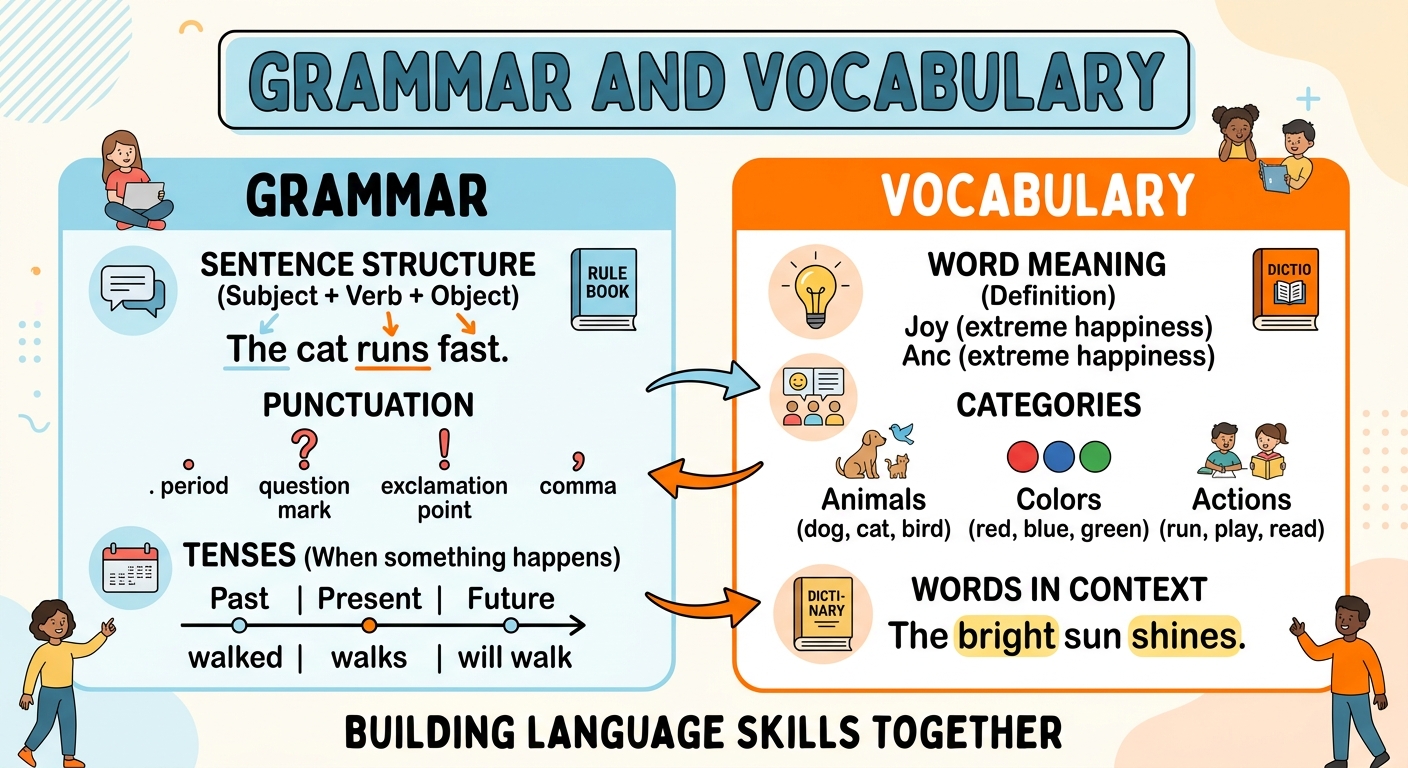
Description
GRAMMAR AND VOCABULARY — FORM 2 STUDY NOTES (PDF)
Master Grammar and Vocabulary with This Complete, Exam-Ready Study Guide!
Are you a Form 2 student, teacher, or exam candidate looking for a clear, detailed, and well-organized resource on Grammar and Vocabulary? This professionally compiled PDF study guide, “004 GRAMMAR AND VOCABULARY F2,” is exactly what you need to understand every concept — from the simple past and past continuous tenses to the present perfect and present perfect continuous tenses, subject-verb agreement, and common grammatical errors.
📘 WHAT’S INSIDE?
This comprehensive resource covers the entire Form 2 Grammar and Vocabulary syllabus, including:
✅ Introduction to Grammar and Vocabulary
Three main activities:
A. Producing contextualised descriptions of personal experiences
B. Composing a passage from a specific context
C. Presenting messages using correct grammar and vocabulary
✅ Producing Contextualised Descriptions of Personal Experiences
The Simple Past Tense:
Definition: Shows that an action was completed in the past
Structure: Affirmative (Subject + verb in past form), Negative (Subject + did not + base form), Question (Did + subject + base form?)
Regular Simple Past Verbs: End in -ed (called, played, arrived, walked, talked)
Irregular Simple Past Verbs: Tell→Told, Bring→Brought, Write→Wrote, Eat→Ate, Go→Went, See→Saw, Take→Took, Make→Made, Give→Gave, Come→Came
The Past Continuous Tense:
Definition: Used to talk about an action that was happening at a specific time in the past
Structure: Affirmative (Subject + was/were + verb + -ing), Negative (Subject + was/were not + verb + -ing), Question (Was/Were + subject + verb + -ing?)
Combining Simple Past and Past Continuous:
Structure: Past Continuous (ongoing action) + Simple Past (interrupting action)
Examples: “I was walking home when I saw my friend”; “She was cooking dinner when the phone rang”
Example Passage: Tullie Mwanjosi’s Story — Key sentences with Simple Past and Past Continuous tenses
Practice Exercise: Combining Tenses — Ten pairs to combine using both tenses
Expressing Future Aspirations and Goals:
Using “Will” (predictions, promises, spontaneous decisions)
Using “Going to” (planned actions and intentions)
Using “Would like to” (desires and wishes)
Example Poem: “My Goals and Dreams”
✅ Composing a Passage from a Specific Context
Grammar Detective Game: Identifying Tense Errors — Passage with errors and corrected version
The Present Perfect Tense:
Definition: Used to describe actions or events that occurred at an unspecified time in the past but are still relevant
Structure: Has/Have + verb in past participle
Examples: “I have checked the playground”; “She has lived here since 2010”; “They have finished their homework”
Using “Since” and “For”: Since (starting point), For (duration)
The Present Perfect Continuous Tense:
Definition: Emphasises the duration of an action that started in the past and is still ongoing or has just been completed
Structure: Has/Have been + verb + -ing
Examples: “I have been looking for him for an hour now”; “She has been studying since 9 a.m.”
Example Dialogue: Mama Rizal and Ahmed — Key sentences with Present Perfect and Present Perfect Continuous tenses
Exercise 4.2: Using “Since” and “For” — Ten sentences to complete
Interview Questions Using Present Tenses — Ten practice questions
✅ Presenting Messages Using Correct Grammar and Vocabulary
Subject-Verb Agreement:
Definition: The verb in a sentence must agree in number with its subject
Rule 1: With a singular subject, use singular forms of verbs (am, is, has, does, or verbs ending with -s or -es)
Rule 2: With a plural subject, use plural forms of verbs (are, were, have, do, or verbs that do not end with -s or -es)
Rule 3: With the pronoun “You” as the subject, use plural forms of verbs
Exercise 4.3: Subject-Verb Agreement Practice — Ten sentences to fill in the blanks
Exercise 4.4: Unscrambling Sentences — Ten sentences to unscramble
Exercise 4.5: Self-Description and Describing Others — Fill in information about yourself and your best friend
✅ Common Grammatical Errors to Avoid
Subject-Verb Agreement Errors:
Error: The dog chase the cat. → Correction: The dog chases the cat.
Error: Each of the students have a book. → Correction: Each of the students has a book.
Error: My friends is coming. → Correction: My friends are coming.
Error: The news are on. → Correction: The news is on.
Tense Errors:
Error: I go to the market yesterday. → Correction: I went to the market yesterday.
Error: She has went home. → Correction: She has gone home.
Error: I was walk when I saw her. → Correction: I was walking when I saw her.
Error: I have been learning English since two years. → Correction: I have been learning English for two years.
Using “Since” and “For” Correctly: Since (specific point in time), For (duration of time)
Examples: “I have lived here since 2010” (Correct); “I have lived here for 2010” (Incorrect); “I have lived here for five years” (Correct); “I have lived here since five years” (Incorrect)
✅ Important Grammar Rules Summary
Simple Past Tense Rules: Completed actions, regular verbs add -ed, irregular verbs have special forms, “did not” + base form for negatives, “Did” + base form for questions
Past Continuous Tense Rules: Actions happening at a specific time in the past, “was/were” + verb + -ing, often used with simple past to show interruption
Present Perfect Tense Rules: Past actions with present relevance, “has/have” + past participle, “since” for starting point, “for” for duration
Present Perfect Continuous Tense Rules: Actions that started in the past and continue, “has/have been” + verb + -ing, emphasises duration
Subject-Verb Agreement Rules: Singular subject needs singular verb, plural subject needs plural verb, “You” always takes plural verb, words like “each,” “everyone,” “neither” take singular verbs, words like “both,” “several,” “many” take plural verbs
✅ Summary of Chapter Objectives
Use simple past tense correctly
Use past continuous tense correctly
Combine simple past and past continuous tenses appropriately
Use present perfect tense correctly
Use present perfect continuous tense correctly
Apply “since” and “for” correctly
Ensure subject-verb agreement in all sentences
Identify and correct common grammatical errors
Use appropriate vocabulary in various contexts
Produce well-structured passages using correct grammar and vocabulary
🎯 WHY CHOOSE THIS STUDY GUIDE?
✔ Exam-Focused — Aligned with the Form 2 English syllabus
✔ Comprehensive — Covers every subtopic in detail
✔ Easy to Understand — Clear explanations, examples, and tables
✔ Practical — Includes practice exercises, example passages, and application activities
✔ Time-Saving — All notes in one organized PDF
✔ Perfect for Revision — Tense structures, subject-verb agreement rules, common errors, and grammar rules clearly summarized
👥 WHO IS THIS FOR?
Form 2 students studying English Language
Teachers preparing lesson notes, schemes of work, and examinations
Candidates revising for national exams (FTNA, CSEE)
Anyone interested in improving their grammar and vocabulary skills
📥 GET YOUR COPY TODAY!
Don’t waste time searching through multiple textbooks. This all-in-one study guide gives you everything you need to master Grammar and Vocabulary — clearly, concisely, and completely.
Download now and start scoring higher in English!
MITIHANI POPOTE — Quality educational resources wherever you are.





Reviews
There are no reviews yet.