
Description
CHAPTER FOUR: EXCRETION IN ANIMALS
Complete Study Notes & Revision Guide
📚 What This Document Covers
This comprehensive chapter breakdown covers everything you need to master excretion in animals — from the fundamental concepts of metabolic waste and the different excretory organs, to the detailed structure and function of the kidney, nephron, urine formation, and the common disorders of the excretory system.
🔬 SECTION 1: FOUNDATIONS OF EXCRETION
Understanding Excretion
Excretion is the removal of metabolic waste products from the body of an organism. These waste products are toxic if allowed to accumulate.
Major Excretory Products
Product Source
Carbon dioxide Cellular respiration
Excess water Cellular respiration and metabolic processes
Salts Dietary intake and metabolic processes
Nitrogenous compounds (ammonia, urea, uric acid) Breakdown of proteins and nucleic acids
Excretion vs. Secretion vs. Ejection
Process Definition Example
Excretion Removal of metabolic waste products Removal of urea by kidneys
Secretion Release of useful substances Release of digestive enzymes
Ejection Removal of undigested food Removal of faeces
🔑 Why this distinction matters: Excretion removes waste products of metabolism; secretion releases useful substances; ejection removes material that was never absorbed.
🫁 SECTION 2: EXCRETION IN HUMANS
The Four Main Excretory Organs
Organ Excretory Products Mechanism
Kidneys Nitrogenous wastes (urea, ammonia, uric acid), excess water, salts Urine formation
Lungs Carbon dioxide, water vapour Exhalation
Skin Water, salts, small amounts of urea Sweat production
Liver Bile pigments (from breakdown of aged red blood cells) Bile excretion
Major Excretory Products in Animals
(a) Nitrogenous Waste Products
Nitrogenous Waste Chemical Formula Toxicity Solubility Animals
Ammonia NH₃ Highly toxic Highly soluble Fish, aquatic invertebrates
Urea CO(NH₂)₂ Less toxic Less soluble Mammals, adult amphibians, sharks
Uric acid C₅H₄N₄O₃ Least toxic Least soluble Birds, reptiles, insects
Animal Classification Based on Nitrogenous Waste:
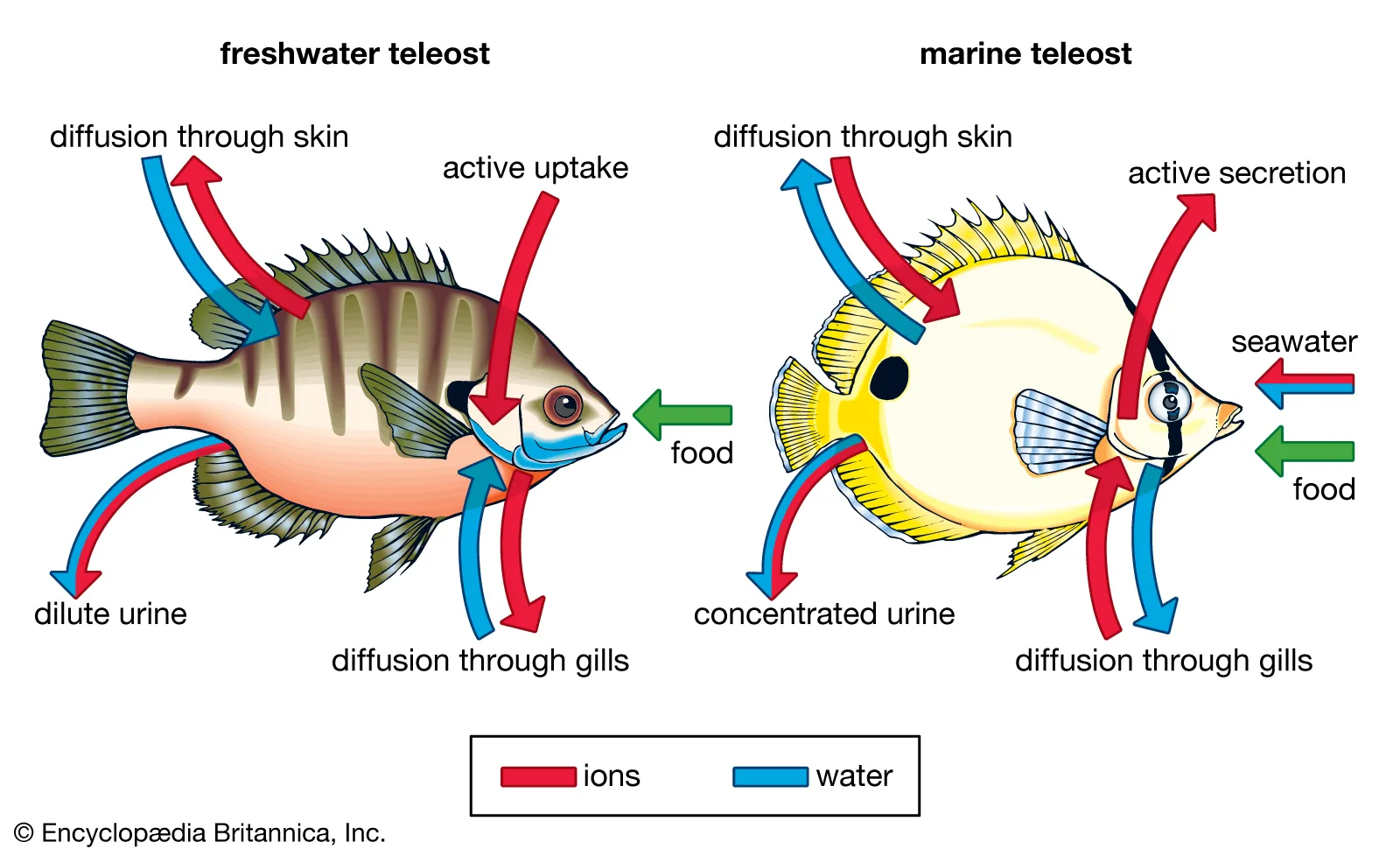
Ammonotelic — excrete ammonia (fish, aquatic invertebrates)
Ureotelic — excrete urea (mammals, adult amphibians, sharks)
Uricotelic — excrete uric acid (birds, reptiles, insects)
💡 Why different animals excrete different wastes: Aquatic animals have unlimited water → can excrete toxic ammonia. Terrestrial animals have limited water → convert ammonia to less toxic urea or uric acid to conserve water.
Urea — the human nitrogenous waste:
Ammonia is converted to urea in the liver (ornithine cycle)
Urea is less toxic and less soluble → can be excreted in moderately concentrated solution → conserves body water
(b) Carbon Dioxide
Produced during respiration
Toxic if accumulated → blood acidosis (low pH)
Transported as carbonic acid → converted back to CO₂ in lungs → exhaled
(c) Excess Water
Removed as: water vapour from lungs, sweat from skin, urine from kidneys
🫘 SECTION 3: THE URINARY SYSTEM
Components
Kidneys — filter blood, produce urine
Ureters — carry urine from kidneys to bladder
Urinary bladder — stores urine temporarily
Urethra — carries urine from bladder to outside
The Kidneys
Location: Pair of reddish-brown bean-shaped organs on each side of the back
Protection: Muscles, ribs, and fat
Blood supply: Renal artery (in), renal vein (out)
Function: Excrete urine by filtering wastes and excess water from blood
The Ureters
Two tubes of smooth muscle
Carry urine from kidney to urinary bladder
Ureterovesical valve prevents backflow
The Urinary Bladder
Spherical muscular sac
Temporarily stores urine
Sphincter muscle prevents emptying until certain level
Micturition — when bladder is full, stretch receptors send impulses to brain → bladder muscles contract, sphincter relaxes → urine expelled
The Urethra
Thin fibromuscular tube
Releases urine to outside
In males: Shared pathway for urine and semen
In females: Shorter and separate from reproductive tract → higher risk of UTIs
🔬 SECTION 4: STRUCTURE OF THE KIDNEY
External Structure
Bean-shaped organ
Renal hilum — inner concave side where renal artery enters and renal vein exits
Surrounded by fibrous capsule — maintains shape, protects inner tissues
Internal Structure (Transverse Section)
Region Description Contents
Cortex Outer darker layer Parts of nephrones, glomeruli, capsules
Medulla Inner region Loop of Henle, collecting ducts, renal pyramids
Pelvis Expanded portion of ureter Urine accumulates before draining to bladder
Renal pyramids: Cone-shaped structures in medulla that project into pelvis → lead to ureter.
💡 Blood supply: Kidneys receive ~8% of all oxygen absorbed through lungs — used to provide energy for filtering blood and producing urine.
🧪 SECTION 5: THE NEPHRON
Definition
The nephron is the structural and functional unit of the kidney — the basic functional unit involved in urine production.
Structure of a Nephron
Part Description Function
Bowman’s capsule Cup-shaped capsule at start Facilitates ultrafiltration
Glomerulus Ball of blood capillaries within Bowman’s capsule High-pressure filtration site
Proximal convoluted tubule First coiled region Reabsorption of glucose, amino acids, water
Loop of Henle Long U-shaped structure Reabsorption of water and salts; creates osmotic gradient
Distal convoluted tubule Second coiled region Reabsorption of salts and water; secretion of wastes
Collecting duct Drains urine to pelvic region Final water reabsorption; collects urine
Blood Flow Through the Nephron
Afferent arteriole → brings blood to glomerulus
Glomerulus → high-pressure filtration
Efferent arteriole → carries blood away (narrower than afferent → maintains high pressure)
Blood flows through capillaries surrounding tubule → allows reabsorption
Ultrafiltration
Definition: Process whereby small molecules (water, glucose, amino acids, urea, salts) are filtered out in Bowman’s capsule due to high hydrostatic pressure.
Mechanism:
Afferent arteriole lumen is smaller than efferent arteriole → high hydrostatic pressure in glomerulus
Pressure forces plasma through capillary walls
Glomerular filtrate passes into Bowman’s capsule
Red blood cells and proteins are retained (too large to pass)
🔑 Why ultrafiltration matters: First step in urine formation — removes waste products while retaining useful large molecules.
Selective Reabsorption
Definition: Process where essential filtrate substances are taken back into the blood.
Where it occurs:
Proximal convoluted tubule: Glucose, amino acids, some water
Descending limb of loop of Henle: Most salts
Distal convoluted tubule: More salts and water
Collecting duct: More water
Mechanisms: Diffusion (passive) and active transport (uses ATP)
💡 Why selective reabsorption matters: Recovers useful substances (glucose, amino acids, water) that would otherwise be lost in urine — maintains blood glucose, amino acid levels, and water balance.
Tubular Secretion
Definition: Passage of certain substances out of capillaries directly into renal tubules.
Examples:
Drugs (e.g., penicillin)
Urea and uric acid that may have been reabsorbed
Excess potassium ions (K⁺)
Hydrogen ions (H⁺) — maintains blood pH
Urine Formation — The Three Steps
Step Location What Happens
1. Glomerular filtration (ultrafiltration) Glomerulus/Bowman’s capsule Blood pressure forces water, glucose, amino acids, urea, salts into Bowman’s capsule; proteins and blood cells retained
2. Selective reabsorption Proximal tubule, loop of Henle, distal tubule, collecting duct Useful substances reabsorbed back into blood
3. Tubular secretion Tubules Additional wastes (drugs, excess K⁺, H⁺, urea) secreted from blood into tubules
Final product: Urine — containing water, urea, uric acid, excess salts, and other waste products.
Adaptive Features of the Urinary System
Adaptation Function
Large afferent arteriole, narrow efferent arteriole Builds up high hydrostatic pressure in glomerulus → facilitates ultrafiltration
Glomerulus capillaries highly coiled and semipermeable Increases surface area → more efficient ultrafiltration
High coiling Creates and maintains high pressure in glomerulus
Thin epithelium Reduces diffusion distance → enhances reabsorption
Proximal and distal convoluted tubules are coiled Increase nephron length and surface area → more efficient reabsorption
Bowman’s capsule is cup-shaped Provides maximum surface area for filtration
Tubule supplied with network of blood capillaries Maximum reabsorption
Numerous nephrones Efficient excretion of waste products
🫁 SECTION 6: OTHER EXCRETORY ORGANS
The Lungs
Function Description
Removing CO₂ CO₂ transported as carbonic acid → converted back to CO₂ in lungs → exhaled
Eliminating water vapour Excreted through breathing → helps maintain fluid balance
Regulating blood pH Expelling CO₂ helps maintain acid-base balance → prevents acidosis
Assisting in heat loss Water vapour loss contributes to temperature regulation
The Liver
Location: Beneath the diaphragm; two lobes with many blood capillaries; gall bladder between lobes.
Functions as an excretory organ:
Function Description
Deamination Breaks down excess amino acids → ammonia → converted to less toxic urea
Detoxification Converts harmful compounds to less toxic compounds → excreted through urine
Formation of bile Red blood cells break down → bile pigments (bilirubin, biliverdin) → excreted in bile
Breakdown of hormones Destroys hormones to balance levels
The Skin
Structure: Contains sweat glands; sweat = water, salts, small amounts of urea and ammonia.
Roles in excretion:
Function Description
Sweat production Removes metabolic waste (water, salts, urea, ammonia)
Regulation of body temperature Evaporation of sweat cools body
Excretion of salt and water Maintains homeostasis
Detoxification Some toxins and heavy metals excreted through sweat
Maintenance of electrolyte balance Excreting excess salts maintains proper balance
💡 Why sweating matters: Sweating is more important for temperature regulation than for excretion — the amount of urea excreted in sweat is small compared to urine.
⚠️ SECTION 7: COMMON DISORDERS OF THE EXCRETORY SYSTEM
7.1 Kidney (Renal) Failure
Definition: Failure of kidney to function adequately due to destruction of nephrons
Causes: Accidents, low blood volume, chronic diseases (hypertension, diabetes), toxicity, lifestyle factors
Effects: Oedema, anaemia, hyperkalemia, cardiac arrhythmias
Treatment: Dialysis, kidney transplant, dietary management
7.2 Kidney Stones (Renal Calculi)
Definition: Hard deposits of minerals and organic substances that crystallize in kidney
Composition: Uric acid, calcium oxalate, or mixture of phosphates
Risk factors: High-oxalate foods, sugar-sweetened beverages, dehydration, high protein diet
Symptoms: Severe pain (lower back), vomiting, sweating, blood in urine
Treatment: Drinking water, surgery, laser lithotripsy, shock wave therapy
7.3 Uraemia
Definition: Abnormally high concentration of urea in blood
Cause: Kidney no longer filtering substances from blood
Symptoms: Yellow skin, itching, smelling of urine, nausea
Control: Low-salt diet, dialysis, wearable artificial kidneys
7.4 Urinary Tract Infections (UTIs)
Definition: Infection in any part of urinary system
Types: Urethritis (urethra), Cystitis (bladder)
Causes: Bacteria/viruses, STIs; women more susceptible (shorter urethra)
Symptoms: Smelling urine, frequent/burning urination, cloudy urine, fever
Prevention: Proper hygiene, hydration, avoid tight pants
Treatment: Antibiotics, probiotics
7.5 Urinary Tract Obstruction
Definition: Blockage preventing normal urine flow
Causes: STDs, kidney stones, tumours
Control: Prevention against STDs, seek medical assistance
7.6 Diabetes Insipidus
Definition: Excessive production of very dilute urine
Cause: Deficiency of vasopressin (ADH)
Difference from diabetes mellitus: Water balance disorder (ADH) vs. glucose regulation disorder (insulin)
7.7 Gout
Definition: High uric acid in blood → deposited in joints → inflammation and pain
Most affected: Toe joints
Risk factors: Excess alcohol, purine-rich foods (red meat), diuretics, overweight
Prevention: High fluid intake, avoid alcohol, maintain healthy weight
7.8 Liver Cirrhosis
Definition: Liver cells degenerate → fibrous tissue formed → scarring and liver failure
Causes: Alcohol, worm infestation, hepatitis, gall bladder obstruction
Effects: Jaundice (yellowing of skin, sclera)
Control: Fat-free food, stop alcohol, medical treatment
7.9 Polycystic Kidney Disease (PKD)
Definition: Genetic disorder with numerous fluid-filled cysts in kidneys
Types: ADPKD (adulthood), ARPKD (infancy/childhood)
Symptoms: High blood pressure, back pain, blood in urine, kidney stones
Treatment: Blood pressure management, Tolvaptan, gene therapy (CRISPR)
7.10 Interstitial Cystitis (Bladder Pain Syndrome)
Definition: Chronic inflammation of bladder wall → pelvic pain and urinary discomfort
Symptoms: Chronic pelvic pain, frequent urination, urgency
Management: Avoid dietary triggers, stress reduction, bladder training
7.11 Nephrotic Syndrome
Definition: Kidney disorder from damage to glomeruli → excessive protein loss in urine
Symptoms: Severe swelling, foamy urine, weight gain, high cholesterol
Management: Low-sodium diet, high-protein diet, regular kidney function tests
📝 SECTION 8: CHAPTER SUMMARY (EXPANDED)
Excretion is the biological process of removing metabolic waste products from the body to maintain homeostasis.
In humans, organs involved in excretion are the kidneys, lungs, skin, and liver — each playing a specific role.
The urinary system comprises the kidneys, ureters, bladder, and urethra.
Urine formation occurs in three key steps:
Ultrafiltration — blood filtered at high pressure in glomerulus
Selective reabsorption — essential substances reabsorbed into bloodstream
Tubular secretion — additional waste removal before urine is collected
Common disorders of the excretory system include:
Kidney failure — kidneys lose ability to filter blood
Kidney stones — solid deposits of minerals and salts
UTIs — bacterial invasion of urethra and bladder
Uraemia — excess urea accumulates in bloodstream
Liver cirrhosis — liver cells damaged and replaced by scar tissue
Gout — excess uric acid accumulation
Prevention and management involve:
Healthy lifestyle choices: hydration, balanced diet, reducing salt and protein intake, avoiding harmful substances
Medical interventions: dialysis or kidney transplants for severe kidney conditions
Excretion is essential for removing harmful substances and maintaining internal balance. Coordinated function of kidneys, lungs, skin, and liver ensures metabolic waste is efficiently eliminated.
🎯 EXAMINATION TIPS
Key Definitions to Memorize
Excretion: Removal of metabolic waste products from the body
Ultrafiltration: Filtration of small molecules in Bowman’s capsule due to high hydrostatic pressure
Selective reabsorption: Process where essential filtrate substances are taken back into blood
Tubular secretion: Passage of substances out of capillaries directly into renal tubules
Nephron: Structural and functional unit of the kidney
Micturition: Urination — expulsion of urine from bladder
Ammonotelic/Ureotelic/Uricotelic: Animals excreting ammonia/urea/uric acid
Common Exam Questions
Compare excretion, secretion, and ejection (table format)
Explain why different animals excrete different nitrogenous wastes
Describe the structure and function of the nephron
Explain the three steps of urine formation
Describe the adaptive features of the urinary system
Explain the role of the liver as an excretory organ
Describe the causes, symptoms, and control of kidney stones
Compare kidney stones and UTIs
Explain how kidney failure affects homeostasis
Describe the causes and effects of liver cirrhosis
Diagram Practice
Internal structure of the kidney (cortex, medulla, pelvis)
Structure of a nephron (labelled)
Urine formation pathway
Urinary system (kidneys, ureters, bladder, urethra)
📚 GLOSSARY OF KEY TERMS
Term Definition
Excretion Removal of metabolic waste products from the body
Secretion Release of useful substances from cells or glands
Ejection Removal of undigested food from digestive tract
Nephron Structural and functional unit of the kidney
Ultrafiltration High-pressure filtration in Bowman’s capsule
Selective reabsorption Reabsorption of essential substances back into blood
Tubular secretion Secretion of wastes from blood into tubules
Glomerulus Ball of blood capillaries within Bowman’s capsule
Bowman’s capsule Cup-shaped capsule at start of nephron
Loop of Henle U-shaped structure that reabsorbs water and salts
Micturition Urination — expulsion of urine from bladder
Ammonotelic Animals that excrete ammonia
Ureotelic Animals that excrete urea
Uricotelic Animals that excrete uric acid
Uraemia High concentration of urea in blood
Dialysis Medical procedure to remove waste products from blood
✅ QUICK REVISION CHECKLIST
□ I can define excretion and distinguish it from secretion and ejection
□ I can name the four main excretory organs and their products
□ I can compare ammonia, urea, and uric acid
□ I can describe the components of the urinary system
□ I can describe the internal structure of the kidney
□ I can label the parts of a nephron
□ I can explain ultrafiltration
□ I can explain selective reabsorption
□ I can explain tubular secretion
□ I can describe the three steps of urine formation
□ I can list the adaptive features of the urinary system
□ I can explain the role of the lungs in excretion
□ I can explain the role of the liver in excretion
□ I can explain the role of the skin in excretion
□ I can describe the causes and symptoms of kidney stones
□ I can describe the causes and symptoms of UTIs
□ I can explain how kidney failure affects homeostasis
□ I can describe the causes and effects of liver cirrhosis
□ I can explain the difference between diabetes insipidus and diabetes mellitus
□ I can describe the causes and prevention of gout
MITIHANI POPOTE — Quality educational resources wherever you are.



Reviews
There are no reviews yet.