
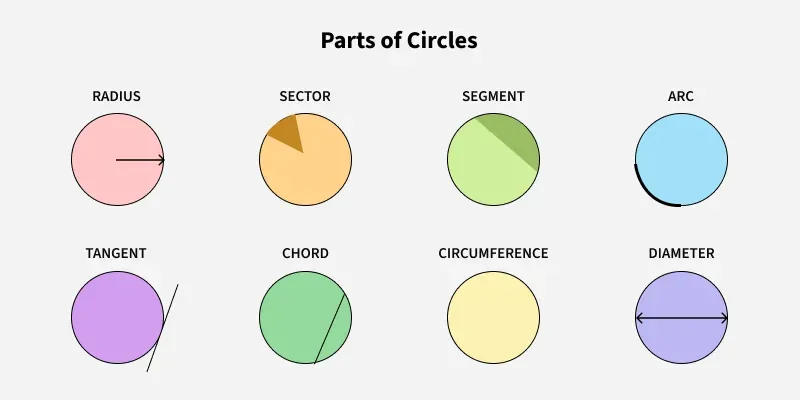
Description
CHAPTER FIVE: CIRCLES — Complete Study Guide
From Parts of a Circle to Advanced Circle Theorems — Master Geometry’s Most Elegant Shape
📘 What This Chapter Covers
The circle is one of the most fundamental and beautiful shapes in geometry. From wheels and clock faces to satellite orbits and roundabouts, circles appear everywhere in the real world. This chapter provides a complete, structured guide to understanding the parts of a circle, measuring arcs and angles, converting between degrees and radians, and mastering the key circle theorems — from the angle at the centre to alternate segment theorems and intersecting secants and tangents.
Whether you’re a student preparing for national examinations or a teacher seeking a clear, ready-to-use reference, this chapter builds both conceptual understanding and geometric reasoning skills.
🎯 Key Topics Covered
1. Parts of a Circle
Centre, radius, diameter, and circumference
Chord, secant, and tangent lines
Arc, segment, and sector
Identifying and naming parts from diagrams
Relationship between radius, diameter, and circumference
2. Central Angles and Arc Length
Definition of a central angle
Relationship between central angle and arc length
Finding the central angle from arc length
Worked examples: gardens, roundabouts, and soccer balls
3. Radian Measure
Definition of a radian
Converting degrees to radians and vice versa
Clock face problems (minute hand rotations)
Applications: tyres, wheels, and angular distance
4. Angle Properties of Circles (Theorems)
Theorem 5.1 — Angle at the centre is twice the angle at the circumference
Theorem 5.2 — Angles in the same segment are equal
Theorem 5.3 — Opposite angles of a cyclic quadrilateral are supplementary
Theorem 5.4 — Exterior angle of a cyclic quadrilateral equals the opposite interior angle
Theorem 5.5 — Angle in a semicircle is a right angle (90°)
Full proofs and worked examples for each theorem
5. Chord Properties of Circles
Theorem 5.6 — Perpendicular bisector of a chord passes through the centre
Theorem 5.7 — Parallel chords intercept congruent arcs
Theorem 5.8 — Equal chords are equidistant from the centre
Finding chord lengths using Pythagoras’ theorem
Distance between parallel chords
6. Tangent Properties of Circles
Theorem 5.10 — Tangent is perpendicular to the radius at the point of contact
Theorem 5.11 — Two tangents from an external point are equal; they subtend equal angles at the centre; the line joining the centre and external point bisects the angle between the tangents
Theorem 5.12 — Alternate segment theorem (angle between chord and tangent equals angle in the alternate segment)
7. Comprehensive Practice
Exercises 5.1 through 5.12 — Covering all topics with graduated difficulty
Revision Exercise 5 — 29 end-of-chapter problems for exam preparation
Chapter Summary — All key theorems and formulas condensed for quick revision
✨ Features That Make This Guide Stand Out
✅ Step-by-step theorem proofs — Understand why each theorem is true, not just how to use it
✅ Clear geometric diagrams — Every theorem and example is illustrated visually
✅ Real-world context — Roundabouts, clock faces, tyres, lighthouses, and satellite orbits
✅ Progressive difficulty — From basic definitions to complex multi-theorem problems
✅ Comprehensive exercises — Over 100 practice problems across all sections
✅ Exam-focused revision — 29 revision problems covering all skill levels
✅ Chapter summary — All theorems and formulas in one place for quick review
📝 Who Is This For?
Secondary school students studying circle geometry for the first time
Examination candidates preparing for national exams (NECTA and similar)
Teachers seeking a structured, ready-to-use teaching resource
Anyone wanting to strengthen their geometric reasoning and proof skills
🧠 What You’ll Be Able to Do After This Chapter
By the end of this chapter, you will be able to:
Identify all parts of a circle (radius, chord, tangent, arc, sector, segment)
Calculate arc length given the central angle and radius
Convert between degrees and radians confidently
Apply the angle at the centre theorem and angles in the same segment theorem
Use cyclic quadrilateral properties to find unknown angles
Apply the angle in a semicircle theorem
Find chord lengths using the perpendicular bisector theorem and Pythagoras
Apply tangent properties to solve problems involving external points
Use the alternate segment theorem and intersecting secant/tangent theorem
Prove geometric statements using circle theorems
Tackle examination-style problems with confidence
📖 How to Use This Guide
Start with the parts of a circle — Build a solid foundation
Master arc length and radian measure — Practice conversions and calculations
Study each theorem carefully — Follow the proofs and worked examples
Practice with the exercises — Each section has targeted problems
Attempt the Revision Exercise — Test yourself under exam conditions
Review the summary — Consolidate all theorems and formulas
🔑 Why Circle Geometry Matters
Circle theorems are not just abstract mathematics — they are practical tools used in:
Engineering — Designing gears, wheels, and circular structures
Architecture — Arches, domes, and circular buildings
Navigation — Calculating distances and angles on circular paths
Astronomy — Modelling planetary orbits and satellite paths
Everyday Life — Clock faces, roundabouts, and circular tracks
Mastering this chapter gives you a powerful set of geometric tools that extend far beyond the classroom.
📊 Key Theorems at a Glance
Theorem Statement
Angle at centre Angle at centre = 2 × angle at circumference
Angles in same segment Angles subtended by the same arc in the same segment are equal
Cyclic quadrilateral Opposite angles sum to 180°
Exterior angle Exterior angle = opposite interior angle
Angle in semicircle Angle subtended by diameter = 90°
Perpendicular bisector Perpendicular bisector of chord passes through centre
Parallel chords Parallel chords intercept congruent arcs
Equal chords Equal chords are equidistant from centre
Tangent-radius Tangent ⊥ radius at point of contact
Two tangents Tangents from external point are equal
Alternate segment Angle between chord and tangent = angle in alternate segment
Start your journey to circle geometry mastery today. Every theorem is proved, every example is worked out, and every exercise is designed to build your confidence.
MITIHANI POPOTE — Quality educational resources wherever you are.





Reviews
There are no reviews yet.