
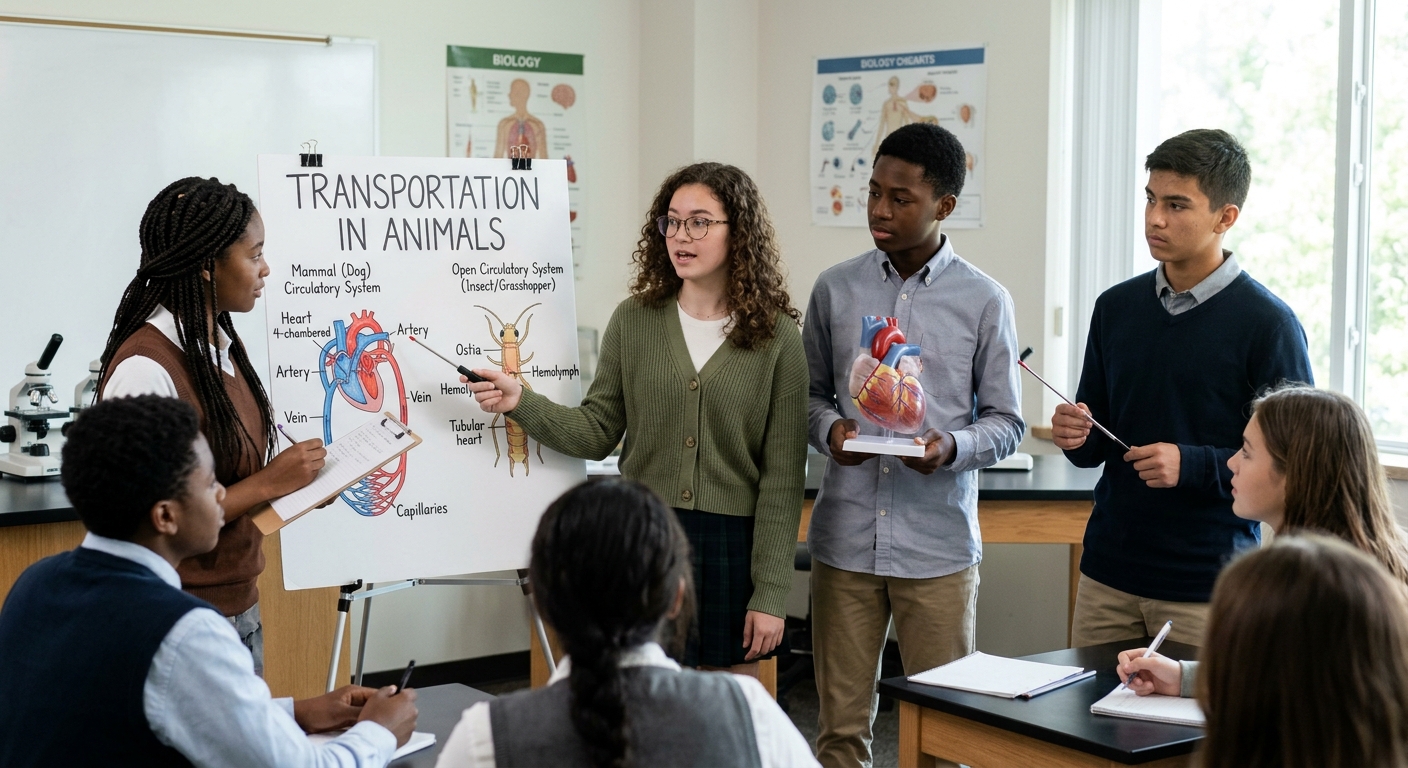
Description
ADVANCED LEVEL BIOLOGY: TRANSPORTATION IN ANIMALS (TIE SYLLABUS)
🩸 Master Circulatory Systems, Blood, Heart Dynamics & Gas Transport
🎯 THE COMPLETE GUIDE FOR FORM FIVE & SIX — ALIGNED TO NECTA/ACSEE
From open vs. closed circulatory systems to Starling’s forces and the Bohr effect, this guide covers everything you need to master animal transport. Clear explanations, real Tanzanian examples, and exam-style questions with model answers — all in one place.
✨ WHAT YOU’LL MASTER
🔹 Subtopic 1: Need for Transport & Types of Systems
Mass flow and SA:V ratio explained
Open vs. Closed circulatory systems with pressure and transport medium
Single vs. Double circulation
Real examples: Cockroach, Locust, Nile Tilapia, African Toad, Maasai Giraffe
🔹 Subtopic 2: Blood & Blood Vessels
Plasma, Erythrocytes, Leucocytes, Thrombocytes
Plasma proteins: Albumin, Globulins, Fibrinogen
Histology of arteries, veins, and capillaries (Tunicae layers)
Structural adaptations for function
🔹 Subtopic 3: The Mammalian Heart & Cardiac Cycle
Myogenic heart and the pacemaker system (SAN, AVN)
Conduction pathway: Bundle of His, Purkinje fibers
Cardiac cycle: Atrial systole, Ventricular systole, Diastole (“LUB-DUB”)
Real examples: Zebu cattle, High-altitude adaptation in Kilimanjaro residents
🔹 Subtopic 4: Fluid Exchange & Lymphatic System
Starling’s Forces: Hydrostatic vs. Oncotic pressure
Net Filtration Pressure at arteriolar and venular ends
Lymphatic system and edema
Real examples: Elephantiasis (Wuchereria bancrofti) and Kwashiorkor
🔹 Subtopic 5: Transport of Respiratory Gases
Haemoglobin structure and cooperative binding
Oxygen Dissociation Curve (sigmoid shape)
Bohr Effect and Chloride Shift
CO₂ transport: Dissolved, Carbamino-haemoglobin, Bicarbonate
Real examples: Mount Kilimanjaro porters and Sickle Cell trait
📖 WHAT’S INSIDE
Section What You’ll Learn
Subtopic 1 Need for transport, SA:V ratio, open/closed systems, single/double circulation
Subtopic 2 Blood components, plasma proteins, vessel histology
Subtopic 3 Heart anatomy, myogenic action, cardiac cycle, conduction system
Subtopic 4 Starling’s forces, tissue fluid formation, lymphatic system
Subtopic 5 Haemoglobin, oxygen dissociation, Bohr effect, chloride shift
10 Key Takeaways Summary of all essential concepts
Exam Questions with Model Answers 10 short-answer, 10 structured, and 10 essay questions
🎓 PERFECT FOR:
✅ Form Five and Six students preparing for NECTA ACSEE examinations
✅ Teachers seeking a structured, syllabus-aligned resource
✅ Private candidates studying independently
✅ Anyone needing a comprehensive revision guide on animal transport
💡 KEY FEATURES
TIE Syllabus aligned — covers all five subtopics comprehensively
Real Tanzanian examples — Cockroach, Tilapia, Giraffe, Zebu cattle, Kilimanjaro porters, Elephantiasis, Kwashiorkor
Mathematical formulas — SA:V ratio, Cardiac Output, Net Filtration Pressure with worked calculations
Diagram descriptions — open/closed systems, heart anatomy, conduction pathway, oxygen dissociation curves
Exam-style questions — Short answers, structured questions, and essay questions with full model answers
10 Key Takeaways — perfect for quick revision
📈 YOUR EXAM SUCCESS STARTS HERE
By the end of this guide, you will be able to:
✔️ Explain why large animals need mass flow transport systems
✔️ Compare open and closed circulatory systems
✔️ Identify blood components and their functions
✔️ Relate blood vessel histology to function
✔️ Describe the myogenic heart and cardiac cycle
✔️ Explain Starling’s forces and tissue fluid formation
✔️ Analyse oxygen and carbon dioxide transport mechanisms
✔️ Answer ACSEE-style questions with confidence
🛒 GET YOUR COPY TODAY
Master animal transport. Ace your Advanced Level Biology exam.
Whether you’re revising for ACSEE, preparing for mock exams, or deepening your understanding of circulatory physiology, this guide gives you the knowledge, examples, and practice questions you need to succeed.
📚 MITIHANI POPOTE
Quality educational resources wherever you are.
© MITIHANI POPOTE | Quality educational resources wherever you are.



Reviews
There are no reviews yet.