
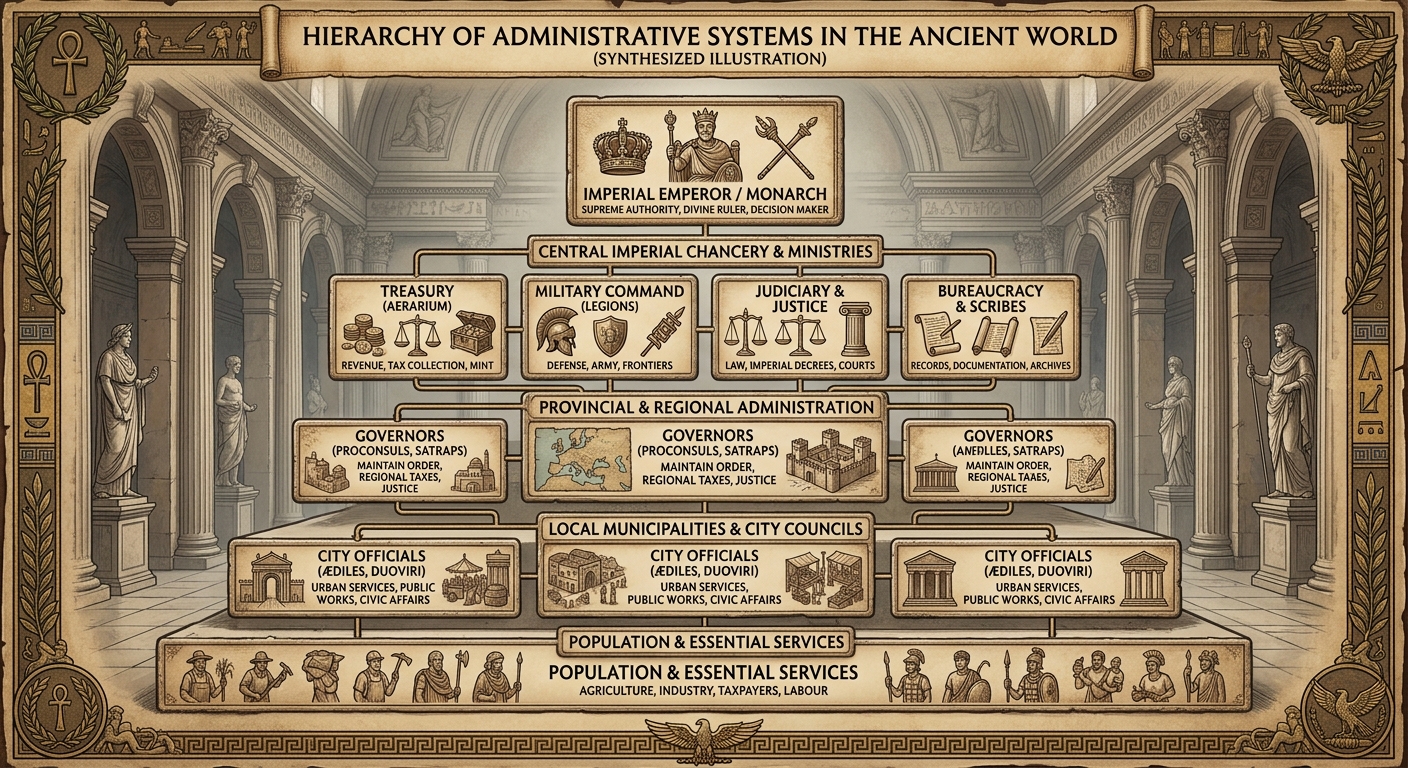
Description
Administrative Systems in the Ancient World – Comprehensive Study Guide (Form Five History)
Master the Art of Governance from Ancient India and China to Egypt, Rome, and the Inca Empire — From City-States to Vast Empires
This expertly structured study guide breaks down one of the most fascinating and examinable topics in ancient history into clear, organized, and highly digestible sections. Whether you are preparing for national examinations, revising for class tests, or seeking a deeper understanding of how the world’s first great civilizations governed their people, this guide is your essential companion.
📖 What’s Inside
1. The Concept of Administration and Administrative Systems
Clear definitions: mobilization of human, material, and financial resources
The chain of command: planning, organizing, directing, and controlling
Examples from ancient Egypt, Greece, and Rome
Four reasons for studying ancient administrative systems: understanding the present, solving contemporary problems, cultural appreciation, and identifying origins of centralization, bureaucracy, and checks and balances
2. Administrative Systems in Ancient Asia
2.1 Ancient India
The Vedic Period:
Early Vedic (c. 1500–1000 BCE): janas (ethnic groups), the Rajan, and the Sabha and Samiti councils
Later Vedic (c. 1000–600 BCE): hereditary kingship, bali as compulsory tribute, decline of councils, rise of Rajya, gana, and sangha
Upanishadic Period: urbanization in the Ganges Valley
The Mauryan Empire (c. 321–185 BCE) — Founded by Chandragupta Maurya:
Central Administration: the King as supreme authority, Mantri Parishad (Council of Ministers), Adhyakshas (department heads), Samaharta (revenue collector), Sannidhata (treasurer)
Provincial Administration: four provinces (Tosali, Ujjayain, Suvarnagiri, Taxila) and vassal states
Local Administration: Rajukas (district collectors), Yuktas, municipal board of 30 members in six committees, Gramani (village headman), Gopa (10–15 villages), regular census
Revenue Administration: land revenue (1/6th of produce), excise, forest, water, mines, and coinage taxes
Judicial Administration: King as highest court of appeal, Dharmathikarin (Chief Justice), Amatyas, Gramavradha, Nagaravyaavaharikamahamatra
Military Administration: Senapati (supreme commander), Board of 30 in six committees (navy, transport, infantry, cavalry, chariots, elephants)
Ashoka’s Reforms (r. 268–232 BCE): repudiation of war, Dhamma, Buddhism, and the Dhamma Mahamatra officers
2.2 Ancient China
Shang Dynasty (c. 1600–1046 BCE): confederation of states around a central domain
Zhou Dynasty (c. 1046–256 BCE): fiefs under clan princes, decline of royal authority, Warring States Period, Confucius (551–479 BCE) and ethical governance
Qin Dynasty (221–206 BCE): Shi Huangdi, the “First Emperor,” foundation of a unified centralized state
Han Dynasty (206 BCE–220 CE):
The Emperor as “Son of Heaven,” Grand Council of Ministers, Prime Minister
Meritocratic Bureaucracy: Public Service Commission competitive examinations in logic, philosophy, ethics, justice, and poetry — later admired by European Enlightenment thinkers and influential on the British civil service
Provincial Seng, local Fu, Confucian legal system based on filial piety
Influence on Korea, Vietnam, and European administrative thought
3. Administrative Systems in the Ancient Middle East
3.1 Ancient Mesopotamia (c. 3500–500 BCE)
The “cradle of civilization” along the Euphrates and Tigris
Four social classes: Royalty, Upper Class (officials, scribes, tax collectors, judges), Middle Class (fishermen, farmers, artisans, potters), Lower Class (slaves, landless, prisoners of war)
Theocratic Socialism: temple-centered government, high priests and kings with direct connection to the gods, temple management of food, dikes, and irrigation
Bureaucracy: hierarchical officials supervising public works, tax collection, and justice
Notable Kings: Ur-Nammu, Sargon, Hammurabi, Tiglath-Pileser
4. Administrative Systems in Ancient Europe
4.1 The Transition to Statehood
Engels’ Theory: private property and social classes led to the creation of the state as an organ of ruling-class power
4.2 Ancient Greece
The Polis (City-State): acropolis, agora, and restricted citizenship (adult male landowners only)
Forms of Government: Monarchy, Oligarchy, Tyranny, Democracy
Athens — The World’s First Democracy:
Key reformers: Draco (621 BCE, written code), Solon (594 BCE, debt cancellation, Assembly veto), Pisistratus (560 BCE, citizenship reform), Cleisthenes (508 BCE, democracy)
Key institutions: Assembly (Ekklesia), Council of Five Hundred (Boule), Magistrates (Archai), Generals (Strategoi) — Pericles held office for 15 consecutive years
Sparta — A Military Oligarchy: Two Kings, Council of Elders (Gerousia), Assembly (Apella), five Ephors with veto power; periocci and helots
4.3 Ancient Rome
The Roman Republic (509–27 BCE):
The Struggle of the Orders: Patricians vs. Plebeians
Plebeian victories: Council of Plebeians and Tribunes (494 BCE), the Twelve Tables (c. 450 BCE), right to marry patricians, hold Consulship, sit in Senate
Key institutions: Senate (300–600 members for life), two Consuls, Comitia Centuriata, Comitia Tributa, Praetor, Censors, Quaestors, Aediles
The Roman Empire (27 BCE–476 CE):
Augustus Caesar, first emperor (27 BCE)
Provincial Administration: proconsuls, Augustus’s reforms (salaries to reduce corruption, censuses, citizenship grants), Diocletian’s tetrarchy and subdivision into nearly 100 provinces
Legal Administration: Juris prudentes, law applies equally to all, punishment for deeds not thoughts
Economic Administration: roads (Appian Way), bridges, aqueducts; Diocletian’s tax system based on capita and iuga, five-year census, Decurions personally liable
Military Organization: legions on permanent border duty, Praetorian Guard (3,000 men)
5. Administrative Systems in Ancient South America
5.1 The Inca Empire (c. 1400–1533 CE)
Largest empire in pre-Columbian America, capital at Cuzco, expansion under Emperor Pachacuti (c. 1438)
Central Government: the Sapa Inca as divine ruler (descendant of the sun god), loyalty through education of conquered leaders’ children in Cuzco, official language Quechua, over 10,000 miles of roads and suspension bridges
Economy: state control of the entire economy, mita (labor tax), no markets, government distribution of goods, surplus storage for emergencies
Social Structure: Upper Class (emperor, priests, officials) and Lower Class (farmers, artisans, servants), no slaves
6. Administrative Systems in Pre-Colonial Africa
6.1 Common Characteristics
Kings and chiefs, Councils of Elders, age-grade systems (e.g., Igbo), administrative officials from the common class
6.2 Ancient Egypt
The Pharaoh: god in human form, absolute power, guardian of ma’at (truth, balance, order, law, justice)
Administrative Hierarchy: Vizier (Chief Minister), Nobles and Priests, Soldiers, Skilled Workers (scribes, physicians, craftsmen, merchants), Peasants and Slaves
Government Functions: security, resource management, infrastructure, territorial integrity
6.3 Ghana Empire (c. 5th–11th Century CE)
Metropolitan Ghana and Provincial Ghana (vassal states: Takrur, Silla, Kaniagya)
The King as absolute monarch and divine, Council of Ministers (mostly Muslim by the 11th century), vassal kings sending sons to the king’s court
Military: 200,000 men including 40,000 bowmen
Economy: all gold reserved for the king, tribute, customs duties (e.g., donkey-load of salt taxed one dinar on entry, two on exit)
Elaborate royal rituals with gold-decorated shields and swords
6.4 Songhai Empire (c. 15th–16th Century CE)
Absolute Monarchy: the Askia as head of state, armed forces, and government
Executive Ministries: Fari Mondzo (state agricultural estates), Kalisa Farma (Finance), Korey Farma (foreign affairs), Hi-koy (Commander-in-Chief and Chief Naval Officer)
Governors appointed by the king, council providing checks and balances through consensus
Professional army with a navy, provincial army officers for tax collection, recruitment, and security
Education and Culture: Islam as state religion, learning centers, Sankore Masjid in Timbuktu as a world-famous center of Islamic scholarship
7. Summary Table
A comprehensive comparison table covering all civilizations: Government Type, Key Features, and Basis of Administration — from the Mauryan Empire and Han China to Mesopotamia, Athens, Sparta, Rome, the Inca, Egypt, Ghana, and Songhai
✨ Key Features
Concise and Structured — Every civilization broken down into central, provincial, local, revenue, judicial, and military administration
Comparative Summary Table — At-a-glance comparison of government types, key features, and bases of administration across ten civilizations
Exam-Focused Content — Ten comparative essay questions covering the most examinable themes
Thematic Analysis — Comparative analysis, centralization vs. decentralization, religion and authority, meritocracy, republic-to-empire transition, theocratic socialism, the Athenian model, provincial administration, feudal Japan, and the Inca model of control
Clear Definitions — Key terms explained: ma’at, mita, Dhamma, Boule, Gerousia, Ephors, theocratic socialism, and more
📝 Comprehensive Assessment Section
Essay Questions (10 Questions)
Each designed to develop critical thinking and comparative analysis:
Comparative Analysis — Ancient China vs. Ancient Egypt: emperor/pharaoh, bureaucracy, and selection of officials
Centralized vs. Decentralized — Mauryan Empire and Ghana/Songhai: features of centralized administration and maintenance of stability
The Role of Religion — Mesopotamia and the Kongo Kingdom: how religious beliefs legitimized political authority
Meritocracy in Administration — Han Dynasty China: the examination system and its contribution to efficiency and longevity
From Republic to Empire — Rome: structural changes in governance, provincial administration, and legal systems
Theocratic Socialism in Mesopotamia — the relationship between temple, king, and economic management
The Athenian Model — strengths and limitations of Athenian democracy concerning citizenship and participation
Provincial Administration — Achaemenid (Persian) vs. Augustan Roman strategies for controlling conquered territories
Decentralization in Feudal Japan — socio-political hierarchy from Emperor to peasants, and the role of the Shogun
The Inca Model of Control — central government, infrastructure, social policies, and the mita labor tax
🎯 Who This Guide Is For
Form Five and Form Six History students preparing for national examinations
Teachers seeking a well-organized reference and teaching resource
Anyone interested in understanding the origins of modern government, bureaucracy, and law
Students preparing for regional and international examinations on ancient world history
Readers fascinated by comparative politics and the evolution of administrative systems
⭐ Why Choose This Guide
✅ Curriculum-Aligned — Follows the official History syllabus structure
✅ Exam-Focused — Comparative essay questions mirror real examination formats
✅ Clear and Concise — Complex administrative structures explained in simple, accessible language
✅ Comprehensive Coverage — From Ancient India and China to Egypt, Rome, Mesopotamia, the Inca, Ghana, and Songhai
✅ Comparative Approach — Thematic questions and a summary table enable cross-civilization analysis
✅ Historical Depth — Traces the origins of centralization, bureaucracy, meritocracy, and checks and balances
✅ Global Perspective — Covers Asia, Europe, the Middle East, South America, and Africa in one volume
Order your copy today and take control of your success!
MITIHANI POPOTE — Quality educational resources wherever you are.

Reviews
There are no reviews yet.