
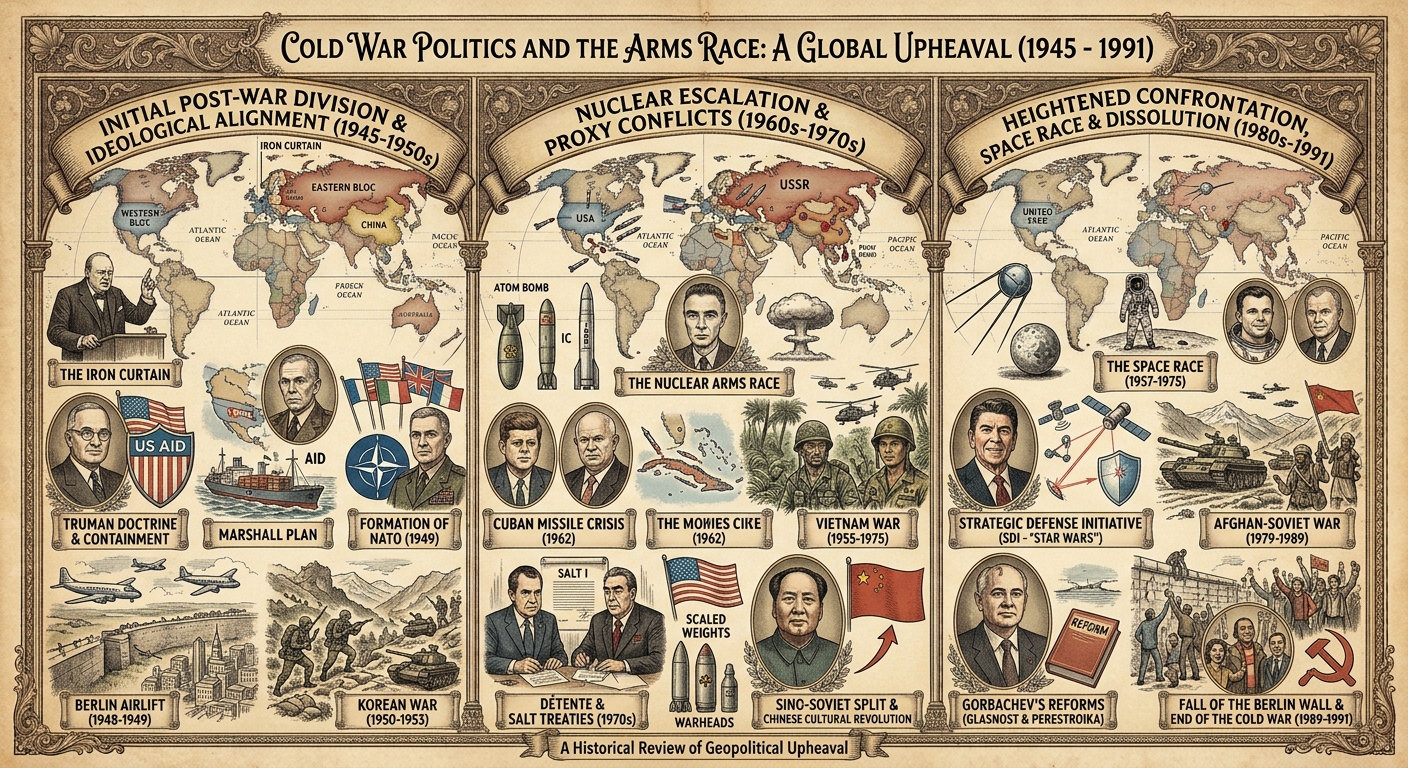
Description
COLD WAR POLITICS AND THE ARMS RACE
📚 Complete Study Guide — Comprehensive, Exam-Focused Notes
🔥 WHY THIS GUIDE IS ESSENTIAL
For nearly half a century, the world held its breath. Two superpowers — armed with enough nuclear weapons to destroy civilization many times over — stood locked in an ideological struggle that shaped every corner of the globe. From the streets of Berlin to the jungles of Vietnam, from the deserts of the Middle East to the plains of Angola, the Cold War was fought through proxy wars, propaganda, espionage, and an arms race that pushed humanity to the brink of annihilation.
This guide transforms a complex, densely packed chapter into a clear, structured, and exam-ready study companion. Whether you are a student aiming for top grades, a teacher building lesson content, or a curious mind seeking to understand how the modern world was shaped by this global rivalry — this guide is your definitive resource.
🎯 WHAT THIS GUIDE COVERS
Introduction: The Cold War (1945–1991)
Definition — an intense ideological and geopolitical rivalry between the United States (capitalism) and the Soviet Union (communism)
Why “cold” — the absence of large-scale direct fighting despite major regional wars (proxy wars)
Key characteristics — no direct military engagement, continual antagonism through political maneuvering, military coalitions, espionage, propaganda, arms buildups, economic aid, and proxy wars
Timeline — from 1945 to the collapse of communism in Eastern Europe (1989) and the dissolution of the USSR (1991)
Origins of the Cold War
Ideological roots — the Russian Socialist Revolution of October 1917, the establishment of the world’s first communist government, and the formation of the Soviet Union in 1922
Capitalist fears — the spread of communism as a threat to private property, the bourgeoisie, and liberal democracy
Early confrontations — the 1918 intervention by capitalist states (USA, Britain, France, Japan) in support of anti-communist forces
Intelligence networks established — COMINFORM (1947), CIA (1947), NATO (1949), Warsaw Pact (1955)
The Space Race — Sputnik (1957), Pioneer V, Lark I and II (1959), and the US satellite to the moon (1961)
Causes of the Cold War — All Eleven Explored in Depth
Ideological Differences — communism vs. capitalism, Soviet expansion into Eastern Europe, the Truman Doctrine and Marshall Plan, and the suppression of the Greek Socialist Revolution (1949)
Russian Expansionist Motives — Stalin’s occupation of Eastern European territories and the spread of communism in Poland, Bulgaria, Romania, Hungary, Yugoslavia, Czechoslovakia, Albania, and East Germany
Media and Propaganda — Soviet state-controlled media vs. American newspapers, radio, films, and television
Cultural Rivalry (Cultural Cold War) — abstract art, Hollywood films, and jazz vs. socialist realism, ballet, and state-sponsored literature; the Olympics as political battlegrounds
Nuclear Arms Development — the secret American atomic bomb, Hiroshima and Nagasaki (1945), Stalin’s view of the bombing as a warning, the Soviet atomic bomb (1949), and US Anti-Ballistic Missiles
Military Alliances — NATO (1949) with all members listed, and the Warsaw Pact (1955) with all members listed
Yalta and Potsdam Conferences — the division of Germany into four occupation zones, the dispute over Poland, the division into West Germany and East Germany, the division of Berlin, and the erection of the Berlin Wall (October 1961)
Stalin’s February 1946 Speech — “communism and capitalism could never live peacefully together”
Churchill’s “Iron Curtain Speech” (March 1946) — “From Stettin in the Baltic to Trieste in the Adriatic an Iron Curtain has descended across the continent”
Economic Recovery Programs — the Marshall Plan (1947) with over $13 billion in aid, Molotov’s denunciation of “dollar imperialism,” and the Molotov Plan establishing CMEA
United Nations Failure — the UN’s inability to stop ideological hostility, both powers using Security Council permanent membership to demonstrate superiority, and the crises that followed (Korean War, Cuban Missile Crisis, Vietnam War)
Manifestations of the Cold War
☢️ The Nuclear Arms Race
Complete timeline table — from the US atomic bomb (1945) to the Soviet SS-20 MIRV (1977), including the hydrogen bomb (1953–1954), ICBMs (1957), Sputnik (1957), Polaris and Poseidon (1970s), and MIRVs (1970)
Key weapons — ICBMs (minimum range 5,500 km), Jupiter and Thor missiles, surface-to-air missiles, torpedoes, frigates, advanced warplanes, and chemical and biological weapons
Reasons for the arms race — ideological fear, balance of power, defensive purposes, technological advances, and civil wars and conflicts
🚀 The Cuban Missile Crisis (1962)
Background — Fidel Castro’s rise to power (1959), the nationalization of American-owned industries, and the Bay of Pigs invasion (1961)
Reasons for the USSR installing missiles — all six reasons fully explained
Crisis events — American spy planes photographing missile bases, Kennedy’s blockade, 25 Russian warships carrying missiles, and the near-outbreak of nuclear war
Resolution — U Thant’s appeal, the USSR’s agreement to remove missiles, the USA’s agreement never to invade Cuba and to remove Jupiter missiles from Turkey, the establishment of the hotline, and the Nuclear Test Ban Treaty (July 1963)
🌍 Proxy Wars and Regional Conflicts
South East Asia:
The Korean War (1950–1953) — background, all six causes, and all seven impacts
The Vietnam War (1955–1975) — background, all seven causes, and all five impacts
The Middle East:
Creation of Israel (1948) — the UN partition plan, the 1948 Arab-Israeli War, and the superpower alignment
The Suez War (1956) — the nationalization of the Suez Canal, underlying factors, key events, superpower involvement, and outcome
The Six-Day War (June 1967) — background, causes, course of war, and impacts
Yom Kippur War (1973) — background, key events, and outcomes including oil as a strategic weapon
Latin America:
Countries involved — Nicaragua, El Salvador, Guatemala, Chile
The Chile example — Salvador Allende’s election (1970), nationalization, US economic sabotage, the 1973 coup, and Pinochet’s rise
Impacts of proxy wars in Latin America — all six impacts
Proxy Wars in Africa:
The Angolan Civil War (1975–2002) — background, the three main parties (MPLA, FNLA, UNITA) with their ideologies, supporters, and leaders, key events, factors shaping US intervention, the Battle of Cuito Cuanavale (1987–1988), and significance
Efforts to Overcome Threats Caused by the Cold War
Non-Proliferation Treaty (NPT) — 1968
Strategic Arms Limitation Talks (SALT I) — 1972
SALT II — 1979
Camp David Accords — 1979
Intermediate-Range Nuclear Forces (INF) Treaty — 1987
Leadership and Political Will — Gorbachev’s glasnost and perestroika, Reagan’s shift to diplomacy
United Nations Role — forums for negotiation, peacekeeping, and humanitarian interventions
Oslo Peace Accords (1993)
Thawing and Freezing of the Cold War
Key Events of Thawing:
Death of Stalin (March 1953) — Khrushchev’s “peaceful coexistence,” Korean War armistice
Khrushchev’s “Secret Speech” (1956) — denunciation of Stalin’s cult of personality
Détente in the 1970s — end of the Vietnam War (1975), Apollo-Soyuz Test Project, Helsinki Conference (1975), Camp David Peace Accords (1979)
Moral and Spiritual Forces — Pope John Paul II (elected 1978), the 1979 visit to Poland, and the Solidarity movement
Reagan-Gorbachev Summits — Geneva (1985), Reykjavik, Washington, Moscow, and the INF Treaty (1987)
Key Events of Freezing:
Hungarian Uprising (1956)
Iranian Revolution (1979)
Soviet Invasion of Afghanistan (1979) — destruction of détente, collapse of SALT II, US sanctions, and the Olympic boycotts
Early 1980s Arms Race — Reagan’s “evil empire” speech, increased defense spending, and new nuclear deployments in Europe
The Reykjavik Summit (1986)
Gorbachev’s proposals — ban all ballistic missiles, eliminate 50% of strategic arms, eliminate all nuclear weapons within a decade, and strengthen the ABM Treaty
Reagan’s position — continued research on the Strategic Defence Initiative (SDI), human rights, Soviet Jewish emigration, and Afghanistan
Outcome — the summit failed to meet its aims
Summary: End of the Cold War
Factors contributing to the Cold War’s end — treaties and peace accords, leadership changes, recognition of unsustainable danger, moral and spiritual forces, economic constraints on the USSR, the collapse of communism in Eastern Europe (1989), and the dissolution of the USSR (1991)
Key lesson — dialogue, trust-building, and institutional frameworks are indispensable for managing global threats
📝 Exercise Questions for Chapter Three — 12 Complete Questions
Covering:
Post-WWII policies and ambitions of the US and USSR
Political, ideological, and economic factors that instigated the Cold War
Whether studying only US and Soviet actions provides a balanced understanding
The Cold War’s destructive and constructive effects
How containment influenced American interventions in Korea and Vietnam
The extent to which arms control agreements mitigated threats to world peace
Underlying causes of the Cuban Missile Crisis
How international organizations can strengthen their role in preventing global conflicts
The Marshall Plan as economic aid applied as a weapon
The impact of political crises (Cuban Missile Crisis, Berlin Blockade) on international stability
Why the Reykjavik Summit failed to meet its aims
Issues preventing the “Two States Solution” to the Israel-Palestine Question
✨ WHY THIS GUIDE STANDS OUT
Feature Benefit
Complete chapter coverage Every section, cause, event, treaty, and consequence is included
Structured for revision Clear headings, numbered lists, tables, and bullet points
Exam-focused 12 exercise questions that mirror real examination formats
Historical depth Dates, leaders, treaties, weapons systems, and statistics all precisely recorded
Conceptual clarity Complex ideas — containment, détente, proxy wars, mutually assured destruction — broken down into digestible explanations
Global perspective Covers Europe, Asia, the Middle East, Latin America, and Africa
Comparative analysis Thawing vs. freezing events; NATO vs. Warsaw Pact; capitalism vs. communism
Ready to use Perfect for students, teachers, and independent learners alike
📖 WHO IS THIS FOR?
Students preparing for history and international relations examinations at secondary and tertiary levels
Teachers looking for well-organized, comprehensive teaching material
Researchers needing a quick yet thorough reference on Cold War politics and the arms race
Lifelong learners curious about the ideological struggle that shaped the modern world
🚀 HOW TO USE THIS GUIDE
Start with the Introduction to understand the scope and key characteristics of the Cold War
Read each section sequentially — the guide builds knowledge progressively
Use the summary sections for quick revision before exams
Work through the 12 exercise questions to test your understanding
Refer back to specific sections when you need quick revision on a particular topic
Compare and contrast thawing and freezing events to understand the fluctuating nature of the Cold War
💡 KEY TAKEAWAYS YOU WILL MASTER
How ideological differences between capitalism and communism created a global rivalry that lasted nearly half a century
How nuclear weapons transformed international relations and created a balance of terror
How the Cuban Missile Crisis brought the world to the brink of nuclear war — and how diplomacy pulled it back
How proxy wars in Korea, Vietnam, the Middle East, Latin America, and Africa allowed superpowers to fight without direct confrontation
How NATO and the Warsaw Pact divided Europe and shaped global security for decades
How arms control agreements (NPT, SALT I, SALT II, INF) attempted to manage the nuclear threat
How détente and thawing offered hope — and how freezing events repeatedly dashed it
How Gorbachev’s reforms and Reagan’s diplomacy helped end the Cold War
How the collapse of communism in Eastern Europe (1989) and the dissolution of the USSR (1991) reshaped the global order
How to analyze and answer exam-style questions with confidence
📌 FINAL WORD
This guide is your complete companion to understanding the Cold War — the ideological struggle that defined the second half of the 20th century. From the Iron Curtain to the Cuban Missile Crisis, from the killing fields of Korea and Vietnam to the battlefields of Angola, from Sputnik to the INF Treaty — everything you need is here, organized, explained, and ready for your success.
MITIHANI POPOTE — Quality educational resources wherever you are.

Reviews
There are no reviews yet.