
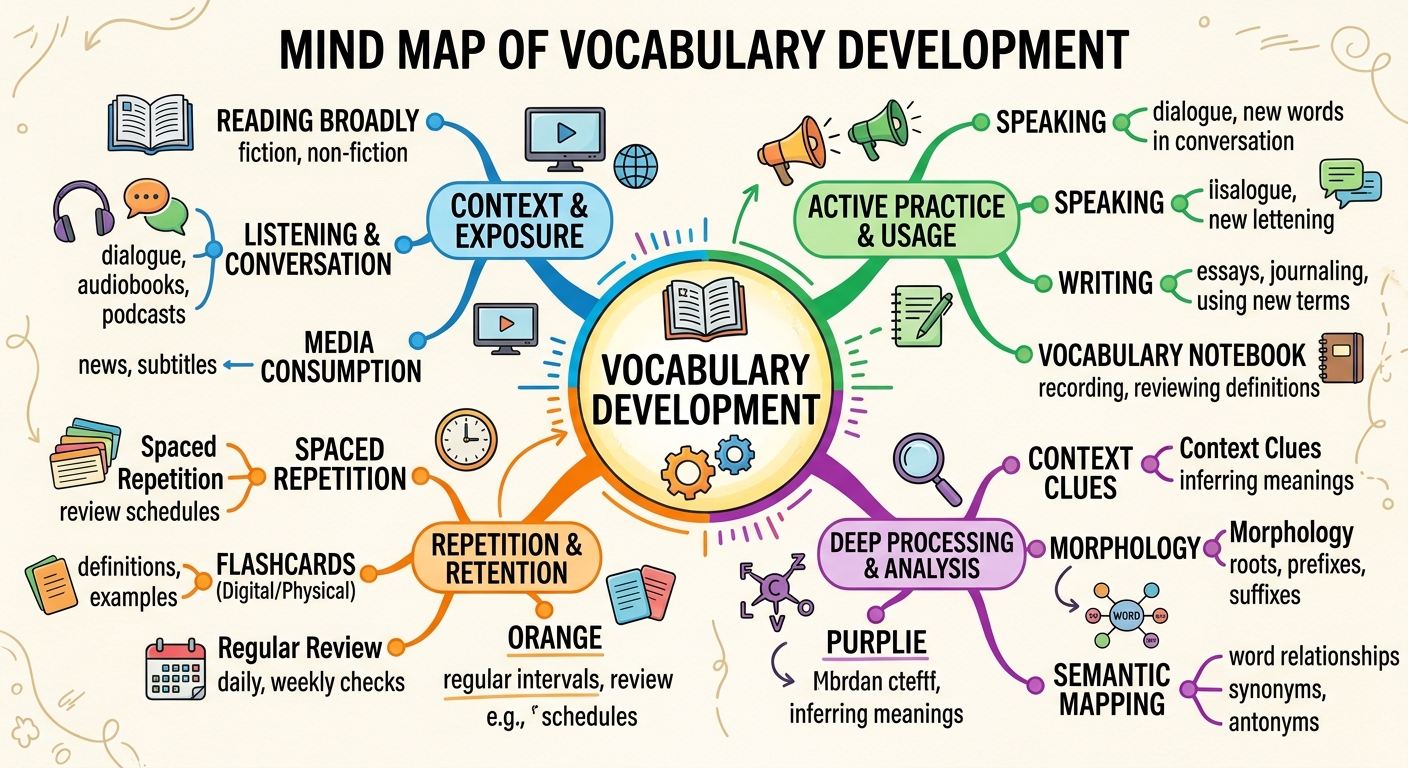
Description
VOCABULARY DEVELOPMENT — Complete Study Guide
Advanced Level English — Form Five
A comprehensive, exam-ready resource covering everything from context clues and word formation to specialized vocabulary in legal, medical, and technical fields — all in one clearly organized document.
📘 What’s Inside
1. Introduction to Vocabulary Development
Clear definitions of all key terms: vocabulary, vocabulary development, lexical knowledge, context clues, synonym, antonym, and word formation
Five key reasons why vocabulary development matters: effective communication, academic success, reading comprehension, social integration, and critical thinking
2. Vocabulary from Oral Texts
Definition of oral texts and why they are valuable vocabulary sources
Four strategies: active listening, contextual understanding, recording and review, and practicing usage
Picture description activity with step-by-step guidance and Tanzanian classroom examples
Tanzanian example: extracting vocabulary from President Samia Suluhu Hassan’s UN speech
3. Discovering Meanings Using Reference Sources
All five types of context clues with signal words and examples:
Definition/Explanation, Synonym, Antonym, Example, and Inference
Technical dictionaries — features and how they differ from general dictionaries
Thesaurus — synonyms, antonyms, and related words
Encyclopedia — comprehensive coverage, historical context, cross-references, and illustrations
Tanzanian example: medical dictionary terms
4. Vocabulary from Specialized Texts
Sources of specialized vocabulary across technical fields, professional contexts, and social contexts
Vocabulary from speeches — formal/diplomatic language and sophisticated vocabulary from President Samia Suluhu Hassan’s speech, with contextual usage examples
Vocabulary from stories — emotional vocabulary, cyber-related terms, and idiomatic expressions from “Cyberbullying”
5. Synonyms and Antonyms
Synonyms: five reasons they matter and a comprehensive examples table
Exercise: finding synonyms for key speech vocabulary
Antonyms: four reasons they matter and three types (gradable, complementary, relational)
Extensive antonym examples table
Exercise: finding antonyms from the “Cyberbullying” story
6. Word Formation Processes
All eight processes explained:
Affixation — complete prefix and suffix tables with meanings and examples
Compounding — closed, hyphenated, and open compounds with Tanzanian examples
Conversion — noun↔verb, adjective↔verb, adjective→noun
Borrowing — from African languages, Romance languages, and others
Blending — examples table (smog, brunch, motel, etc.)
Clipping — full word vs. clipped form table
Acronyms and Initialisms — with Tanzanian examples (NECTA, TRA, SIDO, COSTECH)
Word formation exercise with 10 fill-in-the-blank sentences
7. Vocabulary in Specialized Contexts
Legal vocabulary — proceedings, actions, and outcomes with Tanzanian drama example
Medical vocabulary — conditions, procedures, and personnel
Technical vocabulary — technology, environmental, and business terms
8. Summary
10 key takeaways covering the entire chapter
9. Revision Questions
Five subtopic sections (5 questions each): Introduction, Oral Texts, Reference Sources, Synonyms & Antonyms, and Word Formation
10. NECTA-Style Questions
Section A: 10 Short Answer Questions
Section B: 10 Structured Questions (with mark allocations, 5 marks per part)
Section C: 10 Essay Questions — exam-style discussion topics
11. Keywords Glossary
Complete definitions of every key term in the chapter
✅ Why This Guide Works
Tanzanian context throughout — every section includes examples from Tanzanian speeches, stories, and institutions
All eight word formation processes covered — with complete tables for prefixes, suffixes, blends, and clipped forms
Specialized vocabulary demonstrated — legal, medical, and technical terms with real examples
Exam-focused — NECTA-style short answer, structured, and essay questions with mark allocations
Complete coverage — from context clue types to specialized professional vocabulary in a single document
MITIHANI POPOTE — Quality educational resources wherever you are.



Reviews
There are no reviews yet.