
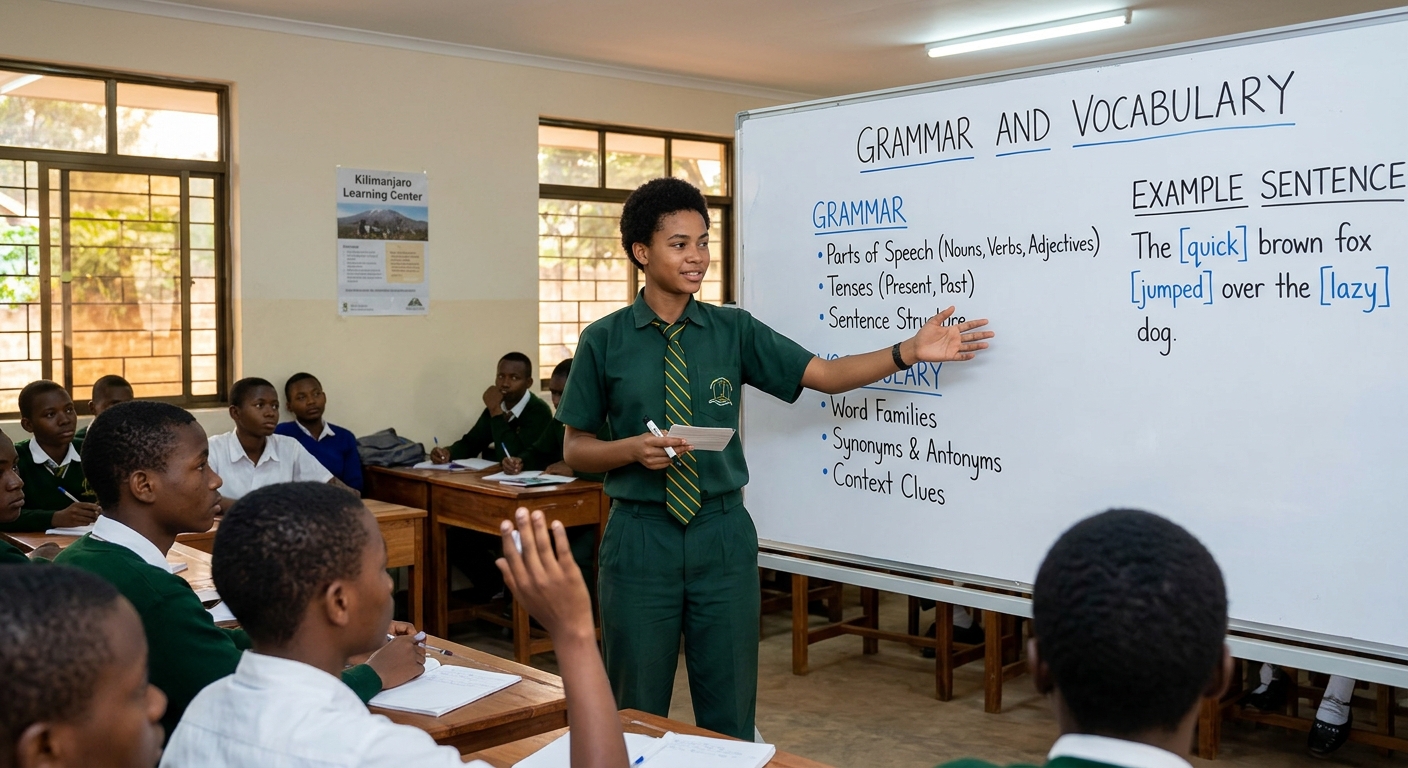
Description
GRAMMAR AND VOCABULARY — Complete Study Guide
Advanced Level English — Form Five
A comprehensive, exam-ready resource covering everything from synonyms and antonyms to all twelve tenses, speech writing, and article writing — all in one clearly organized document.
📘 What’s Inside
1. Introduction to Grammar and Vocabulary
Clear definitions of all key terms: grammar, vocabulary, syntax, morphology, subject-verb agreement, tense, concision, and coherence
Five key reasons why mastering grammar and vocabulary matters: effective communication, academic success, professional development, social interaction, and critical thinking
2. Synonyms
Definition and three key points: similar but not identical, interchangeability, and enriching language
Nuances explained (intensity, formality, connotation, context)
Synonyms in context — a full report analyzed with six synonyms for “emphasized”
Synonyms in speeches — a full speech analyzed, with Tanzanian classroom examples
3. Antonyms
Definition and four key points: creating contrast, improving clarity, adding precision, and supporting critical thinking
All three types explained with examples: gradable, complementary, and relational
Extensive common antonyms table
Antonyms in context — a full dialogue demonstrating contrasting word pairs
Exercise: finding antonyms
4. Subject-Verb Agreement
Definition and key points (basic rule, importance, common errors)
Singular vs. plural examples table
All eight rules fully explained with examples:
Agree with the subject, not intervening words
Subjects joined by or/either/neither
Indefinite pronouns (singular)
Indefinite pronouns (all, any, none, some)
Nouns that appear plural but are singular
Titles, company names, and gerund phrases
Collective nouns
Subject after verb
Two exercises: choosing the correct verb (10 sentences) and editing sentences to correct errors (7 sentences, with corrections)
5. Tenses
Definition of the three primary tenses
Complete tense tree diagram
All twelve tenses fully explained, each with:
Usage
Structure
Positive/negative/question table
Three example sentences
Includes Tanzanian examples throughout (Nyerere, Zanzibar, Serengeti, etc.)
Practice exercise: identifying tenses
6. Preparing Speeches
Stages of speech preparation: topic, purpose, context and audience, title, information collection, and outline
Structure of a speech:
Introduction — greetings by protocol and opening statements
Main body — cohesive devices and transitional words
Conclusion — paraphrasing and call to action
Strategies for delivering speeches: rehearsal, venue, dress code, language, time management, eye contact, voice, posture, gestures, confidence, and answering questions
7. Writing Articles
Definition and components of a news article: headline, by-line, lead paragraph, and storyline
Seven steps for writing articles, from choosing a topic to writing the conclusion
8. Writing Journal Articles
All nine sections explained: title, abstract, introduction, literature review, methodology, results, discussion, conclusion, and references
9. Writing for Specific Purposes
Four types of writing: descriptive, analytical, persuasive, and critical
Features of academic writing table: structured, evidence-based, critical, and balanced
10. Summary
Nine key takeaways covering the entire chapter
11. Revision Questions
Five subtopic sections (5 questions each): Introduction, Synonyms, Antonyms, Subject-Verb Agreement, and Tenses
12. NECTA-Style Questions
Section A: 10 Short Answer Questions
Section B: 10 Structured Questions (with mark allocations, 5 marks per part)
Section C: 10 Essay Questions — exam-style discussion topics
13. Keywords Glossary
Complete definitions of every key term in the chapter
✅ Why This Guide Works
All eight subject-verb agreement rules covered — the most commonly examined grammar topic, with exercises and corrections
All twelve tenses fully tabulated — positive, negative, and question forms for each
Tanzanian context throughout — examples from Tanzanian places, leaders, and institutions
Exam-focused — NECTA-style short answer, structured, and essay questions with mark allocations
Complete coverage — from synonym nuance to journal article structure in a single document
MITIHANI POPOTE — Quality educational resources wherever you are.



Reviews
There are no reviews yet.