
Description
Political Revolutions and Modern Administrative Systems in Europe – Comprehensive Study Guide (Form Five History)
Master the Revolutionary Transformations That Shaped Modern Democracy — From the English Civil War to the French Revolution and the 1848 Uprisings
This expertly structured study guide breaks down one of the most dynamic and examinable topics in modern European history into clear, organized, and highly digestible sections. Whether you are preparing for national examinations, revising for class tests, or seeking a deeper understanding of how political revolutions dismantled absolute monarchy and feudalism to create modern democratic states, this guide is your essential companion.
📖 What’s Inside
Introduction: The Shift from Absolute Monarchy to Modern Democracy
How political revolutions between the 17th and 19th centuries marked a fundamental shift in administrative systems
The transition from divine-right theories of governance to constitutionalism, popular sovereignty, and individual rights
7.1 The Concept of Political Revolution
Clear definition: a fundamental and relatively sudden change in political power and administrative organization
Key characteristics:
Overthrow of an existing government (monarch, dictator, or ruling elite)
Change in administrative systems (absolute monarchy → constitutional monarchy or republic)
Mass participation of various social classes (bourgeoisie, peasants, urban workers)
Ideological foundation: liberty, equality, fraternity, constitutionalism, and popular sovereignty
How European revolutions dismantled feudal and absolutist systems and replaced them with structures reflecting the interests of emerging capitalist and middle classes
7.2 The English Revolution (1640–1689)
A prolonged conflict between monarchy and Parliament that fundamentally altered England’s administrative system
Causes:
Struggle between King and Parliament: James I and Charles I’s belief in divine right, taxation without consent, and dissolution of Parliament
Religious conflicts: imposition of Anglican practices on Scotland and Puritans; the king’s Catholic queen
Economic grievances: forced loans and arbitrary taxation (e.g., ship money)
Phases:
Phase 1: The Civil War (1642–1649): Charles I’s attempt to arrest five MPs, Royalists (Cavaliers) vs. Parliamentarians (Roundheads), Oliver Cromwell’s New Model Army, execution of Charles I in 1649
Phase 2: The Commonwealth and Protectorate (1649–1660): England declared a republic, House of Lords abolished, Cromwell as Lord Protector (1653–1658), military rule and political instability
Phase 3: The Restoration (1660–1688): Charles II and James II, tensions over Catholicism and absolutism
Significance: challenged divine right, strengthened Parliament, laid the foundation for constitutional monarchy
7.3 The Glorious Revolution (1688)
A relatively bloodless coup that permanently established constitutional monarchy in England
Causes:
Fear of Catholic absolutism: James II’s promotion of Catholics and the Declaration of Indulgence (1687)
Fear of a Catholic dynasty: the birth of James II’s son in 1688
Invitation to William of Orange by the “Immortal Seven” English nobles
Events:
William of Orange landed in November 1688; James II fled to France in December 1688
William and Mary offered the crown as joint monarchs in 1689
Key documents:
The Bill of Rights (1689): no suspension of laws or taxation without Parliament’s consent, no standing army in peacetime without approval, free elections, freedom of speech in Parliament, prohibition of Catholics from the throne
The Toleration Act (1689): freedom of worship for Protestant dissenters
The Mutiny Act (1689): parliamentary approval required for maintaining a standing army
Significance: constitutional monarchy established, supremacy of Parliament, foundation for modern British governance, influence on John Locke’s Two Treatises of Government (1689) and social contract theory
7.4 The French Revolution of 1789
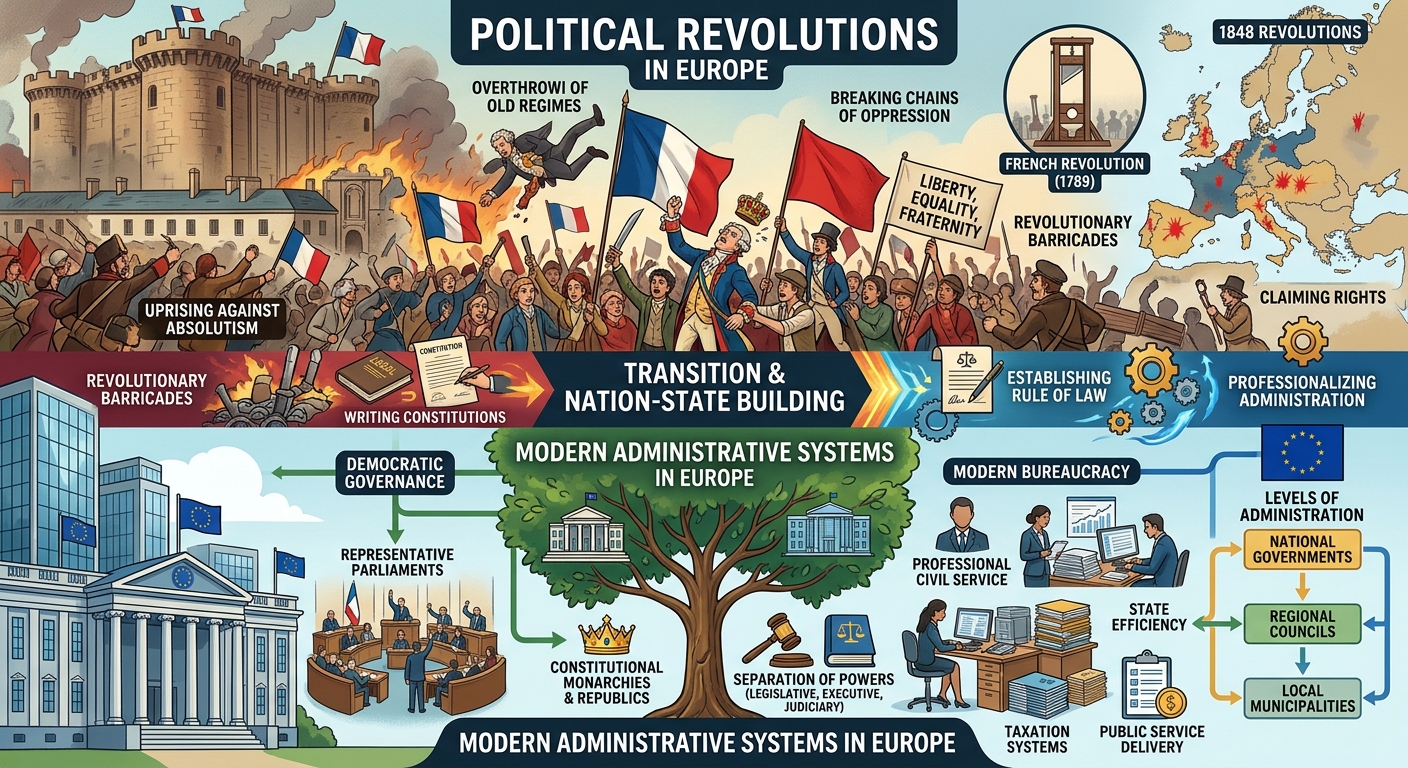
A radical and transformative event that overthrew absolute monarchy, dismantled feudalism, and established new administrative systems based on liberty, equality, and popular sovereignty
Causes:
Social inequalities and the Estate System: First Estate (Clergy, <1% of population, 10% of land, no taxes), Second Estate (Nobility, ~2%, 25% of land, no taxes), Third Estate (97%, bore all taxation, no political power) Financial crisis: debt from the American Revolution and extravagant spending by Louis XVI and Marie Antoinette Enlightenment ideas: Voltaire, Rousseau, Montesquieu — individual liberty, popular sovereignty, separation of powers, social contract Economic hardship: poor harvests in the 1780s, bread shortages, high food prices Phases: Phase 1: The Moderate Phase (1789–1792): Estates-General (May 1789), Tennis Court Oath (June 1789), Storming of the Bastille (July 14, 1789), Abolition of Feudalism (August 1789), Declaration of the Rights of Man and of the Citizen (August 1789), Constitution of 1791 Phase 2: The Radical Phase and Reign of Terror (1792–1794): abolition of the monarchy, First French Republic (1792), execution of Louis XVI (January 1793), Committee of Public Safety led by Robespierre, Reign of Terror (over 40,000 executed by guillotine), Robespierre's overthrow and execution (July 1794) Phase 3: The Directory (1795–1799): five-man executive, weak and corrupt, relied on the military Phase 4: The Rise of Napoleon (1799–1815): coup d'état of 1799, Consulate and French Empire, consolidation of revolutionary gains, spread of principles through conquest, defeat in 1815 Significance: abolished feudalism, established popular sovereignty, Declaration of the Rights of Man, spread nationalism and liberalism, model for future revolutions 7.5 The 1848 Revolutions in Europe A series of widespread and simultaneous uprisings across Europe Causes: Economic hardship: agricultural crisis (potato blight and grain shortages), industrial depression, unemployment, hunger, poverty Demand for political reform: constitutional government, expanded suffrage, freedom of press/assembly/speech, national unification (Germany and Italy), independence from foreign rule (Hungarians in the Austrian Empire) Social grievances of the working class: harsh working conditions, low wages, lack of political representation, spread of socialist and radical ideas Key revolutionary events: France: overthrow of King Louis-Philippe, Second Republic, universal male suffrage, social workshops, the "June Days" uprising, rise of Louis-Napoleon Bonaparte (Napoleon III) German States: uprisings in Prussia, liberal constitutions, Frankfurt Parliament (failed to unite Germany, dissolved 1849) Austrian Empire: revolts in Vienna, Budapest, and Prague; constitution granted; serfdom abolished; Hungarian independence crushed by Austrian and Russian forces Italy: revolts against Austrian rule, Pope briefly expelled from Rome, Roman Republic declared, eventually crushed by Austrian forces Reasons for failure: Divisions among revolutionaries: liberals and middle-class reformers split with socialists and workers; middle class allied with conservatives to suppress workers Lack of unity: uncoordinated revolutions, no unified European-wide leadership Strength of conservative forces: monarchies controlled loyal armies, mobilized military force, and received help from other monarchies (e.g., Russia helping Austria) Significance: end of feudal remnants (final abolition of serfdom in Austria, Prussia, and German states), symbol of popular sovereignty, impetus for reform, influence on political thought (Marx and Engels's Communist Manifesto, 1848) ✨ Key Features Concise and Structured — Every revolution broken down into causes, phases, key events, and significance Comparative Analysis — The English, Glorious, French, and 1848 revolutions compared side by side Primary Document Focus — Detailed coverage of the Bill of Rights (1689), the Declaration of the Rights of Man (1789), and the Tennis Court Oath Exam-Focused Content — Revision questions after every section to test and reinforce understanding Clear Definitions — Key concepts explained: divine right, constitutional monarchy, popular sovereignty, social contract, Reign of Terror, and more Historical Depth — Traces the evolution of modern democratic governance from the 17th to the 19th century Global Relevance — Shows how European revolutions inspired movements in Latin America and beyond 📝 Comprehensive Assessment Section Questions 7.1 (5 Questions) Definition and key characteristics of political revolution How European revolutions contributed to the transition from feudal to modern administrative systems The role of ideology in driving revolutions Why mass participation was critical How revolutions challenged the divine right of kings Questions 7.2 (5 Questions) Main causes of the conflict between Stuart kings and Parliament The three phases of the English Revolution and their governing structures Significance of Charles I's execution in 1649 How the revolution challenged divine right How the revolution strengthened Parliament Questions 7.3 (5 Questions) Fears and grievances that led nobles to invite William of Orange Key provisions of the Bill of Rights (1689) Why the Glorious Revolution is considered "bloodless" Significance of the Mutiny Act (1689) Influence on John Locke and modern constitutional governance Questions 7.4 (5 Questions) Social, economic, and intellectual causes of the French Revolution Key events of the moderate phase (Tennis Court Oath, Storming of the Bastille, Declaration of the Rights of Man) The Reign of Terror and its causes How the revolution abolished feudalism and established new governance principles Long-term significance for Europe and the world Questions 7.5 (5 Questions) Economic, political, and social causes of the 1848 revolutions Key revolutionary events in France, the German States, and the Austrian Empire Why the revolutions ultimately failed Long-term consequences despite short-term failure Growing divisions between liberal middle-class reformers and the radical working class 🎯 Who This Guide Is For Form Five and Form Six History students preparing for national examinations Teachers seeking a well-organized reference and teaching resource Anyone interested in understanding the origins of modern democracy, constitutionalism, and popular sovereignty Students preparing for regional and international examinations on European and world history Readers fascinated by revolutionary movements, political theory, and the evolution of governance ⭐ Why Choose This Guide ✅ Curriculum-Aligned — Follows the official History syllabus structure ✅ Exam-Focused — Revision questions mirror real examination formats ✅ Clear and Concise — Complex political and historical concepts explained in simple, accessible language ✅ Comprehensive Coverage — From the English Revolution (1640) to the 1848 revolutions across Europe ✅ Comparative Approach — Enables cross-revolution analysis and critical thinking ✅ Primary Source Focus — Detailed coverage of the Bill of Rights, Declaration of the Rights of Man, and other key documents ✅ Contemporary Relevance — Connects historical revolutions to modern democratic principles and governance reforms Order your copy today and take control of your success! MITIHANI POPOTE — Quality educational resources wherever you are.
Reviews
There are no reviews yet.