
Description
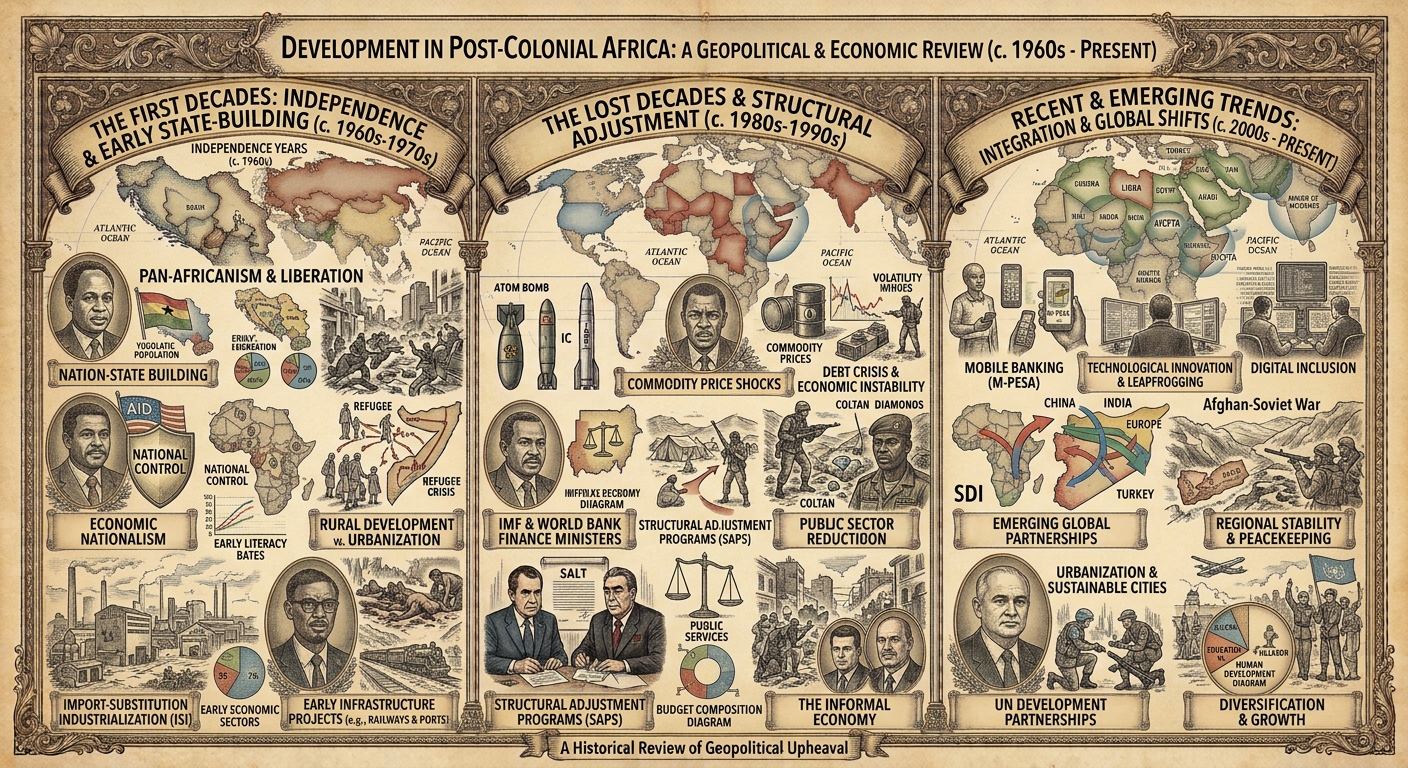
CHAPTER 6: DEVELOPMENT IN POST-COLONIAL AFRICA
📚 Complete Study Guide — Comprehensive, Exam-Focused Notes
🔥 WHY THIS GUIDE IS ESSENTIAL
When the flags of independence rose across Africa in the late 1950s and 1960s, there was immense hope. Leaders promised to transform their nations, to bring the fruits of freedom to their people, and to build prosperous societies. Some countries started well — school enrolments soared, infrastructure expanded, and hospitals and clinics were built. Yet decades later, many of the same challenges persist: ethnic divisions, economic dependence, political instability, and poverty. Why?
This guide transforms a complex, densely packed chapter into a clear, structured, and exam-ready study companion. It traces the journey of post-colonial Africa — the approaches taken, the successes achieved, the failures endured, and the factors that continue to hinder development. Whether you are a student aiming for top grades, a teacher building lesson content, or a curious mind seeking to understand Africa’s modern trajectory — this guide is your definitive resource.
🎯 WHAT THIS GUIDE COVERS
Introduction: The Post-Colonial Period
Clear learning objectives — from exploring the background of post-colonial development to proposing community-based solutions
Key theme: Colonial legacies and Africa’s development
Definition of the post-colonial period — the era following colonial rule, from the 1950s to the present, characterised by efforts to reassess colonial legacies and implement development strategies
Colonial withdrawal and its legacy — physical infrastructure (ports, airports, roads, railways, buildings) and institutional legacy (boundaries, forms of government, educational systems, health systems, business operations, trade contacts, cultural networks)
Major challenge: dismantling the colonial economic system — states remaining producers and exporters of raw materials, supplying manufacturing industries of former colonial powers, acting as markets for finished industrial goods, and trade dominated by big trading companies of colonial powers
Approaches to African Development — Two Phases
Phase 1 (1950s–1980s) — nation-building, indigenisation, regional integration, socialist/capitalist approaches, militarisation
Phase 2 (mid-1980s to present) — Structural Adjustment Programmes, multiparty democracy, economic liberalisation
🏗️ 1. Nation-Building
Definition and context — one of the first steps taken by newly independent nations; leaders confronting fundamental challenges of nationhood and statehood
Challenges included — replacing independent constitutions with republican constitutions, adopting the Westminster parliamentary system, centralising political authority (state-building), creating unity among heterogeneous ethnic groups, providing avenues for political participation, and distributing scarce but allocatable resources
Measures to unify people — the one-party system adoption motivated by ethnic, regional, and religious divisions; examples of one-party states (Tanzania/TANU later CCM, Guinea-Bissau/PAIGC, Guinea/PDG, Kenya/KANU, Ghana/CPP, Upper Volta/Burkina Faso, Mali, Côte d’Ivoire, Malawi, Senegal, Cameroon)
African socialist philosophies — Tanzania’s Ujamaa and Self-Reliance (Arusha Declaration), Uganda’s Obote’s Common Man’s Charter, Guinea’s Sekou Toure’s National Democracy, Zambia’s Kaunda’s Humanism, and Senegal’s Senghor’s Negritude
The party as a mobilising instrument — the political party serving as a vehicle for relative dissociation from inherited political structures
Record of one-party states — a better record of creating a semblance of national unity than multi-party states
Revival of the multiparty system (mid-1980s onward) — reasons including the failure of the single-party system to confront socio-economic and political challenges, particularly the economic crisis of the 1970s and 1980s
🌍 2. Indigenisation (Africanisation)
Definition — a major sectoral approach to socio-economic and political development pursued by many African governments in the late 1960s and 1970s
Colonial economic structure at independence — a complete table showing three levels: Europeans at the top (large industries, major mercantile concerns, plantation farming), Asians and Lebanese in the middle (medium-level industrial activities, wholesaling, larger retail outfits), and Africans at the bottom (peasant farming, fishing, petty trading, labour services)
Civil service situation — the same three-tier structure; better in British West Africa (Nigeria, Ghana) and worse in nearly all other African countries; many countries attaining nationhood with few indigenous college graduates and only a couple of hundred high school graduates
European civil servants in Africa (1958) — an estimated 100,000, excluding university personnel, missionaries, and Europeans employed by local authorities and the UN
Africanisation of the civil service — the process of transforming the inherited colonial model into indigenous public services, not simply an exchange of Africans for non-Africans
Forms of indigenisation:
Nationalisation — wholesale takeover of enterprises; categories including large extractive industries owned by multinational corporations, small branch enterprises (banking, insurance, petroleum distribution), and small and medium-sized enterprises owned by foreigners
Government regulation — monitoring expatriate participation in various activities
Statistics on nationalisation — 875 cases reported in 62 countries worldwide; 340 (39%) in Africa; Africa led in all industry categories except petroleum; total value of indigenised enterprises: several billions of US dollars
Results of indigenisation — some measures of control passed into African hands, but the dominance of foreign capital, expertise, technology, and entrepreneurship persisted
Different economic models — socialist/communist models (Egypt, Algeria, Libya adopting Arab socialism; Soviet or Chinese communist models with modifications), market economies (most French colonial Africa except Guinea Conakry, Kenya, Nigeria), and mixed approaches (combining market economy with Africanisation; Africans participating by purchasing shares in privately owned companies)
Limitations of indigenisation — heavy dependence on external trade, a narrow and vulnerable range of primary export commodities, a sharp divide between traditional and modern sectors, and circumscribed and limited indigenous participation
🤝 3. Regional Integration
Background — economic integration among independent states to promote economic development, reduce dependence on former colonial powers, promote self-reliance, and establish common regional markets
Key organisations:
United Nations Economic Commission for Africa (ECA) — established in 1958 by the UN Economic and Social Council
Organisation of African Unity (OAU) — established in 1963, later became the African Union (AU); objectives primarily political: coordinate and intensify cooperation, improve the lives of Africa’s communities, eradicate all forms of colonialism, and promote international cooperation
ECA role — primary responsibility for promoting economic cooperation and integration; recognised the most viable approach as gradual, embracing narrower geographical areas; Africa divided into four sub-regions (Eastern and Southern Africa, Central Africa, West Africa, North Africa)
Sub-regional offices — established in each of the four sub-regions; primary functions including providing backstop services, facilitating collective decisions and actions, undertaking relevant studies, participating in programming and implementation of multinational projects, and providing continuous on-the-spot technical assistance
Limitations — less effective than expected, lack of resources, and no provisions to ensure government participation in activities
United Nations Development Advisory Teams (UNDATs) — established to strengthen operational capabilities, later replaced by Multinational Programming and Operational Centres (MULPOCs) in 1977
MULPOCs — more operational instruments, promoted economic co-operation, and held great promise for the future of regional economic integration
Regional Economic Communities:
West Africa — ECOWAS, West African Economic Community (CEAO), Council for the Entente, Mano River Union
Central Africa — Economic Community of Central African States (UDEAC), later the Central African Common Market (member states: Central African Republic, Congo, Chad, Gabon, Cameroon)
Great Lakes Region — Economic Community of the Great Lakes Countries (CEPGL): Burundi, Rwanda, Zaire/DRC
East Africa — East African Economic Community (1967): Kenya, Uganda, Tanzania; collapsed in 1977
Eastern and Southern Africa — Eastern and Southern African Preferential Trade Area provisions for the liberalisation of trade, co-operation and inter-country specialisation, development of basic and strategic industries, production of food crops and livestock, development of science and technology, exploitation and utilisation of natural resources, human resources development, and transport and telecommunications networks
North Africa — Permanent Consultative Committee (1964): Libya, Morocco, Tunisia
💰 4. Socialist or Capitalist Approach to Development
Capitalist model characteristics — maintain and increase the flow of foreign factor inputs, national investment resources insufficient, diversify agricultural production for export, intensify the economy’s external dependence, and the state assigned a pivotal role in controlling development
Countries following the capitalist model — Côte d’Ivoire (1960–1970 plan), most former French colonies strengthening economic links with France, and all former French colonies (except Mali and Guinea) retaining monetary links with France
Socialist approach characteristics — decolonise economies, fundamental change in the structure of society, change the colonial economic order, domestic processing of primary products, and import-substitution industrialisation
Key feature — rejection of expropriation of foreign or private property; emphasis on the creation of new capacity rather than nationalisation
Countries following the socialist approach:
Mali — sought to place most of the modern sector under direct state control, foreign trade under state monopoly, control over foreign trade as a key instrument for managing commodity-export surplus, and issued its own currency (Mali franc, 1962)
Algeria (1962) — self-managed agricultural sector, collective organisations run by workers’ assemblies, nationalisation extended to manufacturing, mining, and petroleum sectors; by the end of the 1960s, the public sector represented more than a third of total output
Senegal — Prime Minister Mamadou Dia formulated African socialism (1957–1962); President Leopold Sedar Senghor emphasised traditional communitarian values; village-based multifunctional co-operatives as the basic economic unit; the economy heavily dependent on the French economy; France supplied over two-thirds of public development capital and French investors accounted for more than four-fifths of private capital
Ghana — accepted a mixed economy as a transitional stage
Tanzania — Ujamaa and Self-Reliance philosophy
Zambia — significant elements of public or state ownership
Kenya — mixed economy approach
Objectives of African socialism — economic decolonisation, persistent state intervention in development and control of the economy, equalisation of economic and social opportunities, and limitation of the role of the private sector, private investment, and property
Countries with a socialist approach — Tanzania under Nyerere, Ghana under Nkrumah (initially), Zambia under Kaunda, and Kenya under Kenyatta (with capitalist elements)
Countries with a capitalist approach — Côte d’Ivoire, Kenya, Nigeria, Malawi, and most Francophone countries
Mixed economies — Malawi (firmly committed to free enterprise and a mixed economy development strategy) and Zambia (mixed economy development strategy with significant elements of public or state ownership)
Socialist economic policies in different countries:
Egypt — Agrarian Reform Law limiting land ownership to 200 feddans, nationalisation of the Suez Canal Company, state-led industrialisation, and social welfare and equality policies
Algeria — self-managed agricultural sector, nationalisation of manufacturing, mining, and petroleum, and workers’ assemblies electing administrators
Mali — state control of foreign trade, state monopoly, and the issuance of the Mali franc (1962)
🪖 5. Militarisation of the State
Definition and context — perceived by some African leaders and external observers as a strategy for nation-building and development, expected to promote political stability by ensuring law and order
Military coups in Africa — independence immediately followed by several military coups installing military regimes
Drivers of coups — economic crises (unemployment, inflation, widespread corruption, eroded public trust in civilian administrations), ethnic divisions exacerbating issues, political competition transformed into zero-sum ethnic conflicts, and the failure of newly established African governments
Coups in West Africa — early coups in Togo (13th January 1963), Congo-Brazzaville (15th April 1963), and Benin (23rd October 1963)
Statistics (1960s–1980s) — more than 50 successful coups reported, 56 attempted coups, and 102 alleged military personnel in at least 45 countries
Countries that experienced coups — a complete table including Nigeria (1966, 1975, 1983, 1985), Uganda (1966, 1971, 1979, 1980, 1985, 1986), Somalia (1969), Benin (1963, 1965, 1967, 1969, 1972), Algeria (1965), Libya (1969), Madagascar (1975), and Lesotho (1986)
SOCIAL, POLITICAL, AND ECONOMIC DEVELOPMENT IN DIFFERENT REGIONS
🌍 A. Northern Africa
Overview — the end of colonialism in the 1950s led to the establishment of independent states; cultural questions regarding Islam and modernity became important forces
Two trends — blending Islam and modernity to create moderate, secularised states, and Pan-Islam (purifying Islam and establishing Islamic theocratic states); the Muslim Brotherhood (Egypt) and the Front for Islamic Salvation (FIS) in Algeria
Outcome — military juntas assuming leadership in Egypt, Algeria, and Libya; youth-led revolutions during the Arab Spring (2010s)
1. Egypt
Overview — the first colony in North Africa to regain nominal political independence (1922) and the first to witness revolutionary change (1952) under Colonel Gamal Abdel Nasser
Gamal Abdel Nasser Era (1952–1970):
Key achievements — nationalised the Suez Canal Company (1956), triggering the Suez Canal Crisis and the struggle against neo-colonialism; nationalised land and redistributed it to landless peasants; provided free health and education services
Nasserism — Arab nationalist and Arab socialist political ideology; elements including Arab socialism, republicanism, secularism, nationalism, anti-imperialism, solidarity with the developing world, Pan-Arabism, and international non-alignment
United Arab Republic (1958–1961) — united Egypt and Syria; eventually failed as Egyptian administrative domination alienated Syrians
Economic policies — land reform (Agrarian Reform Law limiting land ownership to 200 feddans, redistributing surplus land to landless peasants), state-led industrialisation (investment in the heavy metallurgical sector, infrastructure development, Helwan steel works, Aswan High Dam), and social welfare (social security, health insurance, free education and health care)
Political climate — permitted a free press in the 1950s, tightened state censorship in the 1960s, dissolved opposition parties (including the Muslim Brotherhood), accused the Muslim Brotherhood of attempting to assassinate Nasser (1954), and executed Sayyid Qutb (Muslim Brotherhood leader) in August 1966
Foreign policy — the Six-Day War with Israel (1967), Pan-Arab ideology, and anti-imperialism
Legacy — created a welfare state, raised the standard of living for millions, and Nasser was considered the only leader who cared for the poorer working classes; died in 1970 of a heart attack
Anwar El-Sadat Era (1970–1981):
Key policies — replaced the 1956 Constitution with the 1971 Constitution; changed the nation’s name from the United Arab Republic to the Arab Republic of Egypt; principal objective: confront Israel and end the occupation of the Sinai Peninsula; sought to galvanise domestic consensus; recognised the alienation of Islamists; led Friday prayers and loosened state restrictions; terminated the services of Soviet technicians, officers, and consultants (1972); renewed Egypt’s alliance with Syria
October 1973 War — Egyptian forces crossed the canal and surprised the Israelis; the US intervened to halt the war; Kissinger strengthened contacts between Israelis and Egyptians; portrayed as a victory despite near-disaster
Infith Policy — the “opening” of the economy; hoped for American and European investment; the fundamental aspiration of the postwar liberalism policy
Camp David Accords (1978) — framework agreements; the Egypt-Israel bilateral peace treaty (March 1979); provided for a phased withdrawal of Israeli forces from Sinai and an exchange of ambassadors
Consequences — Libya and Algeria condemned Egypt; Egypt expelled from the Arab League; the Arab League headquarters moved from Cairo to Tunis; Arab nations broke relations with Egypt; divided many Egyptians; radical Islamists viewed it as a betrayal of Pan-Islam
Assassination — 6th October 1981 by a member of Egyptian Islamic Jihad during the military parade commemorating the 1973 war
Hosni Mubarak Era (1981–2011):
Key policies — launched the Search for Stability; maintained relations with Israel (often strained); suppressed fundamentalist Islamists; a repressive political system; NDP dominance in legislative and presidential elections
Reacceptance in the Arab World — Egypt re-entered the Arab League (1989) and Arab states restored diplomatic relations
1991 Gulf War — joined the UN coalition
2005 Elections — multiple candidates for the first time; Mubarak won; the emergence of new parties (Kafiya — Enough); the imprisonment of Ayman Nour (El-Ghad Party leader)
2005 Parliamentary Elections — political intimidation, widespread fraud, and the Muslim Brotherhood as the strongest opposition (88 of 444 seats)
2006 — political protests compelled Mubarak to postpone local elections
2007 — constitutional amendments prohibiting religious parties, approved by referendum
Arab Spring (2011) — mass demonstrations against poverty, corruption, and political repression; unprecedented across several Arab countries; challenged the authority of entrenched regimes; forced Mubarak from power; protesters opposed Mubarak’s foreign policy (political-military alignment with the US and diplomatic relations with Israel)
2. Tunisia
Overview — gained independence from France (1956); primarily an agricultural country with grain, citrus fruits, and olive products; approximately two-thirds of the land is arable; the only country where Arab Spring revolts led to a successful transition to a participatory democratic system
Habib Bourguiba Era (1956–1987):
Nation-building — made Tunisia the most secular state in the Muslim world; an educational programme (1958) to accelerate literacy; the Institut des Hautes Etudes (1945) became the University of Tunis (1960); granted women extensive rights; established a legal system modelled on Western systems
Personal Status Code (1956) — one of the most secular in the Muslim world; rejected polygamy, provided equal rights in divorce, gave mothers the right to custody of children, and raised the minimum marriageable age to 18 for men and 15 for women
Foreign relations — strongly influenced by French culture and values; maintained close ties with the West
Economic policies — exploited oil and natural gas production; expanded tourism and agriculture; nationalised French property (1964, 1965); Ahmed Ben Salah implemented a socialist system; Ben Salah was sacked and convicted of treason (1970); expanded textile, phosphate, food-processing, and cement production
Political developments — the Parti Socialiste Destourien (PSD) (1964); the Chamber of Deputies recognised Bourguiba as “president for life” (1974); a general strike on 26th January 1978 (“Black Thursday”) with nearly 200 deaths; and the rise of Islamist opposition (Mouvement de la Tendance Islamique, MTI)
Zine El-Abidine Ben Ali Era (1987–2011):
Political changes — appointed Prime Minister (October 1987); Bourguiba declared unfit to rule; promised a transition to democracy; the “National Pact” signed (1989); political parties legalised (except MTI/al-Nahda); the RCD became the successor to the PSD
Economic achievements — impressive economic growth; one of the most liberalised economies in North Africa and the Arab world; GDP growth estimated at 5%; inflation fell to 1% (2005); the Agadir Treaty (2004) creating a free trade zone with Egypt, Jordan, and Morocco; the IMF identifying Algeria as the most significant untapped trading partner
Political repression — authoritarian rule; Western powers complained about the lack of political freedom; re-elected (2004) and became “second president for life”
Arab Spring (2011):
Sparked by an act of defiance: a street vendor burned himself
Fuelled by long-term conditions — authoritarian governments, corruption, lack of civil rights and opportunities, labour unrest, underemployment, rising food costs, undiversified economies, the effects of neoliberal economic policies, mounting foreign debt, and unequal distribution of wealth
Unemployed and distressed educated youths played crucial roles
Empowered by social media — “e-revolutionaries” demonstrated transcultural and transnational sensibilities; the intersection of social media and public space influenced events
Tunisia’s success — the only country where the Arab Spring led to a successful transition to a participatory democratic system; the 2014 elections brought President Mohamed Baji Caid Essebsi
Tunisia’s foreign relations — a friendship treaty with Algeria (1983); a close relationship with Algeria necessary; Libya sponsored an attack by 300 guerrillas at Gafsa (1980); relations with Libya normalised after Ben Ali; joined the UMA (1989); Tunis became the headquarters of the Arab League (after Sadat’s peace deal); hosted the PLO (1982–1994)
Terrorism — 2002: an explosion outside a synagogue on Jerba, killing 21 and injuring 20 (mostly tourists); an Al-Qa’ida attack viewing Tunisia as a Western-aligned state; Rashid Ghannushi of al-Nahda condemned Islamist extremism
🌍 B. Western Africa
Overview — nationalist movements rose after the Second World War; Ghana (Gold Coast) was the first sub-Saharan colony to gain independence (1957); Guinea-Conakry gained independence from France (1958); most French West African colonies gained independence (1960); British colonies (Nigeria, Sierra Leone, Gambia) in the early 1960s
Post-independence challenges — addressing colonial political, economic, and social legacies; ethnic and regional divisions threatening political stability; transforming constitutions into republican systems with executive presidents; Cold War and neocolonialism influence; and political instability (military coups, civil wars) in Nigeria, Sierra Leone, Liberia, Ghana, and Burkina Faso
Development initiatives:
Agriculture development — during colonial rule predominantly monocultural; after independence emphasis on diversification, focusing on food crops and vegetables; improvements in irrigation systems (Ghana’s Operation Feed the Nation, 1972; Nigeria’s Operation Feed Yourself, 1976); agricultural courses introduced at college and other levels; agricultural science emphasised at primary and secondary levels; credit banks and loan schemes established
Industrial development — inherited processing and few assembly industries; efforts to promote secondary industries; measures to ensure raw materials remained within countries; challenges including capital shortages, technology shortages, competent personnel for modern industry, and developed economies imposing stringent conditions on technology transfer
Social development — education expansion (extending literacy to all people, training personnel for administration and social/economic services, Ghana’s free compulsory primary education, Nigeria’s free education in 1975, secondary education expansion through curricular diversification, decolonisation of the curriculum, and 13 universities in Nigeria by 1977); housing (urban housing schemes, rural housing schemes, housing loan schemes, and the expansion of cement and building materials production); health and utilities (water services extended to urban and rural areas, health services extended, and electricity services extended); and youth programmes (schemes to encourage youth to return to villages and address rural-urban migration)
Regional political unions:
Ghana-Guinea Union — proposed by Kwame Nkrumah; Guinea independent (1958) and France cut off aid; Nkrumah offered a £10 million loan for 10 years; Sekou Toure agreed in principle but allowed no further development; no common institutions (political or economic); Mali joined (1960); broke up when Nkrumah was overthrown (1966) and Keita was overthrown (1968)
Mali Federation (1959–1960) — Senegal and Soudan (Mali); reasons for failure including the failure to form a single ruling party, multi-party Senegal vs. one-party Soudan, Senegal’s moderate socialism vs. Mali’s Marxism, Senghor favouring a loose federal structure while Keita supported a strong unitary government, and Senghor opposing rapid Africanisation, the expulsion of French troops, and nationalisation
Senegambian Confederation (1981) — founded 1981; agreements on defence, common foreign representation, and co-operation in Gambia River development; an abortive coup in Banjul (July 1981) changed the situation; Senegalese troops suppressed the coup; the Confederation of Senegambia was set up in 1981; plans to integrate administrations, military, police forces, currencies, and economies failed
Regional integration:
Niger River Commission (1964) — nine West African states; promote joint development of water supply, navigation, hydroelectricity, irrigation, and fisheries
Chad Convention (1964) — Nigeria, Niger, Chad, and Cameroon; joint study of the Lake Chad region and joint use of resources
Organisation for the Development of the Senegal River (1972) — Senegal, Mali, and Mauritania; construction of two dams; the Manatali dam providing hydroelectric power for iron ore deposits
Mano River Union (1973) — Liberia and Sierra Leone; promote joint economic development, infrastructure development, a free trade area, joint industrial enterprise, the Mano River bridge opened (1975), a hydro-electric power plant on the Mano River, and training institutions for joint projects; the Liberian coup slowed early impetus
Economic Community of West African States (ECOWAS) — established 28th May 1975; 16 member states; covers 2 million square miles and 150 million people; expanded regional trade and economic activity; intervened in civil wars in Liberia (Charles Taylor, Johnson’s militias) and Sierra Leone (Foday Sankoh’s RUF) through ECOMOG (military wing); Nigeria contributed substantial peacekeepers; contributed to smooth political transition; and promotes peace in the post-Cold War era
Nigeria
Overview — gained independence from Britain (1960); became a federal republic (1963); experienced successive civilian and military rule
Political development:
Independence legacy — the British system of indirect rule, divided along ethnic, regional, and religious lines, undermined genuine national unity and political stability, and became a source of chaos in post-colonial Nigeria
1966 Crisis — thousands of Igbos killed in the predominantly Muslim northern region; many more forced to flee to south-eastern Nigeria; in May 1967 the Republic of Biafra declared independence; the devastating civil war ended in 1970
1979 Constitution — changed the parliamentary system to a presidential system with strong executive power (modelled on the US system); anti-ethnic division devices: parties had to demonstrate active branches in at least 13 states, and the president had to win 25% of votes in two-thirds of states
1979 Elections — five parties approved; the National Party of Nigeria won; Shehu Shagari elected President
Military coups — 1983: Major General Muhammadu Buhari overthrew Shagari; 1985: Buhari overthrown by Major General Ibrahim Babangida; 1993: Babangida annulled the presidential election; Moshood Abiola led the vote count; Ernest Shonekan became interim president; Major General Sani Sabas Abacha assumed power; Abacha died (1998); Lieutenant General Abdulsalami Abubakar assumed power; 1999: Olusegun Obasanjo won the multiparty democratic election as civilian president
Economic development:
Oil industry — oil extraction began in 1956; by the late 1960s it replaced cocoa, peanuts, and palm products as the foreign exchange earner; joined OPEC (1971); 1974 saw a sharp rise in global oil prices; income channelled into speculative investment; economic benefits accrued to a narrow elite and oil companies; poverty and pollution in the local economy; the rise of activism in the Niger Delta; the Movement for the Survival of the Ogoni People (MOSOP) led by Ken Saro-Wiwa; Saro-Wiwa executed by the Abacha government (1995)
Operation Feed the Nation (OFN) — 1976 — aimed to achieve food sufficiency and self-reliance; failed by 1978 due to dissatisfaction with the authoritative and operational structure and peasant farmers not being reached; improvements under OFN included fertiliser imports rising from 50,000 tonnes (1976) to 400,000 tonnes (1978) and 1,000,000 tonnes (1979) under the Green Revolution; the National Seed Service established in 19 states; 2,200 tonnes of improved seed distributed; rice production emphasised; maize imports continued; poultry production improved; canoes, fishing boats, and gear provided at a 50% subsidy; and the Directorate planned 50 million fish fingerlings and 180,000 tonnes of fish feed
Industrialisation — grew rapidly in the 1970s; production and assembly of consumer goods (vehicle assembly, soap and detergents, soft and hard drinks, pharmaceuticals, beer, paint, building materials); infrastructure expansion (1975–1980); and the Nigerian Enterprises Promotion Decrees (1972, 1977) facilitating the development of an indigenous business community
Social services — hospitals doubled to more than 7,000 (1960–1980); physicians tripled to more than 7,500; expansion in doctors, nurses, pharmacists, hospitals, and dispensaries; and co-operation with international agencies for disease control
Education — Compulsory Universal Primary Education (1974); a complex education system with nine years of universal basic education and secondary and higher education in each of 12 regions; by the 1980s, more secondary schools, colleges, and universities than any other West African country
Commercial sector — encouraged African participation in wholesale and retail trade; during the colonial period large companies controlled cocoa production, imports, and exports; foreign nationals controlled banks (Barclays, Standard Bank); the Indigenisation Decree (1972); and the federal government purchasing 60% of major oil organisations’ marketing activities (1975)
Military impact on the economy — various economic policies aimed at raising the standard of living, characterised by corruption and financial waste, influenced the nation’s economic development; post-civil war: revived the six-year development plan (1962)
Challenges — droughts in northern states (1972, 1974); Sahel countries more severely affected; refugees fleeing from Niger to Nigeria; famine affecting northern Nigeria; Operation Feed Yourself (1976); and irrigation plans and reforestation initiatives
Third National Development Plan Review — identified inflation as the most serious threat; reduced money supply; facilitated rapid development of the private sector; and a “Nigeria first” approach aligned with OPEC value rules
Oil boom — substantial convergence of oil revenues (1973–1979); brief interruption (1978–79); revenues rebounded until mid-1981; rapid increase in wages (particularly the urban professional class); inflation (particularly food prices); and Nigeria’s exports strongly dominated by oil
Structural Adjustment Programmes (SAP):
Background (1983) — Nigeria’s unpaid short-term trade debts: $4 billion; unemployment at its peak; and a payment shortfall
Government actions — the Shagari administration sought IMF assistance for three consecutive years; secured a $2.3 billion loan; failed to meet 17 conditions; the Buhari and Babangida administrations continued
Economic Recovery Programme (July 1986) — designed to align with IMF and World Bank interests; modify and rebuild utilisation and production patterns; eliminate value distortions; reduce excessive reliance on crude oil exports; and reduce reliance on imports of consumer and producer goods
Specific objectives — rebuild and enhance the productive base of the economy; decrease reliance on the oil sector and imports; achieve fiscal and balance of payments sustainability; lay the foundation for practical, non-inflationary development; lessen ineffective public sector interest; enhance the sector’s effectiveness; and improve the development capability of the private sector
Components — strengthening demand management strategies; stimulating household production and widening the supply base; a reasonable exchange rate policy through the Second-level Foreign Exchange Market (SFEM); legitimisation and rebuilding of levy administration; progressive trade and payments progression; diminution of complex organisational controls; cultivating dependence on market forces; reception of fitting pricing arrangements for public enterprise; and commercialisation and privatisation of public sector ventures
Family Economic Advancement Programme (FEAP) — 1997 — General Abacha’s regime; designed to enable Nigerian families to achieve financial independence; laid the groundwork for mechanical take-off; utilising indigenous plant materials; apparatus and equipment manufactured in Nigeria; advancing feasible agro- and non-agro-based activities; and strengthening the rural economy
Transition to civilian rule (1999) — General Abdulsalami Abubakar assumed power (9 June 1998); oversaw the transition to a democratic system; and retired General Olusegun Obasanjo assumed control (May 1999)
Post-Cold War challenges:
Boko Haram — founded by Mohammed Yusuf in Maiduguri (2002); Abubakar Shekau led from 2009 until his death (2021); ideology opposing Westernisation and seeking a strict interpretation of Islamic law (Sharia) in Nigeria; capitalised on economic grievances and the concentration of immense wealth among a small political elite; 60% of the population (173 million in 2013) lived on less than $1 per day; expressed resentment of colonialism and complained about colonial boundaries; opposed the Westernisation of Nigerian society; blamed for “Nigeria’s culture of corruption”; and demanded the establishment of an Islamic state
Boko Haram actions — Sunni Salafi jihadists striving to re-establish an Islamic caliphate and “purify” Islam in northern Nigeria; kidnapping people in northeastern Nigeria; operating in Chad, Niger, northern Cameroon, and Mali; aligned with the Islamic State of Iraq and the Levant; killed tens of thousands since 2009; frequent attacks on police, armed forces, and civilians; deaths of more than 300,000 children; displaced 2.3 million from their homes; massacres including the burning of 59 schoolboys (February 2014); mass abductions including 276 schoolgirls in Chibok, Borno State (April 2014); extreme food insecurity and poverty; lasting physical and mental trauma; and damage to Nigeria’s economy and international image

Reviews
There are no reviews yet.