
Description
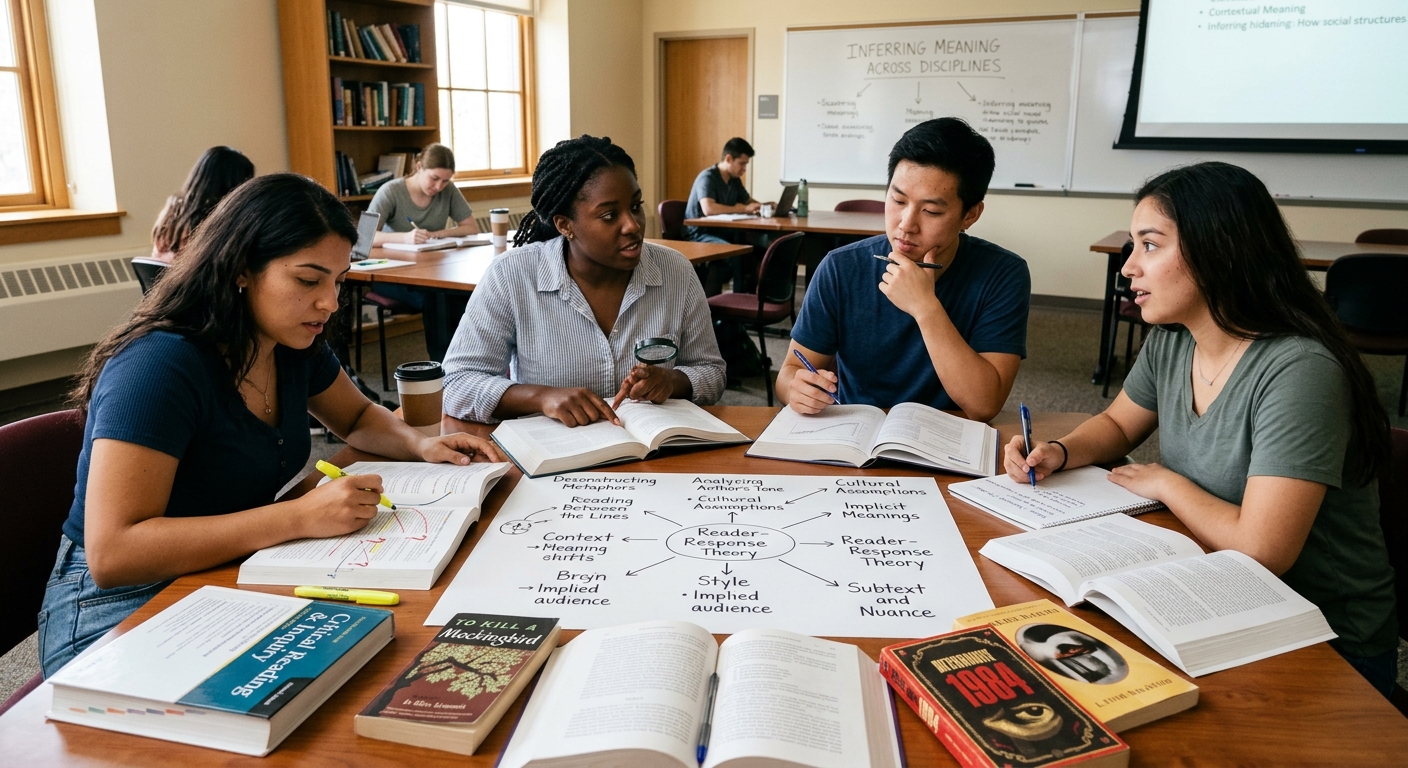
CHAPTER TWO: INFERRING MEANINGS FROM VARIOUS TEXTS
📖 Read Between the Lines — Master the Art of Critical Reading and Interpretation
🎯 UNLOCK THE HIDDEN MEANINGS BEHIND EVERY WORD
Every text carries more than meets the eye. Behind the literal words lie subtle meanings, implied messages, emotional undertones, and unspoken intentions. Can you read them?
This comprehensive chapter teaches you to move beyond surface-level reading and develop the critical skills needed to interpret texts accurately — whether you’re analyzing academic papers, deciphering social media posts, or understanding everyday conversations.
The key? Understanding that word choice matters in communication.
✨ WHAT YOU’LL MASTER
🔹 The Power of Implied Meanings
Discover how words and sentences often carry meanings far beyond their literal definitions. Learn to read critically, interpret accurately, and communicate with precision. Through engaging real-world activities like the “Teacher’s Feedback” and “Late Student” scenarios, you’ll develop the ability to catch what’s really being said — even when it’s not spoken directly.
🔹 Denotation vs. Connotation
Master the crucial difference between a word’s literal dictionary definition (denotation) and its emotional, cultural, or personal associations (connotation) . Understand why “home” evokes warmth and security while “snake” suggests danger and betrayal. Learn how this distinction transforms your ability to:
Read persuasively
Analyze advertising and poetry
Avoid misinterpretation in academic and professional contexts
🔹 Recognizing Tone and Attitude
Tone isn’t just about what you say — it’s about how you say it. Learn to identify and interpret the 11 common tones used in writing and speech:
Authoritative Edgy Casual
Confident Inspirational Friendly
Formal Humorous Sarcastic
Serious Sympathetic —
Discover how the same utterance can express shock, disapproval, anger, doubt, or enthusiasm depending on emphasis and context. Master the cues — word choice, punctuation, sentence structure, pitch, volume, and body language — that reveal true meaning.
🔹 Figurative Language & Irony
Learn to decode metaphors, similes, personification, and irony. Understand how figurative language communicates hidden meanings in social media, songs, literature, and everyday conversations.
🔹 Inferences from Context
Develop the ability to draw logical conclusions from contextual clues. Learn how to piece together implicit messages in academic texts and real-world scenarios.
🔹 Hedging & Academic Caution
Master the art of hedging — the cautious language used by academic and professional writers to express ideas carefully and respectfully. Learn to distinguish between direct claims and hedged statements, and understand why hedging is essential for credibility.
Examples of Hedging Expressions: may, might, appears to, suggests that, could, possible, indicates, seems
Compare:
❌ Direct: “Diet directly improves performance.”
✅ Hedged: “The evidence suggests a possible connection between diet and performance.”
Learn why changing a tentative hypothesis into an absolute fact is academically dishonest — and how to avoid this mistake in your own writing.
📖 WHAT’S INSIDE
Section What You’ll Learn
Introduction to Implied Meanings How language conveys both explicit and implicit messages; why word choice matters
Interpreting Implied Meanings Real-world activities and exercises that demonstrate how meaning hides beneath the surface
Denotation vs. Connotation Detailed comparison table with practical activities for developing your interpretive skills
Recognizing Tone and Attitude The 11 common tones with clear examples; how to read verbal, audio, and visual cues
Hedging in Academic Writing Why cautious language matters; common hedging expressions; practice rewriting direct claims
Paragraph Analysis Step-by-step analysis of a real academic paragraph; identifying hedging and understanding author’s attitude
Revision & Discussion Questions Thought-provoking questions to test and deepen your understanding
🎓 PERFECT FOR:
✅ Students preparing for examinations that test reading comprehension and critical analysis
✅ University students who need to interpret academic texts and write with appropriate caution
✅ Professionals who want to communicate more effectively and understand hidden workplace messages
✅ Writers and communicators seeking to master tone, nuance, and persuasive language
✅ Anyone who wants to read between the lines and understand what people really mean
💡 KEY FEATURES
📝 Real-World Activities & Exercises
Learn through doing! This chapter includes:
“The Teacher’s Feedback” — an ambiguous statement analysis
“The Late Student” — literal vs. implied meaning exercise
Denotation/Connotation practice with words like hare, lice, man, village, and woman
Hedging identification and rewriting exercises
Paragraph analysis with detailed breakdown
📊 Comparison Tables
Clear, easy-to-reference tables for:
Denotation vs. Connotation
The 11 common tones with descriptions and examples
Hedging expressions and their functions
⚠️ Critical Thinking Prompts
Revision and discussion questions that challenge you to apply what you’ve learned to real-world contexts, including:
How denotation/connotation confusion leads to misinterpretation
How inference improves critical reading
How figurative language and irony communicate hidden meanings in social media and songs
Guidelines for inferring meaning from academic texts
🔍 Practical Analysis Skills
Learn to identify:
Hedging words in academic passages
Author’s attitude and stance
The difference between tentative hypotheses and absolute claims
How tone changes meaning entirely
🌟 WHY THIS CHAPTER IS DIFFERENT
Most reading guides focus on what a text says. This chapter teaches you how to understand what a text means — including everything it doesn’t say directly.
Real-world scenarios that mirror everyday communication challenges
Practical exercises that build skills incrementally
Clear frameworks for identifying tone, hedging, and implied meaning
Critical thinking questions that prepare you for examinations and real-life interpretation
Academic focus that ensures you can apply these skills to essays, research papers, and professional documents
📈 YOUR READING JOURNEY STARTS HERE
By the end of this chapter, you will be able to:
✔️ Distinguish between explicit and implicit meanings in texts
✔️ Identify and interpret denotation and connotation accurately
✔️ Recognize and analyze tone and attitude in written and spoken communication
✔️ Detect hedging language and understand its purpose in academic writing
✔️ Draw logical inferences from contextual clues
✔️ Apply critical reading skills to academic texts, social media, literature, and everyday conversation
✔️ Communicate with greater nuance, precision, and awareness
🛒 GET YOUR COPY TODAY
Don’t just read words — understand them deeply.
Whether you’re preparing for exams, writing academic papers, navigating workplace communication, or simply wanting to become a more perceptive reader and listener, this chapter gives you the tools to unlock meaning at every level.
Read smarter. Interpret accurately. Communicate with confidence.
📚 MITIHANI POPOTE
Quality educational resources wherever you are.
Your trusted partner in academic excellence.
Empowering learners through accessible, high-quality educational content — because quality education should know no boundaries.
© MITIHANI POPOTE | Quality educational resources wherever you are.


Reviews
There are no reviews yet.