
Description
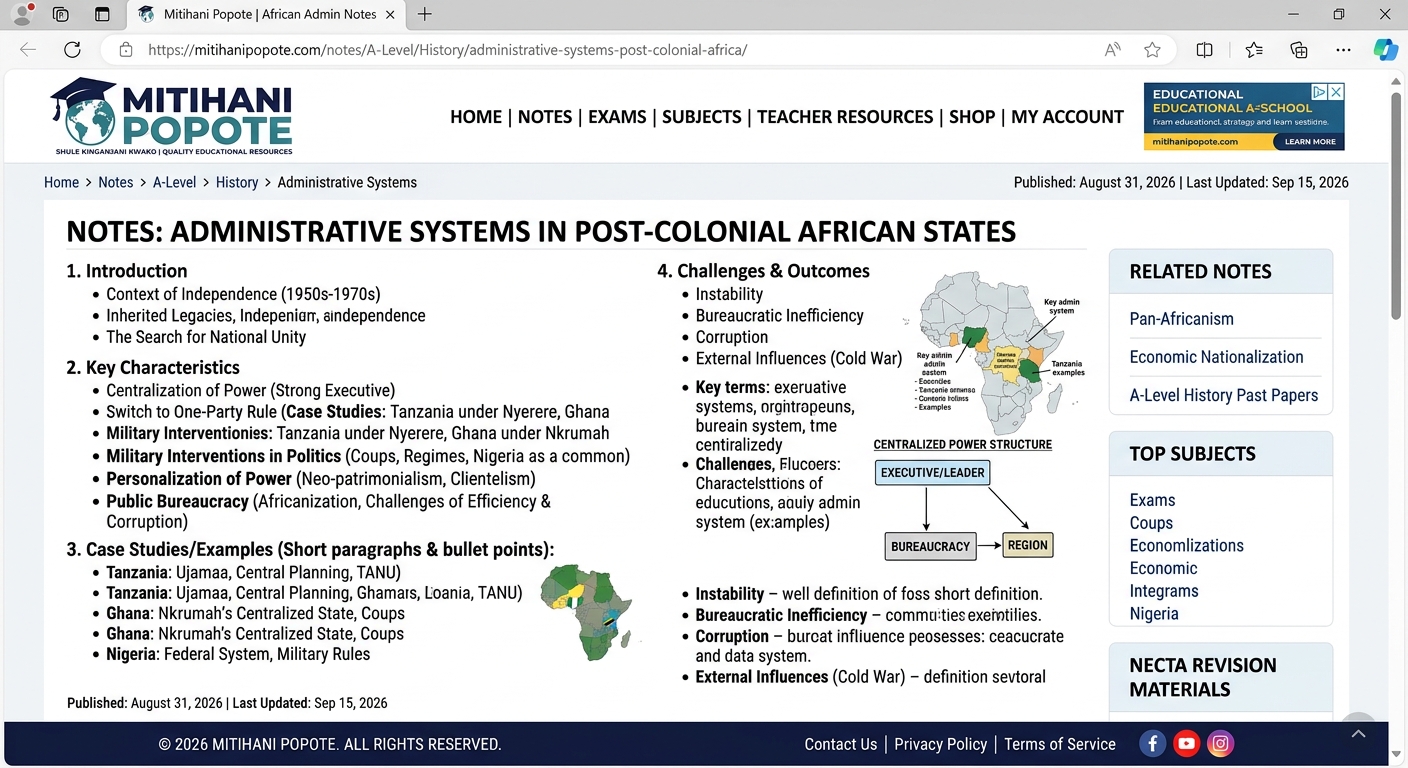
Administrative Systems in Post-Colonial African States – Comprehensive Study Guide (Form Five History)
Master Africa’s Journey from Colonial Legacy to Self-Governance — From Inherited Bureaucracies to Single-Party States, Military Rule, and Democratic Transitions
This expertly structured study guide breaks down one of the most relevant and examinable topics in African history into clear, organized, and highly digestible sections. Whether you are preparing for national examinations, revising for class tests, or seeking a deeper understanding of how African states built their administrative systems after independence, this guide is your essential companion.
📖 What’s Inside
1. The Nature and Character of African Administrative Systems
The colonial legacy: a centralized, hierarchical, and bureaucratic state apparatus designed for control and resource extraction
Alien structures: administrative systems foreign to indigenous political traditions (centralized kingdoms and decentralized, kinship-based societies)
Arbitrary boundaries: borders drawn at the Berlin Conference (1884–85) with little regard for ethnic, cultural, or linguistic divisions
The dual character of the state: a modern, formal bureaucratic apparatus coexisting with informal, traditional, and ethnic loyalties
Core challenges at independence:
Nation-building: forging a cohesive national identity among diverse ethnic groups
State legitimacy: moving beyond the coercive authority of the colonial state
Development: the state as the leading driver of economic and social progress
Managing divisions: navigating ethnic, regional, and religious differences
2. The Forms of Administrative Systems Adopted in Africa Since Independence
The initial democratic experiment (early 1960s):
Multi-party parliamentary systems modeled on the Westminster model (Ghana, Nigeria, Tanzania)
Short-lived due to instability, ethnic polarization, and ineffective governance
The single-party state:
Rationale: multi-party politics seen as a divisive luxury; a single party as a tool for national unity and development
Characteristics: party fused with the state, opposition banned or co-opted, “participatory democracy” claims
Examples: Tanzania under TANU/CCM, Kenya under KANU (after 1969), Zambia under UNIP
Outcome: often led to authoritarianism, power concentrated in a small elite, little accountability
Military rule:
Causes: perceived corruption and inefficiency of civilian governments, political instability and ethnic conflict, the military’s self-perception as the most organized institution
Characteristics: suspension of the constitution, banning of political parties, rule by decree, Supreme Military Council or junta
Justification: framed as a temporary measure to “cleanse” the political system
Examples: Nigeria (1966–1979, 1983–1999), Ghana (1966–1969, 1972–1979, 1981–1992), Uganda (1971–1979, 1985–1986)
Outcome: severe authoritarianism, human rights abuses, economic mismanagement
Return to multi-party democracy (1990s):
End of the Cold War, internal and external pressure for political reform
The “third wave” of democratization: new constitutions, legalized opposition parties, multi-party elections
An imperfect transition, but a significant shift away from single-party and military models
3. Factors that Influenced the Varied Governance Systems in Africa
Historical factors:
Colonial legacy: British indirect rule vs. French direct rule
Nationalist movement: the nature and unity of the anti-colonial struggle
Artificial boundaries: building nations from highly diverse ethnic groups
Political factors:
Ethnic composition: the degree of diversity and intensity of ethnic competition
Leadership and personal ambition: committed developmental leaders (e.g., Nyerere) vs. those using the state for personal enrichment
Instability: recurrent political instability creating conditions for military intervention
Economic factors:
Underdevelopment: colonial legacy of economic dependence on a few primary commodities
Economic crises: falling commodity prices, corruption, and mismanagement
Inequality: stark economic inequalities correlated with ethnic or regional lines
Ideological factors:
Socialism/Nationalism: African socialism (e.g., Ujamaa) as justification for single-party states
Pan-Africanism: the desire for continental unity and liberation from neo-colonial influence
Cold War: global competition between the US and USSR influencing African regimes
✨ Key Features
Concise and Structured — Every topic broken down into clear sub-topics with detailed notes
Comparative Analysis — Single-party states, military rule, and multi-party democracy compared side by side
Real Country Examples — Tanzania, Ghana, Nigeria, Kenya, Zambia, and Uganda
Exam-Focused Content — Five revision questions after every sub-topic to test and reinforce understanding
Clear Definitions — Key concepts explained: dual character of the state, nation-building, state legitimacy, indirect rule, Ujamaa, and more
Historical Depth — Traces Africa’s governance journey from colonial legacy to the “third wave” of democratization
Contemporary Relevance — Connects historical governance choices to modern political debates across the continent
📝 Comprehensive Assessment Section
Questions for Sub-topic 1.1 (5 Questions)
Key features of the colonial administrative system inherited by independent African states
The “dual character” of the post-colonial African state and its two main components
How arbitrary colonial boundaries created challenges for nation-building
Primary challenges facing African leaders in establishing state legitimacy
How the colonial legacy created a contradiction between inherited structures and development goals
Questions for Sub-topic 2.1 (5 Questions)
Main reasons for the initial failure of multi-party democracy in the 1960s
The rationale behind the single-party state model and the problems it intended to solve
Key characteristics of military rule and the justifications given for seizing power
Comparison of the single-party state and military rule models
Key factors that led to the wave of democratization and return to multi-party systems in the 1990s
Questions for Sub-topic 3.1 (5 Questions)
How the nature of the colonial experience (British vs. French rule) influenced post-independence governance
How ethnic composition and the character of the nationalist movement shaped political trajectories
The role of economic factors (underdevelopment and crises) in political instability and military regimes
How African socialism (e.g., Ujamaa) provided a justification for the single-party state model
The extent to which the Cold War influenced the choice and nature of governance systems in post-colonial Africa
🎯 Who This Guide Is For
Form Five and Form Six History students preparing for national examinations
Teachers seeking a well-organized reference and teaching resource
Anyone interested in understanding Africa’s post-independence political evolution
Students preparing for regional and international examinations on African history and governance
Readers fascinated by comparative politics, nation-building, and democratization in Africa
⭐ Why Choose This Guide
✅ Curriculum-Aligned — Follows the official History syllabus structure
✅ Exam-Focused — Revision questions after every sub-topic mirror real examination formats
✅ Clear and Concise — Complex political and historical concepts explained in simple, accessible language
✅ Comprehensive Coverage — From the colonial legacy to single-party states, military rule, and the 1990s democratic transition
✅ Comparative Approach — Enables cross-country and cross-model analysis
✅ Real Country Examples — Tanzania, Ghana, Nigeria, Kenya, Zambia, and Uganda
✅ Contemporary Relevance — Connects historical governance choices to modern political debates and reforms
Order your copy today and take control of your success!
MITIHANI POPOTE — Quality educational resources wherever you are.



Reviews
There are no reviews yet.