
Description
GAS EXCHANGE AND RESPIRATION — Comprehensive Study Notes
A-Level Biology — Form Five
A comprehensive, exam-ready resource covering gas exchange surfaces, ventilation, respiratory gas transport, and all stages of cellular respiration — all in one clearly organized document.
📘 What’s Inside
1. Fundamental Concepts
Clear definitions: gas exchange, breathing/ventilation, transport of gases, cellular respiration, and combustion
Key distinctions table separating processes often confused in exams
Why organisms need gas exchange explained
2. Features of an Efficient Gas-Exchange Surface
Six key features fully explained: surface area, thin barrier, moisture, ventilation, blood supply, and permeability
Fick’s law applied qualitatively with the diffusion rate relationship
3. Gas Exchange in Mammals
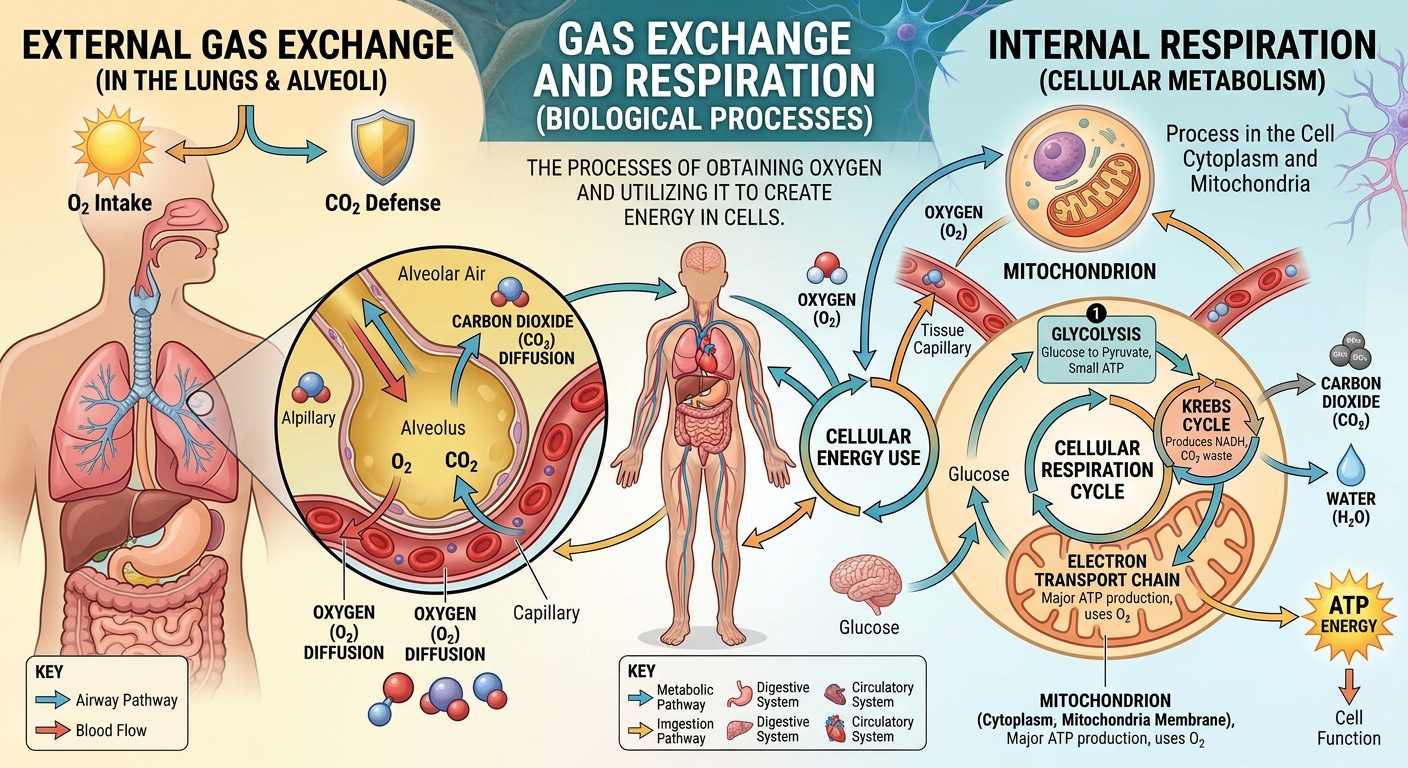
Labelled respiratory system diagram (trachea, bronchi, lungs, diaphragm)
Respiratory tract structures table — nasal cavity through pleural membranes
Labelled alveolar gas exchange diagram with diffusion arrows
How alveolar structure enables efficient exchange
4. Ventilation Mechanism
Labelled inhalation/exhalation flow diagrams
Step-by-step inhalation: diaphragm contraction, intercostal muscles, thoracic volume, pressure changes
Step-by-step exhalation, including forced expiration
Lung volumes and capacities table: tidal volume, IRV, ERV, residual volume, vital capacity, and TLC
5. Transport of Oxygen and Carbon Dioxide
Haemoglobin loading and unloading explained
Oxygen dissociation curve — why it is sigmoid, cooperative binding, right shift vs. left shift
Bohr effect fully explained
CO₂ transport forms table: hydrogencarbonate ions, carbaminohaemoglobin, and dissolved CO₂
Chloride shift explained
6. Gas Exchange in Other Animals
Comparison table covering fish, insects, earthworms, amphibians, and mammals
Counter-current exchange in fish gills explained
Insect tracheal system fully described
7. Gas Exchange in Plants
Labelled plant gas exchange diagram (stoma → intercellular spaces → mesophyll → mitochondrion)
Stomata and guard cell mechanism explained
Day vs. night gas exchange table
8. Cellular Respiration: Overview
ATP cycle diagram (energy → ADP + Pi → ATP → hydrolysis)
Aerobic respiration equation
Labelled stages diagram with locations
Mitochondrion structure related to function (cristae, matrix, intermembrane space)
9. Details of Aerobic Respiration Stages
Glycolysis — cytoplasm, net yield of 2 ATP and 2 NADH
Link reaction — decarboxylation, acetyl-CoA formation
Krebs cycle — citrate, decarboxylation, oxaloacetate regeneration
Electron transport chain and oxidative phosphorylation — chemiosmosis fully explained
Why ATP yield estimates differ (30–32 vs. older simplified totals) with exam guidance
10. Anaerobic Respiration and Fermentation
Comparison table: lactate fermentation, alcoholic fermentation, and true anaerobic respiration
Lactate fermentation pathway fully written out
Aerobic vs. fermentation comparison table
11. Respiratory Quotient (RQ)
Definition and formula
RQ values table for carbohydrates, lipids, proteins, and organic acids
Respirometer method fully explained with controls
12. Factors Affecting Respiration Rate
Temperature, oxygen availability, substrate availability, water availability, and tissue activity
13. Plants: Photosynthesis and Respiration Relationship
Comparison table showing when each occurs and their reactants/products
14. Practical Investigations
Four full investigations: CO₂ production, heat production, oxygen uptake with respirometer, and temperature effect — each with controls and variables
15. Common Errors and Examination Guidance
Eight common mistakes explicitly corrected — e.g., breathing doesn’t release energy, most CO₂ travels as hydrogencarbonate, plants respire continuously
16. Key Terms
Complete glossary of 12 essential terms
17. Examination Practice Questions
14 short-answer questions
6 structured/essay questions with mark allocations
18. Suggested Answer Frameworks
Model structures for alveolar gas exchange, ventilation, aerobic respiration, and respirometer questions
19. Final Revision Checklist
Seven-point self-assessment to track readiness
20. Scope and Source Note
✅ Why This Guide Works
Seven labelled diagrams — respiratory system, alveolus, ventilation flow, gas exchange in plants, ATP cycle, respiration stages, and mitochondrion
Every process shown in ordered steps — ventilation, gas transport, and all four respiration stages
All major comparison tables — respiratory structures, CO₂ transport forms, animal exchange surfaces, day/night gas exchange, and aerobic vs. fermentation
Practical investigations included — with controls, variables, and sources of error
Common errors explicitly corrected — turning frequent lost marks into easy wins
Exam-focused — practice questions, answer frameworks, and a revision checklist
Complete coverage — from Fick’s law to RQ calculations in a single document
MITIHANI POPOTE — Quality educational resources wherever you are.


Reviews
There are no reviews yet.