
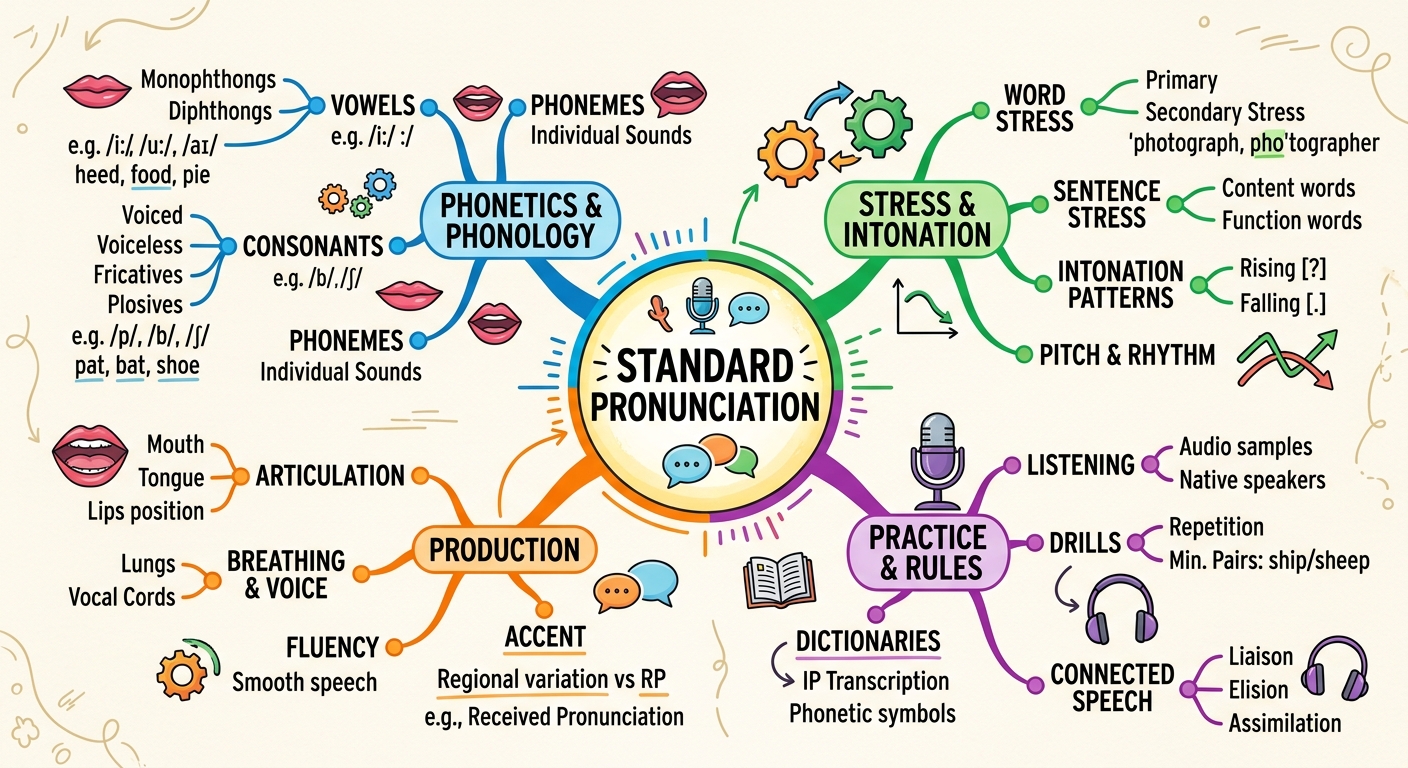
Description
STANDARD PRONUNCIATION — Complete Study Guide
Advanced Level English — Form Five
A comprehensive, exam-ready resource covering everything from phonemes and syllables to intonation, presuppositions, and levels of formality — all in one clearly organized document.
📘 What’s Inside
1. Introduction to Standard Pronunciation
Clear definitions of all key terms: pronunciation, standard pronunciation (RP), phoneme, phonetics, phonology, stress, intonation, and minimal pairs
2. Articulating English Sounds
Understanding phonemes — the 44 English phonemes explained (20 vowels + 24 consonants)
Vowel sounds classified: short vowels, long vowels, and diphthongs with examples
Consonant sounds classified: plosives, fricatives, affricates, nasals, approximants
The Phonemic Chart — complete visual organization of monophthongs, diphthongs, and consonants
Tanzanian context notes — common challenges such as /l/ vs /r/
3. Minimal Pairs
Definition and why they matter for pronunciation practice
Complete table of minimal pairs with the specific sound difference identified (e.g., /ɪ/ vs /iː/, /r/ vs /l/)
Tanzanian learner problem areas with targeted examples
4. Syllables and Syllable Division
5 reasons why syllables matter (pronunciation, spelling, reading, writing, fluency)
Worked syllable division table (chocolate, elephant, computer, etc.)
Tanzanian examples for classroom practice (Mwanza, Dar es Salaam, Kilimanjaro)
5. Word Stress
Definition and the concept of English as a stress-timed language
5 key rules for word stress: two-syllable words, -tion/-sion/-cian endings, -ic/-ical/-ology endings, compound words, and words with prefixes
Stress pattern examples with phonetic transcription
Heteronyms — words that change meaning with stress (PREsent/preSENT, RECord/reCORD, etc.)
Tanzanian classroom example sentences
6. Intonation
Definition and five functions: indicating statement type, conveying emotions, expressing attitude, organizing speech, and social meaning
Four intonation patterns fully explained:
Falling (statements, wh-questions, commands)
Rising (yes/no questions, lists, uncertainty)
Fall-rise (doubt, polite corrections)
Rise-fall (strong emphasis)
Sentence practice table matching sentences to intonation patterns
Tanzanian example: expressing anger, surprise, disbelief, and disappointment
7. Presuppositions
Definition and five reasons they matter (implicit communication, inference, social dynamics, avoiding misunderstandings, critical thinking)
Six types of presuppositions with examples:
Existential, Factive, Lexical, Structural, Non-factive, Counterfactual
10 worked example sentences with the presupposition identified for each
Tanzanian classroom examples
8. Levels of Formality
Definition and three factors affecting formality (relationship, setting, purpose)
All five registers explained with features and contexts:
Frozen, Formal, Consultative, Casual, Intimate
Three full sample dialogues (intimate, casual, consultative) with feature analysis
Tanzanian example: speaking to a teacher vs. a friend vs. a parent
9. Summary
10 key takeaways covering the entire chapter
10. Revision Questions
Five subtopic sections (5 questions each): Phonemes & Sounds, Syllables & Stress, Intonation, Presuppositions, and Levels of Formality
11. NECTA-Style Questions
Section A: 10 Short Answer Questions
Section B: 10 Structured Questions (with mark allocations, 5 marks per part)
Section C: 10 Essay Questions — exam-style discussion topics
12. Keywords Glossary
Complete definitions of every key term in the chapter
✅ Why This Guide Works
Tanzanian context throughout — every section includes examples relevant to Tanzanian learners and classrooms
Phonemic chart included — the complete organization of English sounds in one visual
All registers demonstrated — three full dialogues showing formality levels in action
Exam-focused — NECTA-style short answer, structured, and essay questions with mark allocations
Complete coverage — from phoneme definitions to critical thinking about presuppositions in a single document
MITIHANI POPOTE — Quality educational resources wherever you are.



Reviews
There are no reviews yet.