
Description
Business Regulatory Environment in Tanzania – Comprehensive Study Guide (Form Five Business Studies)
Master the Agencies, Policies, and Incentives That Shape Business in Tanzania — From TIC and TRA to SIDO, FCC, and the Tanzania Development Vision 2025
This expertly structured study guide breaks down one of the most practical and examinable topics in business studies into clear, organized, and highly digestible sections. Whether you are preparing for national examinations, revising for class tests, or seeking a deeper understanding of how government and non-government agencies regulate and support businesses in Tanzania, this guide is your essential companion.
📖 What’s Inside
Roles of Government and Non-Government Agencies in Regulating and Supporting Businesses
How government and non-government agencies play complementary roles in regulating and supporting medium-sized businesses in Tanzania
The provision of essential services such as information and financial assistance
How they create a conducive environment for medium-sized businesses and contribute to the country’s economic development
Why business stakeholders need knowledge of the laws and regulations governing the business environment in Tanzania
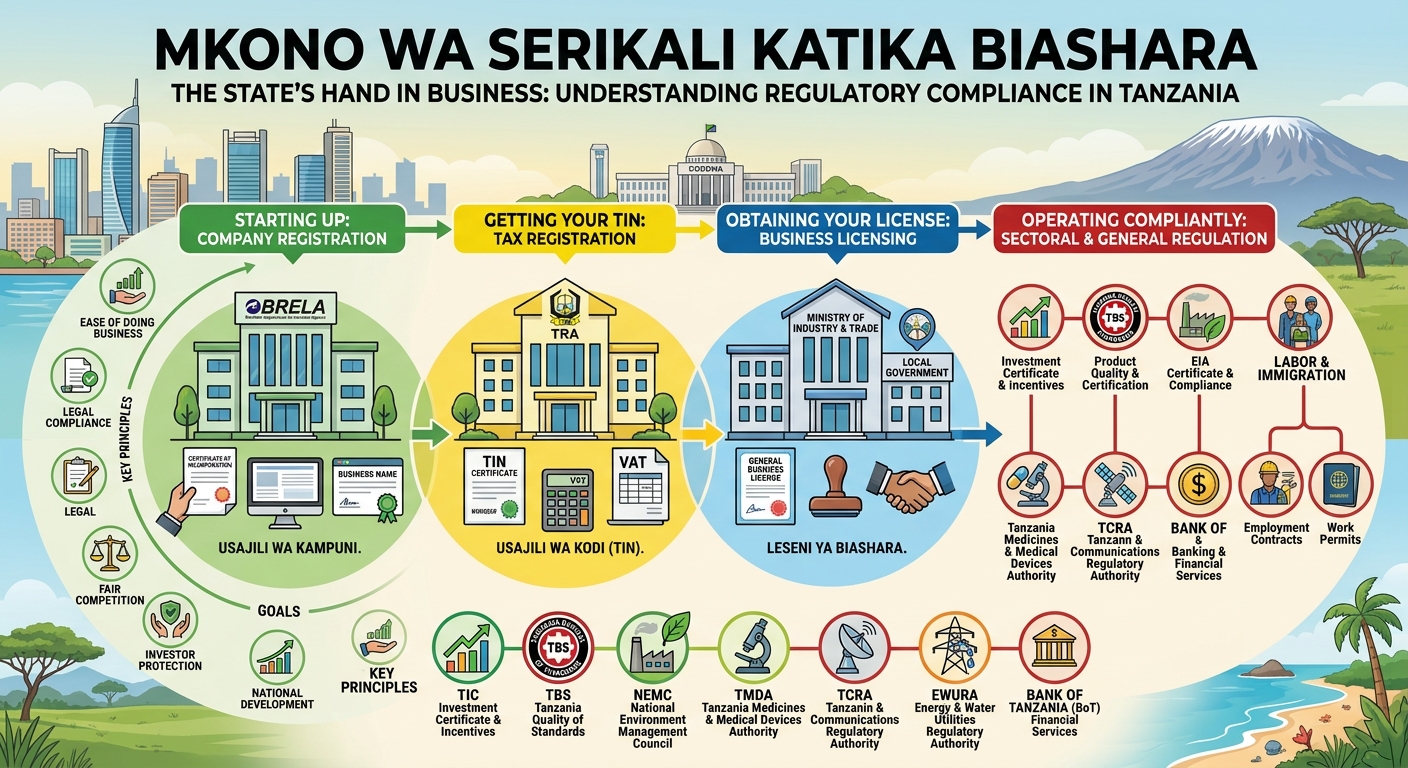
Tanzania Investment Centre (TIC)
Established in 1997 under the Tanzania Investment Act (1997), Cap 38, Revised Edition (R.F.) 2022
The primary agency responsible for promoting and facilitating investments in Tanzania
Key activities: coordinating, promoting, and facilitating investment; advising the government on policy matters to create a competitive, attractive, and sustainable investment climate
Mandate: attracting domestic and foreign investors, facilitating business registration and licensing, and providing advisory services
Support for medium-sized businesses: navigating the investment landscape, obtaining investment certificates, permits, and licenses
Zanzibar Investment Promotion Authority (ZIPA)
Established in 1986; initially a department under the Ministry of Finance and Economic Affairs of Zanzibar
Officially became an Authority under Act No. 4 of 2018
Responsible for promoting and facilitating investments in Zanzibar
Mandated to ensure a conducive business environment, process approval for new investments, facilitate incentives, and provide all necessary permits to investors
Provides institutional support for economic development and ensures coherent economic and business policy formulation in Zanzibar
Tanzania Revenue Authority (TRA)
Established by Act of Parliament No. 11 of 1995; started operations on 1 July 1996
Responsible for overseeing tax administration and revenue collection in Tanzania
Medium-sized businesses are subject to corporate tax, Value-Added Tax (VAT), and payroll taxes
TRA ensures compliance with tax laws, providing guidance and assistance to medium-sized businesses
Offers online platforms and services for tax registration, filing, and payment, streamlining tax processes and enhancing compliance
In Zanzibar, the Zanzibar Revenue Authority (ZRA) works hand in hand with TRA to enhance tax administration
Tanzania Trade Development Authority (TanTrade)
Established by the Tanzania Trade Development Authority Act No. 4 of 2009
Replaced the Board of External Trade (BET, Act No. 5 of 1978) and the Board of Internal Trade (BIT, Act No. 15 of 1973)
Works to create a conducive environment for medium-sized businesses to operate and thrive
Facilitates access to markets, promotes export opportunities, and provides regulatory guidance
Organises international trade fairs creating platforms for medium-sized businesses to showcase products, expand networks, and explore new business opportunities both domestically and internationally
Small Industries Development Organisation (SIDO)
Established under Act No. 28 of 1973; established in October 1973 under the then Ministry of Trade, Industry, and Marketing
Originally tasked with developing the small industry sector; evolved to provide comprehensive support to medium-sized enterprise development
Provides access to infrastructure, technology, and skills development
Collaborates closely with other government agencies and international donors, including the Tanzania Bureau of Standards (TBS), Swedish International Development Cooperation Agency (SIDA), and the World Bank (WB)
Initiatives encompass technology development and transfer, contributing to the growth and competitiveness of medium-sized enterprises
Micro, Small, and Medium Industrial Development Agency (SMIDA)
Established by Act No. 2 of 2018 as an industrial development agency under the Ministry of Trade and Industries
Implements almost the same activities as SIDO in Zanzibar
Core functions: advise, develop, coordinate, promote, and offer every form of support to micro, small, and medium-sized industries in Zanzibar
Support spans from the early stage of formalisation, marketing of the product, to graduation of SMEs to large industry category
Facilitates affordable credit schemes and other financial and non-financial services through the Small and Medium Industrial Development Fund (SMIDF)
Fair Competition Commission (FCC)
Established under Act No. 8 of 2003
Ensures fair and competitive market practices in Tanzania
Mandated to intervene in markets to prevent anti-competitive behaviour, market dominance, price fixing, and other practices that could harm businesses and disrupt market stability
Fosters an environment where medium-sized enterprises and other businesses can compete fairly
Oversight extends to addressing abuse of domination and scrutinizing mergers and acquisitions that lead to market concentration detrimental to medium-sized businesses
Roles of Government Agencies in Promoting Businesses
Access to finance: Tanzania Commercial Bank (TCB) and Tanzania Agricultural Development Bank (TADB) provide financial support through loans, grants, and subsidies
Specialized financing programs such as the Medium and Small Enterprises Credit Guarantee Scheme mitigate lending risks
Collaboration with international development partners and microfinance institutions to expand access to financial services
Capacity building: SIDO and the Vocational Education and Training Authority (VETA) offer technical skills development, entrepreneurship training, and managerial capacity enhancement
Market development: trade facilitation measures, export promotion programs by TanTrade, and infrastructure development (transportation networks, customs procedures, trade corridors)
Tanzania Chamber of Commerce, Industry, and Agriculture (TCCIA)
Established in 1988
Facilitates the country’s transition from a centralized, planned economy to a more open, mixed economy embracing private ownership and entrepreneurship
Collaborates closely with international organisations and the Tanzanian government
Advocacy efforts, capacity-building initiatives, and networking opportunities empower medium-sized businesses to navigate regulatory challenges, access market opportunities, and foster growth
Helps shape policies and regulations by facilitating dialogue between the private sector and government
Enhances access to resources, expertise, and market linkages
Zanzibar National Chamber of Commerce (ZNCC)
Established in 2007 as the Zanzibar National Chamber of Commerce, Industry and Agriculture (ZNCCIA)
Name shortened deliberately as a branding strategy to encompass all private sector players in Zanzibar
Apex body of the private sector in Zanzibar; acts as a voice of the private sector linking members to the government
Main functions: advocacy, training, networking, and information sharing
Specific activities: facilitation of all matters concerning trade, market opportunities, business advisory services, and entrepreneurial skills development
Tanzania Association of Micro-Finance Institutions (TAMFI)
Not-for-profit umbrella organisation for microfinance institutions in Tanzania
Formally registered in 2001 as the network for microfinance activities in the country
Seeks to develop the capability of microfinance institutions and the microfinance sector through advocacy, lobbying, research and development, responsible microfinance, capacity building, and information gathering and dissemination
Promotes and encourages the establishment of new products and related markets
Organises forums and meetings to promote communication among members, strengthen relationships, and transfer information and experience
Tanzania Private Sector Foundation (TPSF)
Formally incorporated under the Companies Act (Cap 212) as a company limited by guarantee on 4th November 1998
Purpose: promoting private sector-led social and economic development in Tanzania
Apex and focal private sector organisation; the voice of the private sector and the umbrella body for private sector associations and corporate bodies in all sectors
Members: business associations, corporate companies, multinationals, SMEs, start-ups, and working groups
Provides a platform for Public-Private Dialogue (PPD) at local, national, and international levels
Opens potential markets through business forums, participation in local and international trade fairs, and capacity-building programs
Roles of Non-Government Agencies in Promoting Businesses
Advocacy: engaging with the government on business environment issues; advocating for public-private dialogue, policy advocacy, and facilitating reforms at local and national levels; involving higher learning institutions for evidence-based policy research
Capacity building: customized training on business management, market access, financial management, and technology efficiency
Networking: platforms and avenues for the private sector to engage with suppliers, agents, distributors, policy makers, financiers or investors, development partners, and customers
Market access: programs providing market information, linkages to various markets, and preparation of exhibitions both locally and internationally
The Concept of Policies
Definition: guidelines, regulations, and measures established by governments or organisations to guide decision-making and achieve specific objectives
In promoting business enterprises, policies create an enabling environment to facilitate growth and sustainability
Policies unlock the full potential of entrepreneurship and enterprise development by aligning regulatory frameworks, incentives, and support programs with the needs and aspirations of businesses
Provide a framework of rules and regulations that support business activities by protecting property rights, ensuring legal certainty, and promoting fair competition
Encourage investment, entrepreneurship, and innovation by establishing a transparent and predictable operating environment
Address market failures and distortions that hinder efficient allocation of resources and business development
Importance of Policies in Promoting Business Enterprises
Creating an enabling environment: rules and regulations that support business activities, protect property rights, ensure legal certainty, and promote fair competition
Addressing market failures: targeting externalities such as information asymmetry, pollution, or monopolistic practices to promote market efficiency and competition
Facilitating access to resources: finance, technology, infrastructure, and labour through targeted interventions
Stimulating economic growth and development: encouraging investment, job creation, and productivity improvements; contributing to poverty reduction, income generation, and inclusive economic development
Ensuring social and environmental responsibility: regulations, standards, and incentives to address social and environmental challenges; Corporate Social Responsibility (CSR) initiatives and labour standards
Tanzania Development Vision 2025
Developed in the late 1990s to guide economic and social development efforts up to 2025
Aim: transforming Tanzania into a middle-income country and transforming the economy from a predominantly agricultural one to a diversified and semi-industrialized economy with a substantial industrial sector
Investment priorities: supporting medium-sized businesses to implement light manufacturing activities
Targeted industries: agro-processing, manufacturing of consumer durables, and assembly industries (processing of meat, leather, fruits, nuts, wood, and paper production)
The government anticipates attracting private sector investments vital to future growth and productivity
Details how the government undertakes to alleviate constraints to private sector participation: providing appropriate guidance, investing in ways that leverage private sector participation, making limited smart interventions, and nurturing collaborative action and effective state-business relations
National Investment Promotion Policy
Established in 1997 with the objectives of supporting maximum mobilization and utilization of domestic capacity, including cooperation with other countries
Promotes export orientation on domestic production of goods and services to enhance the development of the export sector
Encourages inflows of external resources to complement national efforts
Encourages and facilitates the adoption of new technologies
Enhances a transparent legal framework that facilitates the promotion and gives due guarantee of protection to all forms of investment activities
Key areas covered: tax incentives, investment guarantees, and preferential treatment for domestic investors
Tax Incentives
Definition: an aspect of government policy that lowers the amount of tax that individuals or businesses owe in order to encourage certain activities or achieve specific goals
The government of Tanzania offers various tax incentives to medium-sized businesses: tax holidays, reduced corporation tax, and exemptions from income tax, export and import duties, and Value-Added Tax (VAT) on certain products
Several laws and regulations provide room for tax incentives: the Zanzibar Investment Promotion and Protection Act No. 14 of 2018, the Value Added Tax Act Cap 148 revised edition of 2019, the Income Tax Act Cap 332 revised edition of 2019, and the East African Community (EAC) Customs Management Act of 2004 and its amendments
By reducing the tax burden on medium-sized enterprises, these incentives aim to enhance competitiveness, attract investment, and facilitate business expansion
Investment Guarantees
Definition: a form of financial protection offered by governments to investors to safeguard them against potential losses
The Tanzanian government provides investment guarantees to medium-sized businesses to mitigate risks and instill confidence
Forms: guarantees against nationalization and breach of contract, as well as guarantees for repatriation of profits and capital
By offering assurances of protection and stability, investment guarantees help attract long-term investment and foster a conducive business environment
For a medium-sized business to enjoy the investment guarantee, it has to register with TIC and enjoy the rights as provided in the Tanzania Investment Act No. 10 of 2022 (investment guarantees, access to land, and employing expatriates)
Investments are guaranteed against any form of expropriation; Tanzania is a signatory of several multilateral and bilateral agreements on the protection and promotion of foreign investment
Preferential Treatment for Domestic Investors
The government of Tanzania prioritizes domestic investment and offers preferential treatment to domestic investors including medium-sized businesses
Domestic investors benefit from preferential access to government procurement contracts, priority in obtaining licenses and permits, and eligibility for government-funded development programs and incentives
The government may provide financial support, technical assistance, and capacity-building programs specifically tailored to the needs of domestic investors
Access to the African Caribbean and Pacific-European Union (ACP-EU) framework signed on 15th November 2023 with the aim of mobilising investment, supporting trade and fostering private-sector development
Access to the African Growth Opportunity Act (AGOA) enacted on 18th May 2000 as Public Law 106 of the 200th Congress of the USA; renewed most recently in 2015, extended to September 2025; provides duty-free entry into the United States for almost all African products; Tanzania also qualifies for textile and garment benefits under AGOA
Access to the East African Community (EAC) Vision 2050 signed on 2nd March 2016 as implementation of the EAC treaty of 1999 aimed at promoting inter and intra-regional trade and investment; Tanzania’s priority areas include promotion of an investment and savings culture; the EAC also signed a Trade and Investment Framework Agreement (TIFA) with the USA in 2008
Industrial Policies
Definition: strategic initiatives designed by the government to facilitate the development and expansion of key sectors and industries within an economy
Aim at creating a favourable environment for businesses to thrive
Encompass several measures tailored to specific sectors: fiscal incentives, infrastructure development, research and development support, and regulatory reforms
In the context of medium-sized businesses, industrial policies provide frameworks and support mechanisms to overcome challenges and capitalize on opportunities
Include initiatives geared to streamline regulatory processes, reduce administrative burdens, and enhance access to finance and market opportunities
Effective industrial policies play a crucial role in promoting the growth and competitiveness of medium-sized businesses
Tanzania SME Development Policy of 2003
Aims at stimulating SMEs development and growth through improved legal and institutional framework, enhancement of services provision, and improvement of infrastructures
Intends to create an enabling environment for businesses to prosper in the country including medium-sized enterprises
Recognises four categories of businesses: micro, small, medium, and large-scale enterprises
Provides indicators for classifying businesses according to size based on number of employees and capital investment in machinery
National Trade Policy of 2003
Aims at transforming Tanzania’s economy by enhancing the competitiveness of domestic producers to participate in the global economy through trade liberalization
Focuses on increasing efficiency and linkages in domestic production to achieve a diversified competitive export sector
Aims at stimulating growth and development in the country
Sustainable Industrial Development Policy (SIDP)
SIDP of 1996 to 2020 emphasised on the promotion of small and medium-sized industries
Focused on simplification of business registration and licensing processes
Encouraged the simplification of taxation as well as the formalization of informal businesses in the country
Focused on the improvement of financial services accessibility
Focused on enabling youth, women, and people with disabilities to be involved in economic activities
Integrated Industrial Development Strategy (IIDS)
IIDS of 2025 is like an update of the SIDP as it focuses on ensuring that the objectives of SIDP are implemented
Emphasizes transformation in the agriculture sector by improving productivity from low to semi-industrialized
The private sector is considered as the vehicle for economic development
National Agricultural Policy (NAP)
NAP of 2013 aims at addressing the obstacles and problems in the development of the value chains in the agricultural sector
Problems addressed: poor quality of agricultural products, limited participation of the private sector, insufficient productivity, insufficient support services, over-dependency on rain, poor infrastructure and facilities, environmental deterioration, crop pests and diseases
Blueprint for Regulatory Reforms
The Blueprint for Regulatory Reforms of 2018 was established to provide an enabling business environment to improve business operations in the country
Emphasizes that government agencies should provide relevant information to the private sector
The private sector should be prioritized in the envisaged reforms because of their role in economic transformation in Tanzania
Chapter Summary Points
A concise recap of all key agencies, their roles, and the policies promoting medium-sized businesses in Tanzania
✨ Key Features
Concise and Structured — Every agency and policy broken down into clear sections with bullet-point key points
Comprehensive Coverage — From TIC, ZIPA, TRA, TanTrade, SIDO, SMIDA, FCC, TCCIA, ZNCC, TAMFI, and TPSF to the Tanzania Development Vision 2025, National Investment Promotion Policy, tax incentives, investment guarantees, and industrial policies
Real Tanzanian Context — Acts of Parliament, establishment years, and specific mandates for every agency
Balanced Analysis — Roles of both government and non-government agencies in regulating and supporting businesses
Exam-Focused Content — Structured key points and NECTA-standard questions designed for easy recall and revision
Clear Definitions — Key concepts explained: policies, tax incentives, investment guarantees, preferential treatment, industrial policies, and more
Summary Section — A concise recap of all key points for quick revision before examinations
📝 Comprehensive Assessment Section
NECTA Standard Questions (15 Questions)
Question One
(a) Explain the role of the Tanzania Investment Centre (TIC) in promoting medium-sized businesses in Tanzania
(b) Describe four services offered by the Tanzania Revenue Authority (TRA) that are relevant to medium-sized businesses
Question Two
(a) Differentiate between the roles of the Fair Competition Commission (FCC) and the Tanzania Trade Development Authority (TanTrade)
(b) Explain how the Tanzania Chamber of Commerce, Industry and Agriculture (TCCIA) supports medium-sized businesses
Question Three
Examine the importance of policies in promoting business enterprises in Tanzania (six points)
Question Four
(a) Explain the objectives of the Tanzania Development Vision 2025 in relation to medium-sized businesses
(b) Describe how the National Investment Promotion Policy of 1997 supports investment in Tanzania
Question Five
Discuss the tax incentives available to medium-sized businesses and explain how each incentive promotes business growth
Question Six
(a) Explain the role of the Tanzania Private Sector Foundation (TPSF) in promoting private sector development
(b) Describe the functions of the Zanzibar National Chamber of Commerce (ZNCC) in supporting businesses in Zanzibar
Question Seven
Assess the contribution of the Small Industries Development Organisation (SIDO) to the development of medium-sized enterprises
Question Eight
(a) Explain the concept of investment guarantees and describe how they benefit medium-sized businesses
(b) Describe the preferential treatments available to domestic investors in Tanzania
Question Nine
Evaluate the effectiveness of the Sustainable Industrial Development Policy (SIDP) and the Integrated Industrial Development Strategy (IIDS) in promoting medium-sized businesses
Question Ten
(a) Explain how the Blueprint for Regulatory Reforms of 2018 improves the business environment
(b) Describe the role of the National Agricultural Policy (NAP) of 2013 in addressing challenges in agricultural value chains
Question Eleven
Compare and contrast the roles of government agencies and non-government agencies in promoting medium-sized businesses
Question Twelve
(a) Explain the functions of the Micro, Small and Medium Industrial Development Agency (SMIDA) in Zanzibar
(b) Describe the role of the Tanzania Association of Micro-Finance Institutions (TAMFI) in developing the microfinance sector
Question Thirteen
Discuss the challenges facing medium-sized businesses in complying with the regulatory environment and suggest ways to address them
Question Fourteen
(a) Explain how the National Trade Policy of 2003 promotes the competitiveness of domestic producers
(b) Describe the role of the Tanzania SME Development Policy of 2003 in creating an enabling environment
Question Fifteen
“The regulatory environment in Tanzania is conducive for the growth of medium-sized businesses.” Discuss with reference to the roles of at least four government agencies
🎯 Who This Guide Is For
Form Five and Form Six Business Studies students preparing for national examinations
Teachers seeking a well-organized reference and teaching resource
Anyone interested in understanding the regulatory landscape for businesses in Tanzania
Students preparing for regional and international examinations on business and entrepreneurship
Entrepreneurs and business owners seeking to navigate the Tanzanian regulatory environment
⭐ Why Choose This Guide
✅ Curriculum-Aligned — Follows the official Business Studies syllabus structure
✅ Exam-Focused — NECTA-standard questions and structured key points designed for easy recall and revision
✅ Clear and Concise — Complex regulatory concepts explained in simple, accessible language
✅ Comprehensive Coverage — From TIC, TRA, SIDO, and FCC to the Tanzania Development Vision 2025, tax incentives, and industrial policies
✅ Real Tanzanian Context — Acts of Parliament, establishment years, and specific mandates for every agency
✅ Balanced Analysis — Roles of both government and non-government agencies
✅ Summary Section — A concise recap of all key points for quick revision before examinations
Order your copy today and take control of your success!
MITIHANI POPOTE — Quality educational resources wherever you are.




Reviews
There are no reviews yet.