
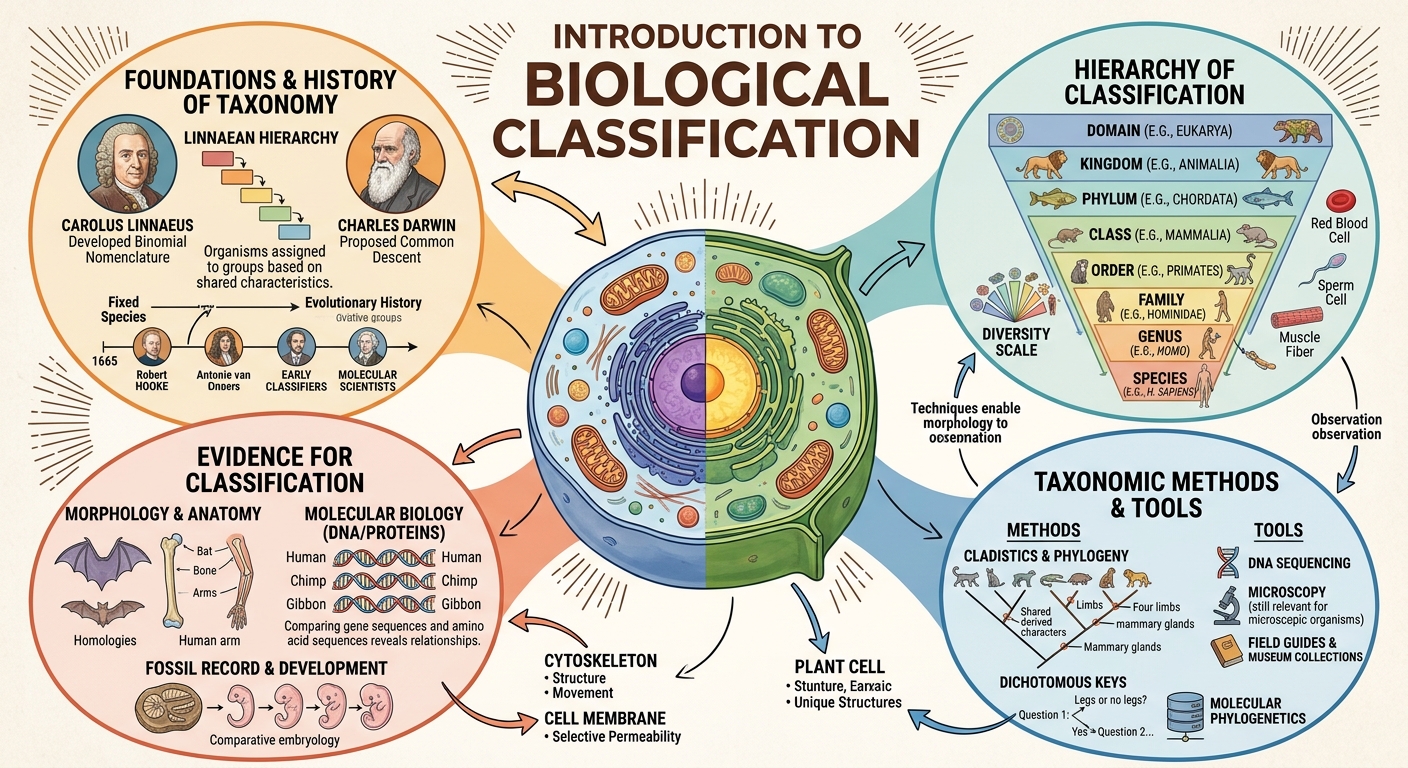
Description
PRINCIPLES OF CLASSIFICATION — Comprehensive Study Notes
A-Level Biology — Form Five (TIE Syllabus, Revised Edition 2024)
A comprehensive, exam-ready resource covering taxonomy, classification systems, taxonomic hierarchy, binomial nomenclature, and dichotomous keys — all in one clearly organized document.
📘 What’s Inside
1. The Concept of Classification
Clear definitions: classification, taxonomy, taxonomist, and taxon
Historical background — Aristotle, Carolus Linnaeus (Systema Naturae), and modern molecular approaches
Six reasons why classification matters, with a lion/leopard worked example
2. Classification Systems
Artificial system — merits and demerits fully explained with examples (flying/non-flying grouping)
Natural system — merits and demerits, using morphology, anatomy, embryology, and DNA evidence
Comparison table contrasting artificial and natural systems across evidence used, main purpose, evolutionary history, cost, and main weakness
Other approaches explained: phyletic, phenetics, and phylogenetics/cladistics — with the key reminder that similarity and relatedness are not identical
3. Taxonomic Ranks and Hierarchy
All seven ranks defined from Kingdom to Species
Hierarchy diagram showing general → specific progression
Full worked example: human classification (Animalia → Chordata → Mammalia → Primates → Hominidae → Homo → Homo sapiens)
Relationships among ranks explained, plus the biological species concept and its limitations
4. Nomenclature and Binomial Nomenclature
Definition of nomenclature and binomial nomenclature
All eight rules for writing scientific names — capitalisation, italics/underlining, Latinisation, abbreviation, and author citation
Table of correct forms with meanings (Zea mays, Panthera leo, Escherichia coli, sp. vs. spp.)
Why scientific names matter
Common examination errors highlighted (capitalisation, italics, reversing genus/species)
5. Taxonomic Keys
Definition and diagnostic features explained
Six-step procedure for using a dichotomous key
Eight-step procedure for constructing one
Indented vs. bracketed keys compared
Full worked example: a four-organism key (bird, bat, grasshopper, spider) with test runs
Qualities of a good key — mutually exclusive alternatives, observable features, and correct numbering
6. Key Terms for Quick Revision
Complete glossary table of 15 terms: classification, taxonomy, taxonomist, taxon/taxa, taxonomic hierarchy, rank, nomenclature, binomial nomenclature, specific epithet, diagnostic feature, couplet, lead, and clade
7. Examination Practice
Section A: 15 Short-Answer Questions
Section B: 5 Structured/Essay Questions including a key-construction task
8. Suggested Answers and Marking Points
Full answer guide for all 15 short-answer questions
Essay marking guidance — how to structure comparison, hierarchy, nomenclature, and key-construction answers
Final examination reminder distinguishing classification, taxonomy, nomenclature, and identification
9. Source and Scope Note
Notes aligned to TIE Biology for Advanced Secondary Schools, Form Five, Chapter Two
✅ Why This Guide Works
Every classification system compared in tables — artificial vs. natural, phenetics vs. phylogenetics
Binomial nomenclature rules with correct and incorrect examples — the most commonly examined skill
Full worked dichotomous key — both how to use one and how to build one, with test runs
Suggested answers included — not just questions, but model answers and marking guidance
Exam-focused — common errors highlighted and a final reminder on easily confused terms
Complete coverage — from Aristotle to cladistics in a single document
MITIHANI POPOTE — Quality educational resources wherever you are.



Reviews
There are no reviews yet.