
Description
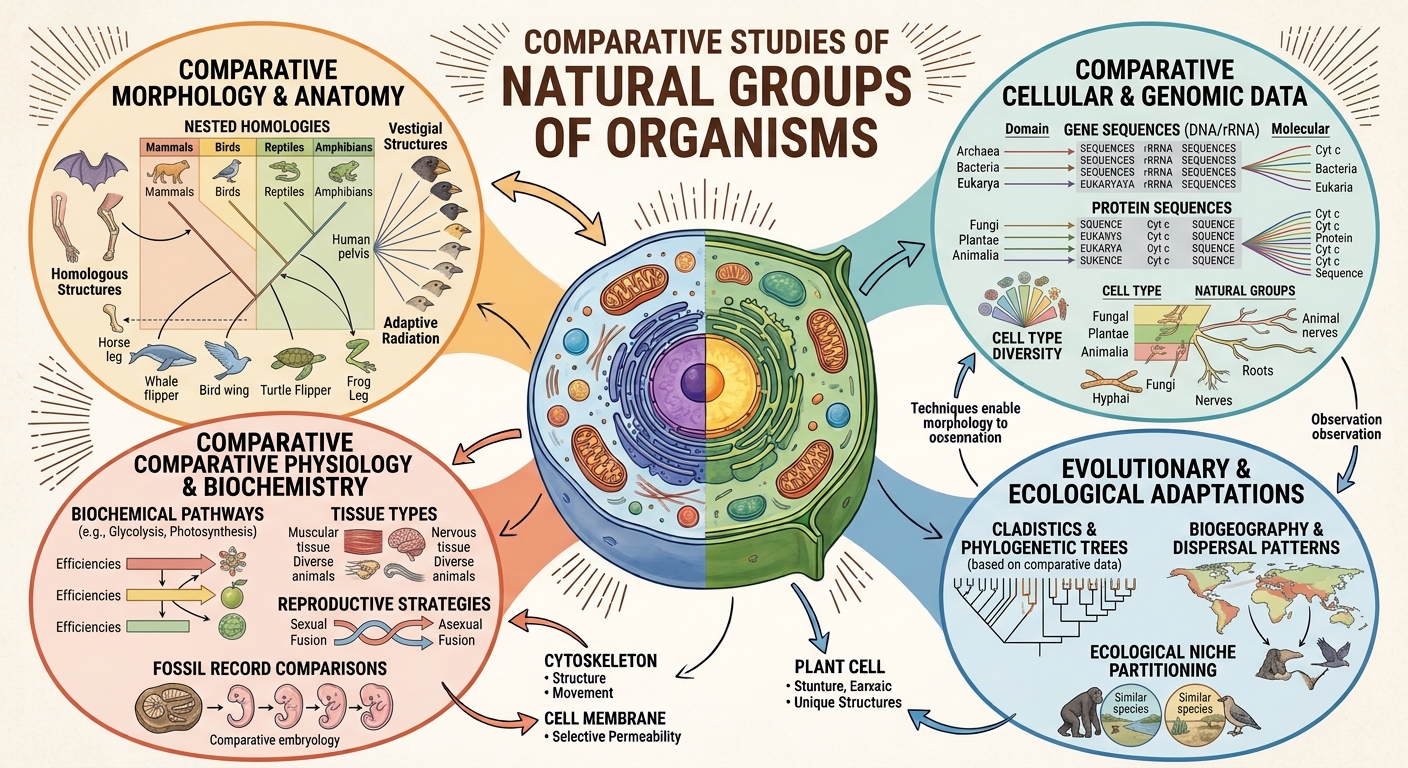
COMPARATIVE STUDIES OF NATURAL GROUPS OF ORGANISMS — Comprehensive Study Notes
A-Level Biology — Form Five (TIE Syllabus, Revised Edition 2024)
A comprehensive, exam-ready resource covering bacteria, protocists, fungi, plants, and animals — plus viruses — compared under identical headings, all in one clearly organized document.
📘 What’s Inside
1. Meaning and Basis of Natural Groups
Definition and eight major comparison criteria: cell type, cellularity, cell wall, nutrition, body organisation, reproduction, movement, and genetic/evolutionary evidence
The key insight that a single feature is never enough (e.g., fungi and plants both have cell walls but differ in composition and nutrition)
2. Overview of the Principal Groups
Summary table comparing all five groups across cell organisation, cell wall, nutrition, and typical examples
Broad cell-organisation comparison
3. Bacteria
Labelled diagram of a typical bacterial cell (nucleoid, ribosomes, cytoplasm, capsule, flagellum, pili)
Main features: size, shapes (cocci, bacilli, vibrios, spirilla), Gram-positive vs. Gram-negative walls
Reproduction by binary fission, plus horizontal gene transfer (transformation, transduction, conjugation)
Nutrition (photoautotrophic, chemoautotrophic, heterotrophic) and ecological roles — decomposers, nitrogen fixers, disease, biotechnology
4. Protocists
Definition of this diverse eukaryotic group
Main features: nucleus, membrane-bound organelles, aquatic habitats, varied movement (pseudopodia, cilia, flagella)
Five representative organisms fully described: Amoeba, Paramecium, Euglena, Plasmodium, and Spirogyra
5. Fungi
Main features: chitin walls, no chlorophyll, septate vs. coenocytic hyphae
Extracellular digestion explained (saprotrophic, parasitic, mutualistic)
Labelled mould structure diagram showing sporangia and mycelium
Five importance points — decomposition, food/fermentation, antibiotics, mycorrhizae, and disease
6. Plants
General characteristics: cellulose walls, chloroplasts, large vacuoles, alternation of generations
Major plant groups table: bryophytes, pteridophytes, gymnosperms, and angiosperms compared by vascular tissue, reproduction, and examples
Alternation of generations diagram showing sporophyte (2n) → meiosis → spores (n) → gametophyte (n) → fertilisation → zygote
7. Animals
General characteristics: no cell walls, ingestion, movement, sexual reproduction, embryonic blastula
Major invertebrate divisions table — Porifera through Chordata, with characteristics and examples
All five vertebrate classes tabulated — fish, amphibians, reptiles, birds, and mammals compared by body covering, respiration, temperature regulation, and reproduction
Important note on “Pisces” as a traditional rather than phylogenetic grouping
8. Comparative Synthesis
Master comparison table across all five groups: cell type, typical cells, cell wall, chloroplasts, nutrition, and organisation
Similarities and differences clearly summarized
9. Viruses: An Important Comparison
Why viruses are acellular and excluded from the five cellular groups
Structure, host dependence, and distinction from cellular organisms
10. Examination Skills and Common Errors
Eight common mistakes explicitly corrected — e.g., don’t call fungi plants, don’t confuse spores with seeds, don’t say all protocists are unicellular
11. Revision Questions
12 revision questions covering definitions, comparisons, life cycles, and classification reasoning
12. Suggested Answer Points
Model answer guide for selected questions, plus an essay framework for long comparative answers
13. Source and Scope Note
Notes aligned to TIE Biology for Advanced Level Secondary Schools, Chapter Three, with transparency about the scanned source
✅ Why This Guide Works
Every group compared under identical headings — exactly how examiners ask for comparisons
Five labelled diagrams — bacterial cell, mould structure, alternation of generations, and more
All five vertebrate classes and nine invertebrate divisions tabulated
Viruses given their own section — the most commonly confused “sixth group”
Common errors explicitly corrected — turning frequent lost marks into easy wins
Exam-focused — suggested answers, essay framework, and revision questions included
Complete coverage — from bacteria to chordates in a single document
MITIHANI POPOTE — Quality educational resources wherever you are.


Reviews
There are no reviews yet.