
Description
COORDINATION AND IRRITABILITY — Comprehensive Study Notes
A-Level Biology — Form Five (TIE Syllabus, Revised Edition 2024)
A comprehensive, exam-ready resource covering nervous and hormonal coordination, sensory receptors, plant responses, and phytohormones — all in one clearly organized document.
📘 What’s Inside
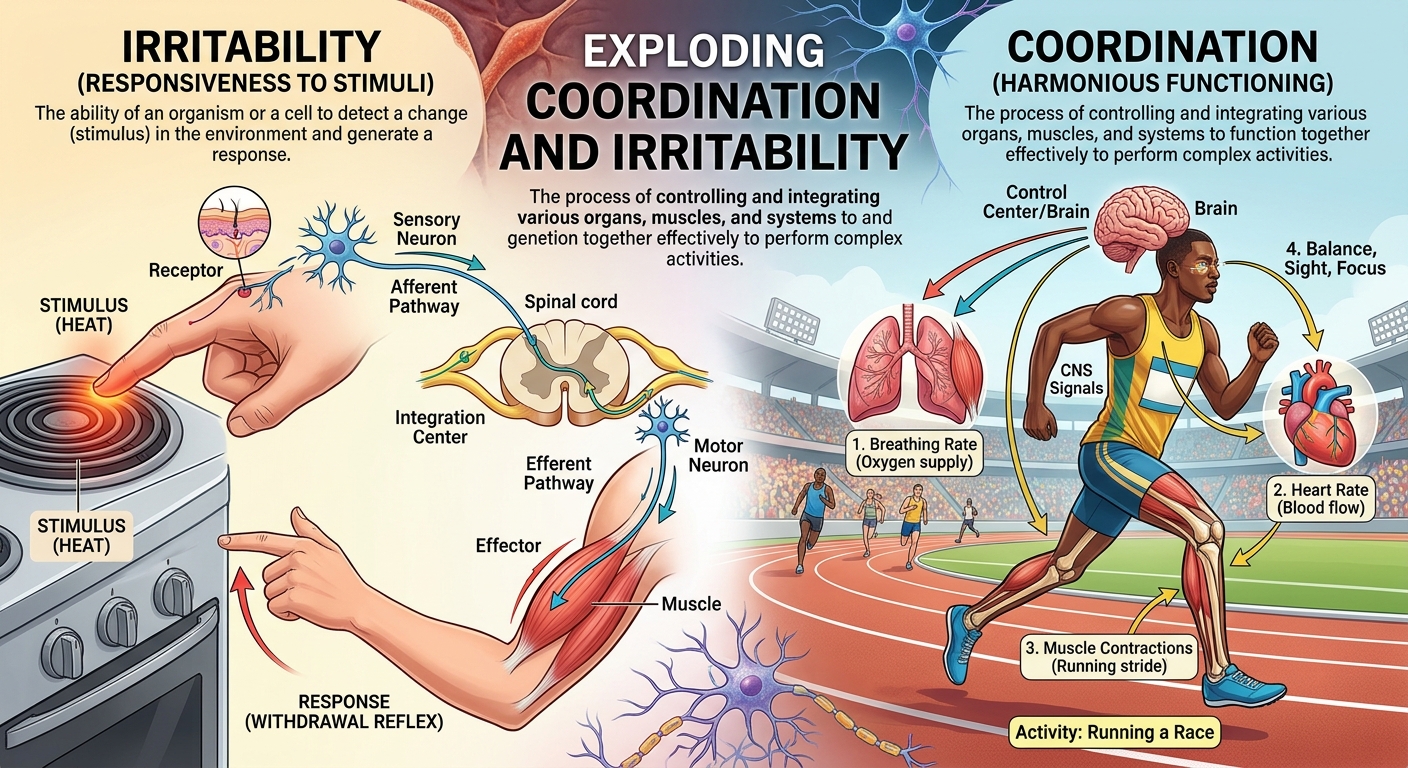
1. Meaning of Coordination and Irritability
Clear definitions: irritability, coordination, stimulus, receptor, and effector
Five reasons why coordination matters, including homeostasis
The general response pathway (stimulus → detection → integration → action → change) with a hot-object reflex example
2. Nervous Coordination in Mammals
Nervous system divisions table: CNS, PNS, somatic, and autonomic
Labelled motor neurone diagram with all parts explained (dendrites, axon, myelin sheath, nodes of Ranvier, terminals)
Three neurone types compared: sensory, relay, and motor
Action potential fully explained in five stages — resting potential, depolarisation, repolarisation, refractory period, and restoration
Labelled action potential graph (depolarisation, repolarisation, hyperpolarisation)
Saltatory vs. continuous conduction explained
Synaptic transmission in six steps with labelled synapse diagram
Brain regions table: cerebrum, cerebellum, medulla oblongata, hypothalamus, thalamus, and spinal cord
Sympathetic vs. parasympathetic table (fight or flight vs. rest and digest)
3. Reflex Actions and Reflex Arcs
Definition and five-step reflex arc pathway
Withdrawal reflex worked example
Four reflex types: unconditioned, conditioned, spinal, and cranial
Reflex vs. voluntary action comparison table
4. Sensory Receptors
Classification by stimulus: mechanoreceptors, thermoreceptors, chemoreceptors, photoreceptors, nociceptors, and osmoreceptors — with examples
Classification by location: exteroceptors, interoceptors, and proprioceptors
Five receptor properties: specificity, sensitivity, adaptation, transduction, and receptive field
The human eye — labelled diagram, structures table, rods vs. cones comparison table, accommodation explained, and the pupil reflex
The human ear — structures table and the full hearing pathway
5. Hormonal Coordination in Mammals
Features of hormonal coordination and the endocrine system
Major endocrine glands table — hypothalamus, pituitary, thyroid, parathyroid, adrenal cortex/medulla, pancreas, ovaries, and testes
Negative feedback diagram and explanation
Blood glucose control fully diagrammed — insulin and glucagon in negative feedback loops
Selected hormones explained: ADH, thyroxine, adrenaline, insulin, glucagon, oestrogen, and progesterone
Diabetes mellitus table: Type 1 vs. Type 2 causes and features
6. Coordination in Plants
How plants coordinate without a nervous system
Plant responses table: tropism, nastic movement, and tactic response
All five tropisms explained: phototropism, gravitropism, hydrotropism, thigmotropism, and chemotropism
Labelled phototropism diagram showing auxin redistribution
Labelled gravitropism diagram comparing root and shoot responses
Nastic movements: thigmonasty (Mimosa), photonasty, and thermonasty
Tropism vs. nastic movement comparison table
7. Plant Hormones (Phytohormones)
Major plant hormones table: auxins, gibberellins, cytokinins, abscisic acid, and ethylene — with actions and applications
Auxin and apical dominance with labelled diagram
Hormone interactions explained (auxin–cytokinin balance, gibberellin–ABA opposition, ethylene interactions)
Six agricultural applications with a caution about concentration and timing
8. Nervous and Hormonal Coordination Compared
Comparison table across messenger, transport route, and speed
9. Homeostasis and Coordination
Definition and the role of receptors, control centres, and effectors
Homeostatic control table covering temperature, blood glucose, water potential, and calcium
10. Practical and Experimental Skills
Six-step protocol for investigating phototropism
Protocol for investigating Mimosa touch response
Variables explained: independent, dependent, controlled, and reliability measures
11. Key Terms for Examination Revision
Complete glossary
12. Examination Questions
18 short-answer questions covering every subtopic
6 essay/structured questions with multi-part mark allocations
13. Suggested Answer Points
Model answer guide for selected questions plus essay technique guidance
14. Source and Scope Note
Notes aligned to TIE Biology for Advanced Secondary Schools, Chapter Four, with transparency about the scanned source
✅ Why This Guide Works
Six labelled diagrams — motor neurone, action potential, synapse, eye, phototropism, and gravitropism
Every process shown in numbered steps — action potential, synaptic transmission, reflex arc, and hearing pathway
All major comparison tables — sympathetic/parasympathetic, rods/cones, reflex/voluntary, tropism/nastic, nervous/hormonal
Homeostasis integrated — glucose, temperature, water, and calcium all in one table
Practical experiments included — with variables and reliability guidance
Exam-focused — 18 short-answer questions, 6 structured essays, and model answer points
Complete coverage — from neurone structure to plant hormone applications in a single document
MITIHANI POPOTE — Quality educational resources wherever you are.


Reviews
There are no reviews yet.