
Description
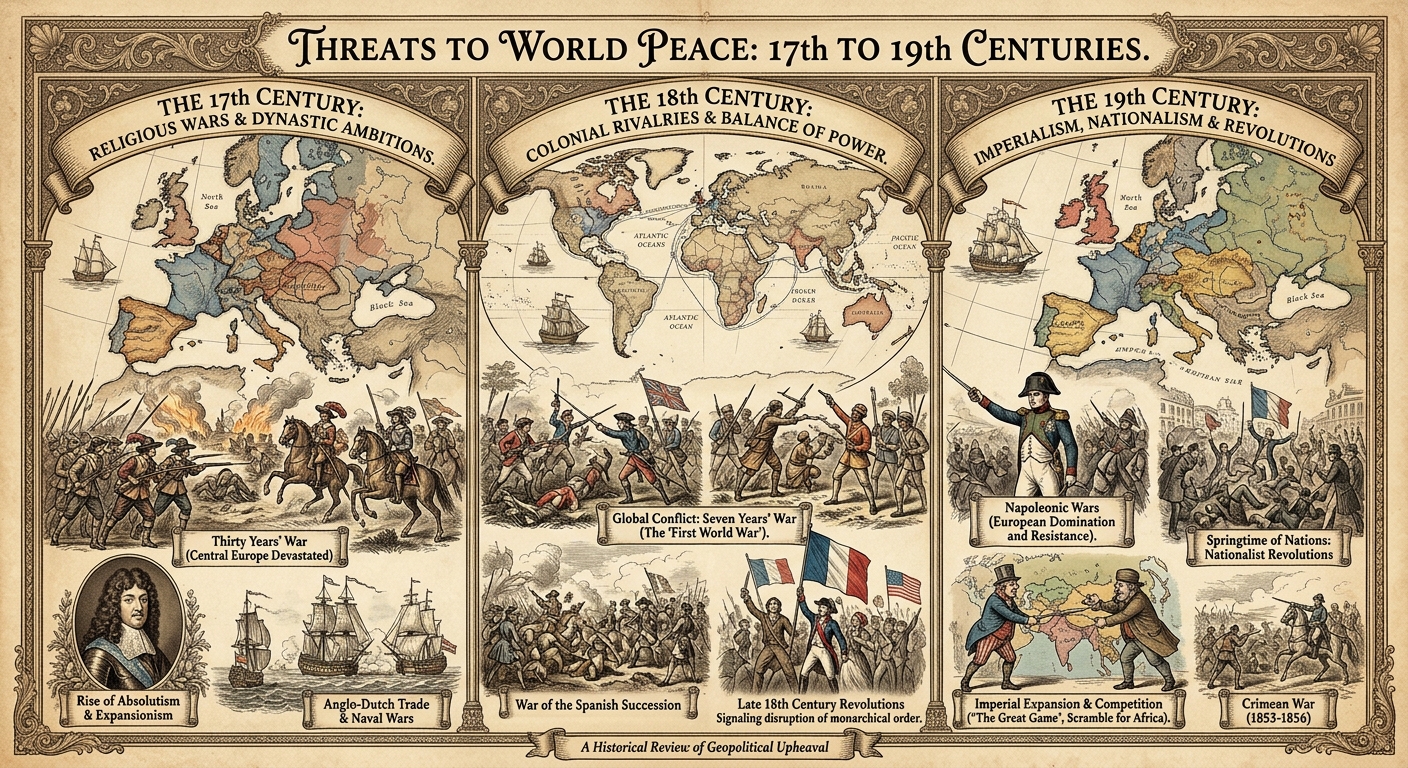
CHAPTER 1: THREATS TO WORLD PEACE FROM THE 17TH TO 19TH CENTURIES
📚 Complete Study Guide — Comprehensive, Exam-Focused Notes
🔥 WHY THIS GUIDE IS ESSENTIAL
This is not just another history summary. It is a complete, meticulously structured study companion that transforms a dense academic chapter into a powerful learning tool. Whether you are a student preparing for national examinations, a teacher seeking ready-made content, or a lifelong learner exploring the forces that shaped the modern world — this guide delivers clarity, depth, and exam-ready precision.
🎯 WHAT THIS GUIDE COVERS
Introduction: Threats to World Peace
Colonial ambitions, religious conflicts, the rise of nation-states, political revolutions, economic rivalries, and human rights violations
Clear learning objectives to guide your study
The Concept of Threats to World Peace and Security
Definition and historical context — from the emergence of capitalism in the 15th century to the global system of the 17th century
Traditional security threats: religious persecution, territorial disputes, economic interests, conventional military conflicts, and military alliances
Mercantilism and expansionism — domestic unification vs. external conquest and colonization
The rise of global powers: Britain, France, Austria, Russia, Germany, and Italy
Realism in global security — why nations pursue distinct priorities
Features of Threats to World Peace and Security
Conflict-Inducing — wars, uprisings, rebellions, civil wars, and insurgencies
Civilian Suffering — loss of life, displacement, famine, and long-term societal scars
Resolved or Prevented Through Diplomacy — the Treaty of Westphalia, alliances, and peace conferences
The Great Wars: A Deep Dive
⚔️ The Thirty Years’ War (1618–1648)
Four phases fully detailed: Bohemian (1618–1625), Danish (1625–1629), Swedish (1630–1635), and French-Swedish (1635–1648)
The Defenestration of Prague — the immediate trigger
Causes: religious factors, power struggles among states, economic motivations, and the immediate trigger
Impact: political consequences, the Westphalia Peace Treaty terms, human and financial costs (4.5–8 million dead; Germany’s population decline of over 50%), military development (Gustavus’s innovations), social and cultural impact (witch-hunts, literature), and the scientific and intellectual aftermath
⚔️ The Napoleonic Wars (1803–1815)
Background: the French Revolution, the First and Second Coalitions
All the coalitions covered: Third (1803–1805), Fourth (1806–1807), Peninsular War and Fifth (1809), the Russian Campaign (1812), Sixth Coalition (1813–1814), and the Hundred Days and Seventh Coalition (1815)
Effects: political and nationalist effects, impact on Spanish and Portuguese empires, the Haitian Revolution and Louisiana Purchase, military innovations (mass conscription, aerial surveillance, semaphore communication), social and cultural impact, economic and industrial impact, military intelligence, the concept of total war, and the Congress of Vienna
⚔️ The Franco-Prussian War (1870–1871)
Causes in full: Prussian ambition, French fear, rivalry escalation, the Ems Dispatch manipulation, French decision for war, German mobilization, and the alliance situation
Course of the war — from the French invasion to the Siege of Paris and the proclamation of the German Empire at Versailles
Impact: the rise of German power, French humiliation and revanchism, collapse of the Second French Empire, military innovations, disruption of the European balance of power, diplomatic realignments, and global consequences
New Ideas as a Result of the Great Wars
📜 The Westphalian Treaty (1648)
Overview and the two treaties: Münster and Osnabrück
Key provisions: religious toleration, territorial adjustments, and constitutional changes
Impact on modern international relations: sovereignty principle, diplomatic peace negotiation, international law development, human rights during wartime, balance of power, religious tolerance, and treaty legacies
👑 Sovereignty
Definition and etymology — from Latin superanus and French suverainete
Historical context: Ancient Greece and Rome, the medieval period, Jean Bodin (1576), the Westphalia Peace Treaty (1648), Thomas Hobbes (1651), Jean-Jacques Rousseau (1762), the French Revolution (1789–1799), and the Industrial Revolution
Sovereignty and global peace — nation-state fusion and its challenges
⚖️ Balance of Power
Definition and historical evolution: Ancient Greece, 15th-century Italy, the 16th–17th centuries, the 18th century, and the 19th century
European balance of power in the 19th century: the Congress of Vienna (1815), major events, the superpowers, and influencing factors
Effects of the Vienna Congress and constraints of balance of power
🤝 Military Alliance
Definition — legally binding treaties vs. coalitions
Historical evolution: antiquity, the Middle Ages, and 17th–19th century Europe
Notable alliances: the Holy Alliance (1815), the Triple Alliance (1882), and the Triple Entente (1907)
Factors in alliance formation, characteristics of alliances, and their significance
📝 Discussion Questions for Exam Practice
Nine thought-provoking questions covering:
The changing nature of threats to world peace
The Peace of Passau and Peace of Augsburg’s influence on the Thirty Years’ War
The significance of the Westphalia Treaty
The importance of the balance of power in 19th-century Europe
The significance of military alliances in maintaining global peace
The contribution of great wars to military technology
Why countries form military alliances — and two advantages
Whether military alliances today contribute to peace or conflict
The extent of the Congress of Vienna’s success
✨ WHY THIS GUIDE STANDS OUT
Feature Benefit
Complete chapter coverage Nothing is left out — every section, phase, treaty, and concept is included
Structured for revision Clear headings, bullet points, and tables make revision fast and effective
Exam-focused Discussion questions at the end mirror real examination formats
Historical depth Dates, battles, treaties, and key figures are all precisely recorded
Conceptual clarity Complex ideas like sovereignty, balance of power, and military alliances are broken down into digestible explanations
Ready to use Perfect for students, teachers, and independent learners alike
📖 WHO IS THIS FOR?
Students preparing for history examinations at secondary and tertiary levels
Teachers looking for well-organized, comprehensive teaching material
Researchers needing a quick yet thorough reference on 17th–19th century conflicts
Lifelong learners curious about the wars, treaties, and ideas that shaped the modern world
🚀 HOW TO USE THIS GUIDE
Start with the Introduction to understand the scope and objectives
Read each section sequentially — the guide is designed to build knowledge progressively
Use the discussion questions to test your understanding and prepare for exams
Refer back to specific sections when you need quick revision on a particular topic
Compare and contrast the three great wars to understand patterns in conflict and diplomacy
💡 KEY TAKEAWAYS YOU WILL MASTER
How the Thirty Years’ War reshaped European politics and gave birth to the modern state system
How the Napoleonic Wars spread nationalism, liberalism, and the concept of total war across Europe and beyond
How the Franco-Prussian War created the conditions for World War I
How the Treaty of Westphalia established the principles of sovereignty and diplomatic negotiation that still govern international relations today
How sovereignty, the balance of power, and military alliances evolved as tools for maintaining — or disrupting — global peace
How to analyze and answer exam-style questions with confidence
📌 FINAL WORD
This guide is your complete companion to understanding one of the most transformative periods in world history. From the battlefields of Bohemia to the halls of Westphalia, from Napoleon’s sweeping campaigns to Bismarck’s calculated diplomacy — everything you need is here, organized, explained, and ready for your success.
MITIHANI POPOTE — Quality educational resources wherever you are.
Reviews
There are no reviews yet.