
Description
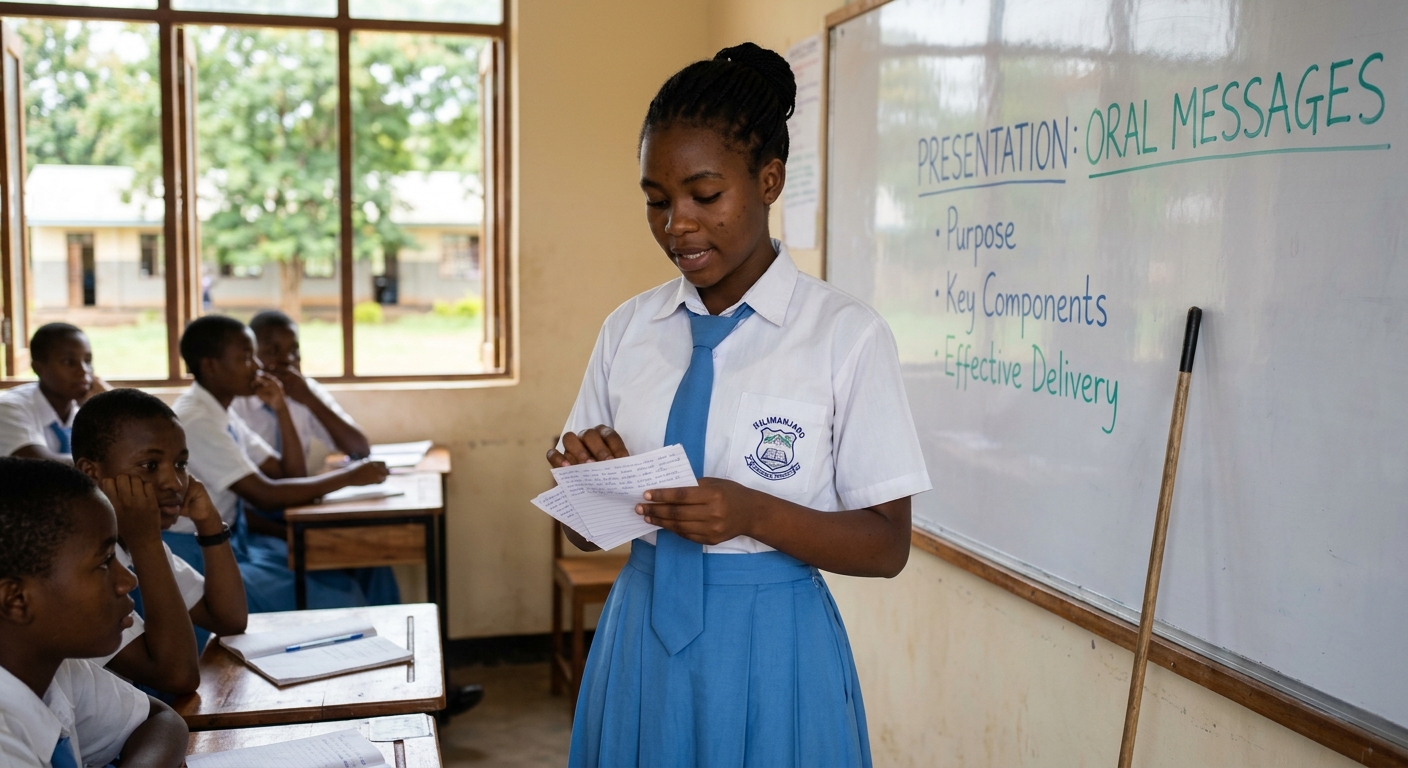
ORAL MESSAGES — Complete Study Guide
Advanced Level English — Form Five
A comprehensive, exam-ready resource covering everything from proverbs and connotative meanings to registers, rhetorical devices, phrasal verbs, and responding to oral messages — all in one clearly organized document.
📘 What’s Inside
1. Introduction to Oral Messages
Clear definitions of all key terms: oral messages, oral communication, register, denotative meaning, connotative meaning, rhetorical meaning, implied meaning, proverb, and phrasal verb
Five key reasons why understanding oral messages matters: effective communication, academic success, professional development, social integration, and critical thinking
2. Proverbs and Sayings
Definition and cultural significance
20 common proverbs fully explained, each with:
Meaning
Tanzanian equivalent (e.g., “Once bitten, twice shy” → Mwana aliyechomwa na moto…)
Example sentence
Covers: Once bitten twice shy, Actions speak louder than words, No pain no gain, Every cloud has a silver lining, Rome wasn’t built in a day, Kill two birds with one stone, The early bird catches the worm, Where there’s a will there’s a way, and more
3. Denotative and Connotative Meanings
Denotative meaning: the literal, dictionary definition
Connotative meaning: the emotional and cultural associations
Three types of connotation: positive, neutral, and negative
Comparison table showing denotative vs. connotative meanings for the same word (e.g., “economical” = frugal vs. stingy)
Full dialogue analysis (Feruzi and Sada) demonstrating how connotation shifts meaning in conversation
4. Registers
Definition and five types of registers: formal, informal, technical, literary, and colloquial
Three complete sample texts with feature analysis:
Text A: Formal register (speech)
Text B: Informal register (casual conversation)
Text C: Technical register (research report)
5. Rhetorical and Implied Meanings
11 rhetorical devices fully explained with examples: alliteration, anaphora, rhetorical question, onomatopoeia, simile, personification, metaphor, euphemism, parallelism, irony, and hyperbole
Definition of implied meaning and four reasons it matters
Full speech analysis on drug abuse — identifying rhetorical devices (repetition, rhetorical questions, imagery) and implied meanings
6. Phrasal Verbs
Definition and four key points: composition, importance, idiomatic nature, and versatility
Nine phrasal verbs from a story with meanings and example sentences (set out, ran into, hung out, came across, lost track of, head back, push through, make it, parted ways)
Additional phrasal verbs table
7. Responding to Oral Messages
Four key factors: active listening, critical thinking, self-confidence, and autonomy
Four techniques for responding with example phrases:
Clarification (“Could you please repeat that?”)
Paraphrasing (“So what you’re saying is…”)
Questioning (“Can you give an example?”)
Expressing opinions (“In my opinion…”)
8. Summary
10 key takeaways covering the entire chapter
9. Revision Questions
Five subtopic sections (5 questions each): Meanings, Registers, Rhetorical & Implied Meanings, Phrasal Verbs, and Responding
10. NECTA-Style Questions
Section A: 10 Short Answer Questions
Section B: 10 Structured Questions (with mark allocations, 5 marks per part)
Section C: 10 Essay Questions — exam-style discussion topics
11. Keywords Glossary
Complete definitions of every key term in the chapter
✅ Why This Guide Works
20 proverbs with Tanzanian equivalents — connecting English wisdom to local culture
All 11 rhetorical devices covered — with examples and a full speech analysis
Three register samples analyzed — formal, informal, and technical in action
Phrasal verbs from a story — showing them in natural context rather than as a list
Exam-focused — NECTA-style short answer, structured, and essay questions with mark allocations
Complete coverage — from literal vs. figurative meaning to responding with confidence in a single document
MITIHANI POPOTE — Quality educational resources wherever you are.



Reviews
There are no reviews yet.