
Description
Business Registration in Tanzania – Comprehensive Study Guide (Form Five Business Studies)
Master the Licenses, Certificates, and Procedures for Legally Operating a Business in Tanzania — From BRELA and BPRA to TIN, VAT, OSHA, and Intellectual Property Rights
This expertly structured study guide breaks down one of the most practical and examinable topics in business studies into clear, organized, and highly digestible sections. Whether you are preparing for national examinations, revising for class tests, or seeking a deeper understanding of how businesses are registered and regulated in Tanzania, this guide is your essential companion.
📖 What’s Inside
The Concept of Business Registration
Clear definition: the process of obtaining legal authorisation to start and operate a business in a given locality (also called business formalisation)
Involves registering the business, products, properties, documents, intellectual property, and more
Not limited to starting the business but also day-to-day operations
Evidence of registration: business licenses, permits, and certificates
A gateway towards achieving business performance which subsequently affects economic performance
Importance of Business Registration
Enhances freedom to do business: the government instructs business owners to operate with a valid business license issued by the respective Authority
Access to credit: registered businesses are more likely to access credit from financial institutions due to legal recognition and proper documentation
Market access: opens up opportunities for domestic and international markets, including government procurement contracts and export opportunities
Intellectual property rights: protects trademarks, patents, and industrial designs from infringement
Improves tax administration: enables the government to effectively administer taxes and collect revenue for public services
Facilitates planning process: provides the government with accurate data on businesses essential for economic planning and policy formulation
General Licenses
Broad permits, licenses, or certificates issued by LGAs, BRELA, or BPRA or their agencies
Acquired after applying for sectoral business licenses
Examples: business licenses, company registration certificates, business name registration certificates, certificates of compliance, Taxpayer Identification Number (TIN) certificates, VAT certificates, tax clearance certificates, incentive certificates, occupational safety and health certificates, and fire safety certificates
Business License
Issued upon registering the business; authorisation to start and operate
Tanzania Mainland: two classes
Class A: issued by the Ministry of Industry and Trade (MIT) through the Business Registrations and Licensing Agency (BRELA)
Class B: issued by Local Government Authorities (LGAs)
Zanzibar: BPRA is responsible for registering companies, firms (partnership and sole proprietorship), civil society, cooperative society, and public corporations
Company Registration Certificate (Certificate of Incorporation)
Companies must be registered or incorporated in the list of the Company Registrar
Tanzania Mainland: registered under the Company Act of 2002; certificate issued by BRELA
Zanzibar: registered under the Companies Act of 2013; certificate issued by BPRA
Confirms the formation and registration of a company
Business Name Registration Certificate
Issued to individuals, partnerships, or corporations to exclusively register a trading name
Individual business name: owned by one natural person or legal person
Business name for partners: owned by more than one natural person(s) and/or legal person(s)
Business name for a corporation: owned by a corporate body
BRELA registers business names in Tanzania Mainland; BPRA in Zanzibar
Certificate of Compliance
Provided to foreign companies established, registered, and operating in other countries
Required to operate in Tanzania
Awarded by BRELA (Tanzania Mainland) and BPRA (Zanzibar) to foreign companies intending to open branches
Confirms compliance with the registration requirements of the country
Taxpayer Identification Number (TIN) Certificate
A unique tax identification number for individuals, firms, or companies
Tanzania Mainland: upon company registration and acquisition of the incorporation number, the business must have a TIN granted by the Tanzania Revenue Authority (TRA)
The original TIN Certificate requires submission of requisite forms and documentation to the relevant tax authorities
Essential for tax administration and compliance
Businesses with annual turnover meeting the registration threshold of at least TShs. 200 million (Tanzania Mainland) and TShs. 100 million (Zanzibar) are required to register for VAT
VAT Certificate
Issued by TRA to businesses registered for Value Added Tax (VAT)
As at 2024, required by businesses with annual turnover of at least TShs. 200 million (Tanzania Mainland) and TShs. 100 million (Zanzibar)
Issued under Section 25 of the Value Added Tax Act No. 24 of 1997
Important for businesses required to charge and remit VAT
Tax Clearance Certificate
Issued by TRA (Tanzania Mainland) and ZRA (Zanzibar)
Confirms that the individual or business entity has complied with all tax obligations in a given period
Important for businesses seeking government contracts or loans from financial institutions
Demonstrates compliance with tax laws and regulations
Incentive Certificate
Holders are entitled to various investment incentives
Tanzania Mainland: Tanzania Investment Centre (TIC) issues incentive certificates
Zanzibar: Zanzibar Investment Promotion Authority (ZIPA) issues incentive certificates
A one-stop Centre for acquiring most licenses has been established in both cases
Investment incentives are given depending on conditions set by TIC and ZIPA
Occupational Safety and Health Certificate
Good health and safety of all workers are key factors for improving productivity
Responsibility of the government, employers, and workers to ensure safe and healthy workplaces
Regulations protect workers from traditional work hazards and new hazards (nano-technology, biological risks, biotechnology, chemical risks, and psychological stress)
Tanzania Mainland: Occupational Safety and Health Authority (OSHA)
Zanzibar: Department of Occupational Safety and Health (OSIH) in the Ministry of Work, Economic Affairs and Investment
Fire Safety Certificate
Business entities must ensure fire safety at the workplace
The Fire and Rescue Services Department under the Ministry of Home Affairs manages fire accidents, controls rescue services, and prevents disasters
Issued to businesses that comply with fire safety standards
Not differentiated between Tanzania Mainland and Zanzibar (the same ministry serves both sides)
Issued under the Fire and Rescue Force Act No. 14 of 2007
Pension Funds Registration
Employers must register their employees with pension funds
Pension funds secure the financial future of employees
Tanzania Mainland: National Social Security Fund (NSSF) serves private sector employees; Public Service Social Security Fund (PSSSF) serves public sector employees
Zanzibar: Zanzibar Social Security Fund (ZSSF) serves both public and private sector employees
Registration is a legal obligation for employers in Tanzania
Work Permit
Issued to non-citizens in Tanzania
Tanzania Mainland: Commissioner of Labour
Zanzibar: Labour Commissioner of Zanzibar
Five categories (Class A to E):
Class A: investors and the self-employed
Class B: prescribed professions (medical and health care professionals, experts in oil & gas, teachers and university lecturers in science and mathematics)
Class C: other professions
Class D: employees or foreigners engaged in approved religious and charitable activities
Class E: refugees
Residence Permit
Issued to non-citizens intending to live in Tanzania
Issued by the Commissioner General of Immigration Services in Tanzania Mainland and Zanzibar
Three types (Class A to C):
Class A: non-citizens who intend to engage in trade, business, professional activities, agriculture, animal husbandry, mineral prospecting, or manufacturing
Class B: foreigners who have obtained specified employment and have been issued a work permit by the Labour Commissioner
Class C: foreigners intending to reside for purposes other than A or B (students, researchers, volunteers, persons attending cases in Courts of Law, former employees winding up affairs, and persons attending medical treatment)
Intellectual Property Rights
Four types and their registration bodies:
Copyright: administered by the Copyright Society of Tanzania (COSOTA) in Tanzania Mainland and the Office of Copyright Society of Zanzibar (COSOZA) in Zanzibar
Patents: administered by BRELA or the African Regional Intellectual Property Organisation (ARIPO) in Tanzania Mainland; by BPRA or ARIPO in Zanzibar
Trademarks: administered by BRELA or ARIPO in Tanzania Mainland
Industrial designs: administered by BRELA or ARIPO in Tanzania Mainland
Important in protecting business secrets, industrial designs, and other forms of intellectual property
Sectoral Licenses
Sector-specific permits, licenses, or certificates issued by sector ministries or their agencies
Majority acquired before applying for general business licenses
In some instances, mandatory to acquire a sectoral license to operate the business
Examples: tourist agency license, insurance license, banking license, capital exchange and stock licenses, telecommunication and broadcasting licenses, mining licenses, explosive dealers license, customs agency license, medicine and medical devices permit, industrial license, shipping license, land transport license, air worthiness certificate and permits, merchant license, electricity license, petroleum dealers license, water dealers license, water drilling permit, gaming license, ammunition dealers’ license, crop board permits, export permits, and professional certificates
Essential for businesses operating in specific sectors to ensure compliance with sector-specific regulations
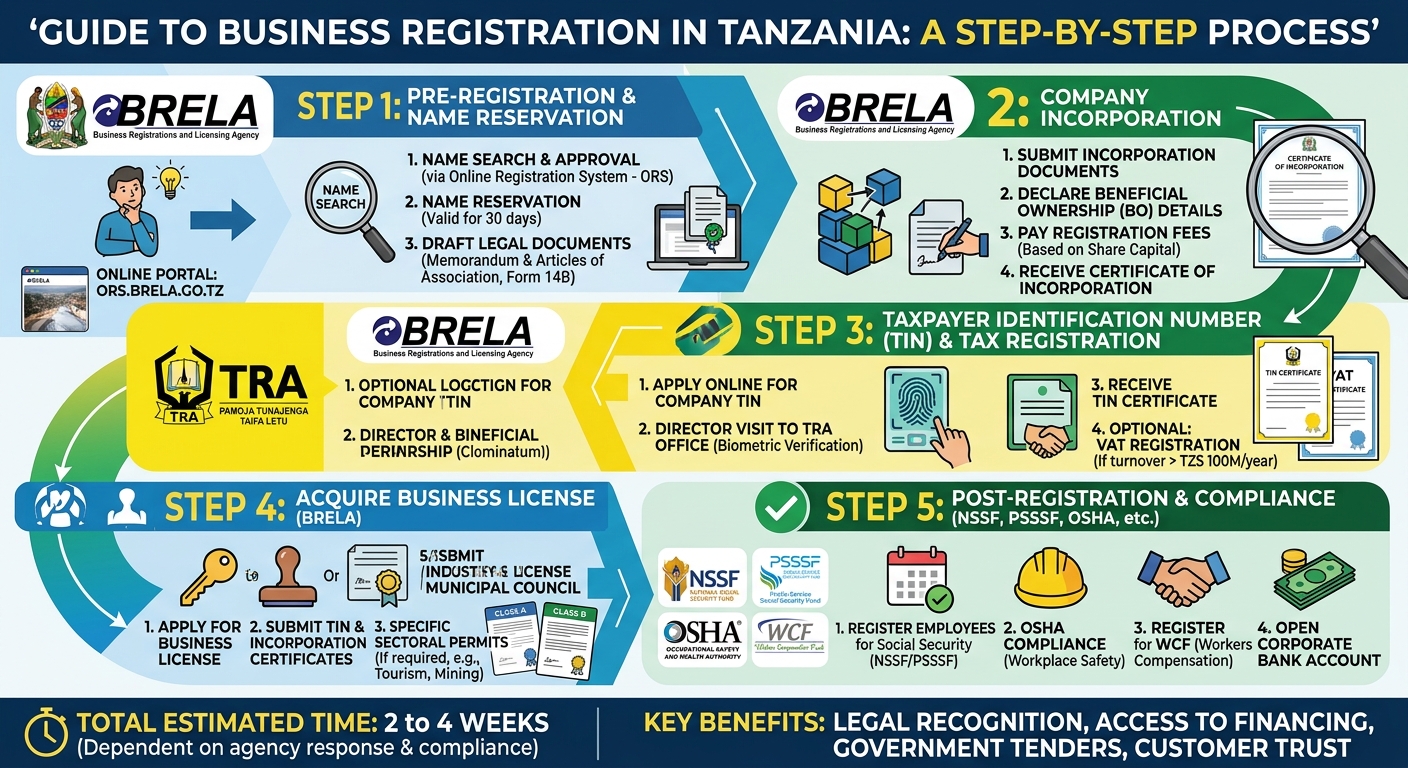
Procedures for Registering Businesses
Procedures vary depending on the type of license and locality (Tanzania Mainland and Zanzibar)
General procedures for business license, business name and company registration, and TIN acquisition are almost similar in both
Sectoral license procedures differ from one sector to another
Most applications are done online through the Online Registration System (ORS)
The procedures involve creating an account, name clearance, filling in the application form, uploading attachments, making and confirming payment, submitting the application, and receiving a decision from the agency
Procedures for Business Name Registration
Creating an account through the ORS via BRELA or BPRA website
Selecting the ‘registration of business names’ option from the ‘our-services’ menu
Name clearance: assessing other registered business names that are similar
Filling in the application form
Uploading the attachments
Making and confirming payment: a control number is generated for the registration fee and annual maintenance fee
Submitting the application; corrections may be required; if no corrections, the applicant receives an approval and certificate with the business name and business extract with director’s details
Procedures for Company Registration
Creating an account through the ORS via BRELA or BPRA website
Selecting the ‘registration of companies’ option
Selecting the type of company: foreign company, private company (limited by guarantee or shares), public company limited by shares, or unlimited private company
Filling in the application form as per details required
Uploading attachments: directors and shareholders details, certified copies of memorandum and articles of associations
Making and confirming payment; submitting the application; corrections may be required; if no corrections, the applicant receives an approval and certificate of incorporation
Procedures for Acquiring Business License from LGAs
LGAs offer business licenses for Class “B” businesses (established and operate in a specific local district/municipal area)
Opening an account: requires a national ID and TIN number; LGAs assign the applicant a representative role
Selecting the type of business license being sought
Filling the application form: principal business details and business contact information
Uploading the necessary details: title deed/lease agreement/sales agreement or residential license, birth certificate or passport, memorandum and articles of association, and certificate of incorporation
Decision from LGAs: rejection requires adjustments and resubmission; if no objection, a control number is issued for payment
Receiving the license: after payment, the applicant receives a business license; options to renew (one year or temporary one month), transfer (if location changed), or terminate
Procedures for Acquiring a Business License from BRELA or BPRA
BRELA and BPRA offer business licenses for Class A businesses (established and operate across the country and engage in international businesses)
Creating an account through the ORS
Selecting the preferred option (e.g., industrial license)
Filling in the application form: license owner, address, products, planned investment, license details, location, planned capacity, planned materials, and planned employment
Uploading the attachment
Making and confirming payment: a control number is generated
Submitting the application: corrections may be required; if no issues, the applicant receives an approval and business license
Procedures for Applying for a TIN Certificate
TRA and ZRA services are accessible online through the taxpayer portal
A pre-requisite is that one of the directors applying on behalf must have an individual TIN
Get an individual TIN for the applicant or director (resident or non-resident)
Fill in the Business TIN Registration Form
Estimate the income, tax payable, and payment installments
Upload/submit the necessary documents: certified memorandum and articles of association, introduction letter from LGAs, certificate of incorporation, certified lease agreement or title deed, and power of attorney
Submit the request to the Authority for review
Procedures for Registering with Pension Funds
Understand the eligibility requirements set by the pension funds (number of employees or sector)
Gather the required documents: registration documents, tax identification number, and employees’ details
Contact the relevant authority of the pension fund for guidance
Complete the application forms accurately and submit with supporting documents
Await approval; once approved, receive confirmation including the registration number and instructions for periodic contributions
Start making contributions on behalf of employees; necessary documents include a copy of certificate of incorporation or registration, TIN certificate, business license, and certificate of business name
Sanctions for Non-Compliance of Registered and Unregistered Medium-Sized Businesses
The first obligation is to register the business and acquire the necessary licenses before commencement
Sanctions differ depending on the type of license
Sanctions apply to both unregistered and registered businesses depending on the fault committed
Sanctions:
Failure to operate the business: a business entity that has not complied should not start the respective business; a medium-sized business is not expected to operate in Tanzania without a valid business license
Fines or penalties: the majority of Acts and regulations state fines or penalties for failure to acquire necessary licenses and permits
Imprisonment: some Acts and regulations suggest imprisonment due to non-compliance
Suspension, revocation, or de-registration of the license: if premises have ceased to be used for the purpose; if the business owner, manager, or person-in-charge has been convicted of any offence; if the business owner has become bankrupt or a company has gone into liquidation; failure to comply with any condition of the certificate of registration; submitted false information during application; and not complying with the laws governing the business
Fines or penalties after registration: changing location without notification, failure to file tax returns, carrying on business at any place not specified in the certificate, and failure to surrender a suspended, revoked, or cancelled certificate to the Registrar
Confiscation of property: tax evasion, trading of counterfeit or expired products, and trading in illegal or unregistered products
Chapter Summary Points
A concise recap of all key concepts: the definition of business registration, its importance, the types of licenses, the procedures for registering a business name, company, business license, and TIN, and the sanctions for non-compliance
✨ Key Features
Concise and Structured — Every license, certificate, and procedure broken down into clear sections with bullet-point key points
Comprehensive Coverage — From general and sectoral licenses to TIN, VAT, OSHA, fire safety, pension funds, work permits, residence permits, and intellectual property rights
Real Tanzanian Context — BRELA, BPRA, TRA, ZRA, TIC, ZIPA, OSHA, OSIH, NSSF, PSSSF, ZSSF, COSOTA, COSOZA, and ARIPO
Step-by-Step Procedures — Clear, numbered procedures for business name registration, company registration, LGA and BRELA/BPRA licenses, TIN certificates, and pension fund registration
Exam-Focused Content — Structured key points and NECTA-standard questions designed for easy recall and revision
Clear Definitions — Key concepts explained: business registration, business formalisation, Class A and Class B licenses, TIN, VAT, tax clearance, incentive certificates, work permits, residence permits, and intellectual property rights
Summary Section — A concise recap of all key points for quick revision before examinations
📝 Comprehensive Assessment Section
NECTA Standard Questions (15 Questions)
Question One
(a) Explain the concept of business registration and describe its importance to a medium-sized business in Tanzania
(b) Describe the types of general licenses that a medium-sized business is required to possess
Question Two
(a) Differentiate between Class A and Class B business licenses in Tanzania Mainland
(b) Explain the procedures for acquiring a business license from the LGAs
Question Three
(a) Describe the procedures for registering a business name in Tanzania
(b) Explain the procedures for registering a company in Tanzania
Question Four
Examine the sanctions that a medium-sized business may face for non-compliance with business registration requirements (six points)
Question Five
(a) Explain the importance of the TIN certificate to a medium-sized business
(b) Describe the procedures for applying for a TIN certificate from TRA
Question Six
(a) Explain the role of OSHA in ensuring workplace safety
(b) Describe the importance of the Fire Safety Certificate to a medium-sized business
Question Seven
Discuss the types of intellectual property rights available in Tanzania and explain the importance of protecting intellectual property for medium-sized businesses
Question Eight
(a) Explain the concept of sectoral licenses and describe five examples
(b) Describe the procedures for acquiring a business license from BRELA or BPRA
Question Nine
Assess the importance of business registration to the economic development of Tanzania (six points)
Question Ten
(a) Explain the procedures for registering with pension funds
(b) Describe the types of work permits and residence permits available to non-citizens
Question Eleven
Compare and contrast the business registration procedures in Tanzania Mainland and Zanzibar
Question Twelve
(a) Explain the circumstances under which a business license may be suspended, revoked, or de-registered
(b) Describe the situations in which the property of a medium-sized business may be confiscated
Question Thirteen
Discuss the challenges facing medium-sized businesses in complying with business registration requirements and suggest ways to address them
Question Fourteen
(a) Explain the importance of the Certificate of Compliance to foreign companies operating in Tanzania
(b) Describe the procedures for acquiring a Certificate of Compliance from BRELA or BPRA
Question Fifteen
“The business registration process in Tanzania is complex and time-consuming.” Discuss this statement with reference to the procedures for registering a business name, a company, and acquiring a business license
🎯 Who This Guide Is For
Form Five and Form Six Business Studies students preparing for national examinations
Teachers seeking a well-organized reference and teaching resource
Anyone interested in understanding the business registration landscape in Tanzania
Students preparing for regional and international examinations on business and entrepreneurship
Entrepreneurs and business owners seeking to navigate the Tanzanian registration process
⭐ Why Choose This Guide
✅ Curriculum-Aligned — Follows the official Business Studies syllabus structure
✅ Exam-Focused — NECTA-standard questions and structured key points designed for easy recall and revision
✅ Clear and Concise — Complex registration concepts explained in simple, accessible language
✅ Comprehensive Coverage — From general and sectoral licenses to TIN, VAT, OSHA, fire safety, pension funds, work permits, residence permits, and intellectual property rights
✅ Real Tanzanian Context — BRELA, BPRA, TRA, ZRA, TIC, ZIPA, OSHA, OSIH, NSSF, PSSSF, ZSSF, COSOTA, COSOZA, and ARIPO
✅ Step-by-Step Procedures — Clear, numbered procedures for every registration type
✅ Summary Section — A concise recap of all key points for quick revision before examinations
Order your copy today and take control of your success!
MITIHANI POPOTE — Quality educational resources wherever you are.



Reviews
There are no reviews yet.