
Description
CHAPTER 5: CIVIL AND ETHNIC WARS IN THE WORLD
📚 Complete Study Guide — Comprehensive, Exam-Focused Notes
🔥 WHY THIS GUIDE IS ESSENTIAL
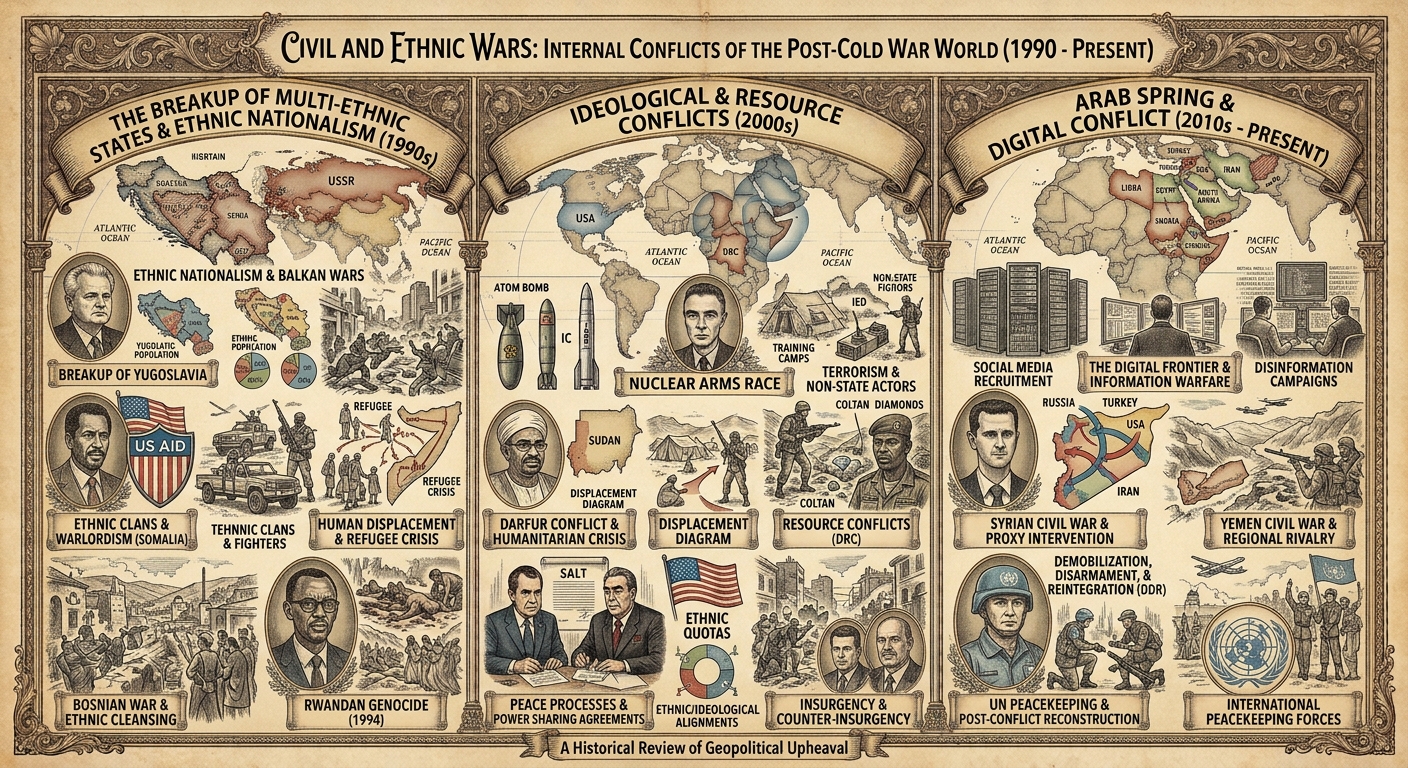
When neighbours turn against neighbours, when communities that once shared markets and schools are driven apart by identity and fear, the result is some of the most brutal conflicts in human history. From the killing fields of Cambodia to the genocide in Rwanda, from the shattered streets of Mogadishu to the besieged towns of Darfur and Yemen, civil and ethnic wars have claimed millions of lives, displaced countless millions more, and left deep scars that generations struggle to heal.
This guide transforms a complex, densely packed chapter into a clear, structured, and exam-ready study companion. Whether you are a student aiming for top grades, a teacher building lesson content, or a curious mind seeking to understand why communities turn to violence — and how peace can be rebuilt — this guide is your definitive resource.
🎯 WHAT THIS GUIDE COVERS
Introduction: The Concept of Civil and Ethnic Wars
Clear learning objectives — from understanding the concept and nature of these wars to exploring peacebuilding approaches and developing competencies to promote unity
Key theme: Civil wars and the struggle for power
Definitions and Types
Ethnic wars — armed conflicts fought between or among ethnic groups sharing common cultural characteristics (language, history, beliefs, values), often within a defined territory, arising from ethnic rivalries, identity-based grievances, and competition for power and resources
Four types of ethnic conflict — between groups within a state, between an ethnic group and the state, separatist movements, and revolutionary movements
Civil wars — conflicts among groups within a population, organized, large-scale violence carried out through collective action, associated with widespread internal strife, mass killings, destruction of property, and displacement
Key distinction — civil wars arise from factors beyond ethnic interests, but many civil wars in Africa are primarily linked to ethnic problems; politicized ethnicity is the root cause of civil wars in post-colonial Africa
Historical Context
Ancient conflicts — Hebrews, Babylonians, Greeks, Phoenicians
Soviet Union — approximately 120 ethnic conflicts within its borders
Post-Cold War era — significant increase in ethnic conflicts, particularly within communist states; Eastern Europe became the leading battleground
Examples — Serbia (1990s), Kosovo (1990s), Bosnia-Herzegovina (1990s)
Kosovo War background — the escalating ethnic conflict between the Serbian government and the Albanian majority, the Kosovo Liberation Army, the 1995 armed campaign, the 1998 escalation, the mass displacement, and the NATO intervention
Impact of the Cold War on Ethnic Conflicts
During the Cold War — USA-Soviet bipolar ideological politics brought ideologically allied nations together and neutralized national and local divisive elements (ethnicity, nationalism), preventing many civil and ethnic wars
After the Cold War — immediate restructuring of the world economy to fit the capitalist system, nations turning attention to internal socio-economic and political problems, the “renaissance of identity politics,” and the persistence of civil and ethnic wars worldwide
Underlying Factors of Civil and Ethnic Wars
Six commonly cited factors — struggles for autonomy or self-determination, struggles for control over resources, unemployment, weak governance, struggles for power, and ethnic identity
Impact on World Peace
Created an atmosphere of insecurity, posed a threat to world peace and security, caused serious social, economic, and political problems, and continued to put world peace and security at risk
Seven Key Characteristics of Civil and Ethnic Wars
Organized groups within the same state — aiming to take control of a country or region, achieve independence, or change government policies
Collective acts of violence — carried out through organized collective action, not individual or random acts
Widespread internal strife — mass killings, destruction of property, and displacement of people
Decentralized insurgencies — modern wars feature insurgent or rebel groups, not centralized military forces
Unconventional military strategies — terrorism against civilians, targeted assassinations, and avoiding confrontation with powerful militaries
Blurred lines between fighters and civilians — the distinction between civilians and combatants is blurred; individuals sometimes become perpetrators and use violence to settle personal disputes
Fixed identities (ethnic wars) — ethnic identity is perceived as more fixed than ideological identity, making compromise difficult
Definition of Civil War (Elbadawi and Sambanis)
An armed conflict that has: caused more than one thousand deaths, challenged the sovereignty of an internationally recognized state, occurred within the recognized boundaries of that state, and involved the state as one of the principal combatants
SOME CASES OF CIVIL AND ETHNIC WARS — All Nine Explored in Depth
🇽🇰 1. The Kosovo Conflict
Background — the 1989 decision by Serbian President Slobodan Milosevic to end Kosovo’s autonomous status, the ethnic imbalance (Albanian majority, Serb minority), and the Albanian settlements dating back to the late 17th century
Initial resistance (1989–1995) — passive resistance led by Professor Ibrahim Rugova and the Democratic League of Kosovo (LDK); the Serbian government’s laws undermining fundamental rights; Rugova’s parallel social services funded by taxes from Albanians within Kosovo and in Western Europe and North America; two parallel states ruling Kosovo
Shift to active resistance (1995) — the abandonment of non-violent means due to Rugova’s failure, the Dayton Peace Accords’ failure to satisfy Albanian demands, and the feeling of exclusion
Kosovo Liberation Army (UCK) — the violent campaign for independence beginning in 1997, the seizure of ammunition, military training and weaponry from abroad (especially Albania), and the strong base in the Drenica Valley
Escalation and international intervention (1998–1999) — attacks and counterattacks, deaths in the Drenica Valley, the first international intervention by the United States, and the NATO intervention (1999) with air attacks targeting Serb forces
Impact — deaths and displacement, sexual harassment of women by Serb forces, psychological effects, violations of children’s rights, detention and rape
Key characteristics — ethnic violence planned and organized by the ruling authority, systematic violence by Serb security forces (VJ army, MUP police), the potential for genocide, the struggle for political legitimacy and ethnic identity, minority vs. majority, and horrifying human rights violations
Regional and global involvement — NATO, EU, and UN involvement; the threat to regional security; the immigration threat to EU countries; Russia’s resistance to NATO intervention due to shared Slavic heritage, Eastern Orthodox faith, and centuries of historical alliance
🇷🇼🇧🇮 2. Civil War in Rwanda and Burundi
Historical background (colonial legacy) — German and Belgian favouritism of the Tutsi minority, the creation of deep ethnic divisions with the Hutu majority, ethnic identity cards, the classification of people as Hutu, Tutsi, or Twa, colonial education prioritizing Tutsi pupils, missionary and government schools denying Hutus equal opportunities, racial theories (Tutsi of “Hamitic” origin, racially superior), and economic resources concentrated among Tutsi
Consequences — a legacy of resentment and mistrust, Hutus seeking to reverse injustices after independence, political violence, coups, mass killings, refugee crises, and the Belgians’ late 1950s shift of support to Hutu, which deepened divisions and entrenched cycles of revenge
Burundi Civil War — independence from Belgium (1st July 1962), the 1966 coup by Michel Mcombero, the 1972 massacre (Hutu militants attacking Tutsi; over 100,000 refugees fleeing to Tanzania and Rwanda), the 1987 coup by Major Pierre Buyoya, the democratic transition in the 1990s (PALIPEHUTU-FNL, FROLINA, FRODEBU), the 1993 elections (Melchior Ndadaye becoming the first democratically elected Hutu president), the October 1993 coup and Ndadaye’s murder, the chaos and mass killings, and the 1994 death of President Cyprian Ntaryamira in a plane crash with the Rwandan president
Rwandan Civil War and Genocide — the colonial legacy, pre-war violence (1959–1961), mass killings of Tutsi, survivors seeking refuge in Uganda, Tanzania, and Zaire, the formation of RANU (1979) later renamed the Rwandan Patriotic Front (RPF), the RPF invasion from Uganda (1st October 1990), Habyarimana’s regime (1973 coup, northern Hutu elites, the Bushiru clan), and the 1994 genocide (6th April 1994 — the plane carrying Habyarimana and Ntaryamira shot down with surface-to-air missiles; the Interahamwe massacres; the RPF victory in July 1994; President Pasteur Bizimungu and Vice President Paul Kagame)
Aftermath — the old Rwandan Hutu regime forces fleeing to Zaire, rebuilding strength, and launching an insurgency; the Burundian CNDD-FDD and PALIPEHUTU-FNL allying with Rwandan Hutu factions; the Rwandan government aiding the Burundian government (1995) and attacking Hutu refugee camps
Regional intervention — Mobutu Sese Seko (Zaire), Tanzania’s stabilization efforts, the African Union’s intervention in Burundi (1998), and the Arusha Peace Talks (15th June 1998) with Chief Negotiator Mwalimu Julius Nyerere and later Nelson Mandela
Arusha Accords (August 2000) — the transitional government, the rotation of the presidency and vice-presidency every 18 months, power-sharing between Hutus and Tutsis, and the refusal of two leading Hutu rebel groups to participate
Post-Accord developments — the FDD winning the 2005 parliamentary elections and Pierre Nkurunziza (Hutu FDD) being elected president
🇸🇴 3. The Somali Conflict
Background — the authoritarian regime of General Mohamed Siad Barre (1969–1991), his rise through a military coup, his promise to unify Somalia under “Scientific Socialism”
Barre’s rule and clan politics — reliance on clan-based patronage, political repression, the “MOD coalition” (Marehan, Ogaden, Dolbahanta), the domination of state institutions and the security apparatus, and the alienation of other clans (Dir, Isaac, Darood, Hawiye, Rahanweyn)
Opposition and resistance — the Somali National Movement (SNM) supported by the Isaac clan in the north and the Somali Salvation Democratic Front (SSDF) composed mainly of the Majeerteen clan
Barre’s response — clan-based militias, scorched-earth tactics, aerial bombardments with foreign mercenary pilots, and severe civilian suffering
Escalation and state collapse — the 1986 car crash, the succession rivalry (Khadija backing General Maslah Mohamed vs. Abdurahman Jama Barre), the 1990 government reshuffle, the United Somali Congress (USC) of the Hawiye clan, and the January 1991 flight of Barre from Villa Somalia
Humanitarian crisis and international intervention — the 1992–1993 famine, displacement, and near-total collapse of governance; the US-led Operation Restore Hope (1992–1993); Hussein Farrah Aidid (born 1962, moved to the US at 14, served in the US Marine Corps, liaison between his father’s forces and the US military); and the resistance of local warlords
Peace efforts — the Cairo Declaration (December 1997), Hussein Aidid signing a peace agreement with Ali Mahid Mohamed, sharing control of Mogadishu, renouncing the claim to the presidency, and later serving as Deputy Prime Minister and Minister of the Interior in the Transitional Federal Government (2005–2007)
Current situation — Somalia divided into seven federal member states and one regional administration; Somaliland and Puntland declared semi-autonomous or independent but not internationally recognized; the federal member states (Galmudug, Hirshabelle, Jubaland, South West, Puntland, Benadir municipality)
🇲🇲 4. Rohingya Conflict (Myanmar)
Background — Muslims of northern Rakhine State identifying as the “Rohingya ethnic group,” claiming the right to self-determination and recognition, the term used since at least the 1950s, and the Myanmar government and other ethnic groups not recognizing this identity (regarding Rohingya as migrants from Bangladesh)
Historical timeline — post-WWII periodic outbreaks of ethnic violence, tensions increasing from the 1960s, the 1962 coup by General Ne Win, prohibitions on moving between villages, the 1978 military operation displacing roughly 200,000 Rohingya to Bangladesh, and the 1991 political influence of the Muslim National Democratic Party for Human Rights and the government’s heightened security response
Escalation and 2017 crisis — the 2012 intensification of violence; the August 2017 ARSA attacks on police posts and a military base; the Myanmar security forces’ large-scale crackdown; ARSA designated a terrorist organization; hundreds of thousands of Rohingya fleeing to Bangladesh
International condemnation — Myanmar’s military actions as ethnic cleansing and genocide; human rights reports documenting killings, systematic rapes, and the destruction of 354 villages; an estimated 6,700 Rohingya killed in 2017 alone; mass graves confirming mass killings
1982 Citizenship Law — effectively denying Rohingya nationality, leaving them without legal protection and denied access to fundamental rights
Humanitarian conditions — dire conditions, ongoing conflict and displacement, widespread food insecurity, and vulnerability among Rohingya populations in Myanmar and in refugee camps in Bangladesh
International response — UN condemnation, humanitarian interventions, legal action; the International Court of Justice (2019) ordering Myanmar to take measures to prevent genocide; limited accountability; stalled repatriation efforts
Key lessons — the consequences of ethnic exclusion, denial of identity, and statelessness; the need for legal recognition, protection of human rights, and genuine reconciliation
🇲🇱 5. Mali Conflict
Colonial legacy — French colonial policy in Mali (then French Sudan) creating divisions across social, economic, and political life, undermining certain ethnic groups while favouring others, weakening national unity, and complicating post-independence efforts to build a cohesive identity
Ethnic composition of Mali — a complete table of ethnic groups and their locations (Mande speakers, Fula, Seina, Soninke, Songhai, Tuareg, Maure, Dogon, Bozo, Diawara, Xaasongaxango)
Power imbalance — Mande-speaking groups as the most influential segment, benefiting more from French colonial education and dominating politics and the economy in the post-colonial state; the Tuaregs politically and economically marginalized
Tuareg Rebellion — the National Movement for the Liberation of Azawad (MNLA) formed in October 2011, its leadership (Mahmoud Ag Aghaly, Colonel Dila Ag Alsherif, Colonel Mohamed Ag Najem), its ideology (nationalism, autonomy, Berberism, secularism), its allies (Ansar Dine, AQIM), its opponents, and its membership (Songhai, Arabs, Fulani, Tuareg; former Tuareg rebels from previous uprisings; Tuareg militants who fought as mercenaries for Gaddafi’s regime in Libya; volunteers from various ethnic groups; and soldiers who deserted from the Malian army)
Military coup (2012) — the 22nd March 2012 coup led by Captain Amadou Sanogo, ending the democratic civilian government of President Amadou Toumani Toure, and the overthrow during the strong Tuareg rebellion
Rise of terrorist groups — instability enabling Al-Qaeda in the Islamic Maghreb (AQIM) to expand into northern Mali, exploit the power vacuum, and become a threat to regional and global security
🇾🇪 6. Yemen Civil War
Overview — began in 2014 between the Houthis and the internationally recognized government led by the Presidential Leadership Council under Rashad al-Alimi
Timeline — September 2014 (Houthi forces taking over the capital Sanaa), March 2015 (the Houthi-led Supreme Revolutionary Committee overthrowing President Abdrabhuh Mansur Hadi), and the expansion of control in southern provinces
International involvement — Iran supporting the Houthis; Saudi Arabia, the US, and Western countries supporting the Yemen government
Causes — rising poverty from severe unemployment and drought, declines in imports and exports, poor state governance, and the suppression of human rights
Historical context — Yemen (Aden) gaining independence from British rule in 1967, civil wars during the presidency of Ali Abdullah Saleh, his ruthless rule under the General People’s Congress (GPC), his alliance with security forces, suppression of freedom of speech, attempts to amend the constitution, crimes against humanity, and the order to open fire on innocent demonstrators
Friday of Dignity Massacre (18th March 2011) — unidentified state security officers opening fire on protesters, killing 45 people and wounding 200
Opposition and revolution — widespread condemnation, senior officials challenging the government, senior army officers (including Ali Mohsen al-Ahmar) announcing the protection of demonstrators, most GPC members defecting, and the protagonists joining the Joint Meeting Party (JMP)
Public demonstrations — the creation of symbolic sites of reform, including Taghyeer (‘Change Square’) at Sana’a University, and similar sites in Hodeida, Aden, Taiz, al-Ghayda, al-Jabeen, and Zinjibar
Saleh’s departure — the 3rd June 2011 explosion inside a mosque in his palace (survived with severe injuries) and the 23rd November 2011 signing of the document in Riyadh to end his presidential tenure
Impact — casualties, destroyed infrastructure and property, a paralyzed economy, the endangerment of the international water route in the Red Sea, increased smuggling and human trafficking, lawlessness, prostitution, child sex slaves, and hunger
International humanitarian intervention — limited by financial constraints, ideological differences, and the war’s threat to the security of humanitarians
🇰🇭 7. Civil War in Cambodia
Overview — a prolonged civil war lasting more than 60 years (1945–2006), driven by the struggle for power, nationalism, and ethnicity; extreme violence from guerrilla warfare, political confrontations, ethnic tensions, and genocidal persecution
Genocide (1975–1979) — an estimated 1.7 million people lost their lives, accompanied by the bombardment of civilians, international interventions, foreign occupation, and most violence during the Khmer Rouge regime
Pre-war period — independence under King Norodom Sihanouk, his policy of nonalignment, his opposition to communist economic policy, and the transformation of Cambodia into a one-party state
Pro-communist groups — beginning in the early 1950s, receiving support from Vietnam, the Khmer People’s Revolutionary Party (KPRP) established in 1951, opposition to Sihanouk’s rule, members hunted down by security officers (e.g., monk Tou Samouth, underground Communist leader), imprisonment without trial, and nearly half of Cambodia’s veteran communists fleeing to Hanoi as refugees
Growing threat — underground anti-communist groups growing strong enough to threaten the regime, the KPRP receiving newly trained Chinese leaders, and Sihanouk’s regime doubling harsh measures against leftists
Vietnam War impact — the 1964–1965 destabilization of the Cambodian economy, affected exports, the atmosphere of warfare along borders, Cambodian products smuggled into Vietnam, reduced foreign exchange, the influx of communist refugees from Vietnam, and the government’s inability to control movements
Khmer Rouge rise — 1967 (the newly renamed Communist Party of Kampuchea beginning limited armed struggle in the countryside), 18th March 1970 (Sihanouk’s government overthrown by General Lon Nol; the country renamed the Khmer Republic), and the ethnic cleansing (ordering the army to massacre hundreds of ethnic Vietnamese residents, causing 300,000 to flee back to Vietnam)
Lon Nol Regime (1970–1975) — escalating ethnic violence targeting Vietnamese residents, Thai and Cham ethnic groups; national unity becoming increasingly shaky; and the Khmer Rouge taking military control of Phnom Penh
Democratic Kampuchea (1975–1979) — the secret leadership of Saloth Sar (Pol Pot), the Party Centre (Mocchim) based in Phnom Penh, and the genocidal persecution (conquered urban inhabitants labelled foreigners, relocated or deported to rural areas, subjected to hard unpaid labour in agricultural labour camps, forced to work excessive hours, denied leisure time and health care)
Deaths — many dying of starvation and disease; by early 1979 an estimated 1.3 million people killed; supporters of the former Khmer Republic regime hunted down and killed (government officials, schoolteachers, soldiers, army officers)
Minority suffering — an estimated 50% of Chinese immigrants in rural Cambodia exterminated (1975–1979), more than 100,000 Vietnamese driven out, those who remained (an estimated 10,000) systematically butchered, the Cham Muslim rebellion along the Mekong River met with brutal government reprisals, and other minority groups (Thai, Lao) facing similar genocidal persecution
End of the Khmer Rouge regime — uprisings weakening the regime (the 1975 Cham Muslim rebellion, the 1978 ethnic Khmer uprising, the attempted mutiny of 1978 CPK-Centre forces), and the Vietnamese intervention (150,000 Vietnamese troops deployed on 25th December 1978; Phnom Penh taken on 7th January 1979)
People’s Republic of Kampuchea (PRK) — the new regime headed by Heng Samrin, Chea Sim, and Foreign Minister Hun Sen; the 1989 withdrawal of Vietnamese troops; the country’s name changed to the State of Cambodia; internal tension and political confrontation continuing until 1999; and UN intervention bringing the Khmer Rouge to an end
International involvement — the US and its allies, the Soviet Union and its allies, China, North Korea, and Vietnam; US-led operations to contain communism through SEATO; Soviet support for communist movements in Cambodia and Vietnam
🇮🇱🇵🇸 8. Israel-Palestinian Conflict
Overview — one of the most serious and devastating conflicts in the Middle East, persisting since 1948; the core is a long history of ethnic tensions over territory and the Israeli military occupation of Palestinian territories
Historical roots — British colonial policies in the Middle East, the 1916 Sykes-Picot Agreement between Britain and France dividing the Middle East into spheres of influence, and the 1917 Balfour Declaration ensuring the establishment of a national home for the Jewish people in Palestine
Conflict timeline — 1948 (the creation of the Jewish state of Israel under Prime Minister David Ben Gurion), 1967 (the Six-Day War), 1973 (the Yom Kippur War), 2000 (the Second Intifada), and ongoing conflicts with Hamas and Hezbollah
Violence and suffering — Israeli soldiers controlling the lives of Palestinians in occupied areas, increasingly tight security measures (checkpoints, tanks, helicopter gunships, F-16 fighter jets), air attacks on Palestinians, and Palestinian counterattacks (air attacks, suicide bombings)
Outcome — human suffering (particularly women and children), destruction of physical infrastructure, and regular international intervention yet to bear fruit
Humanitarian situation (2006) — UN humanitarian agencies revealing poverty in Gaza close to 80% and over 40% of people unemployed
Types of violence — Israeli violence carried out by the Israeli military forces and Israeli settlers (receiving military support), targeting Palestinian military groups and sometimes civilians; Palestinian violence coming from individuals and small armed Palestinian groups, targeting Israeli military checkpoints, soldiers, and settlers in occupied territories
Global threat to peace — numerous actors and religions involved (Judaism, Christianity, Islam each claiming Jerusalem as a holy place); international actors with economic and geostrategic interests (US, Britain, France, Iran, Saudi Arabia, Qatar, Turkey, Italy, Germany, Russia, China, Japan, Australia, Canada, Spain); interests in crude oil and natural gas, security in international waterways (Shatt al-Arab, Red Sea, chokepoints, Suez Canal); and African countries siding with Palestine due to their shared history of struggles against colonialism and imperialism
Positions on Israel — Iran and some Arab League nations maintaining that Israel should be wiped off the face of the earth; the US and Western powers working to protect Israel with diplomatic, military, and economic support
Recent escalation (2025) — Israel launching strikes on Iran’s nuclear institutions because Iran supports Hamas, Hezbollah, and the Houthis; previous strikes on Iran’s Arak heavy water facility; US involvement striking Iran’s nuclear sites at Isfahan, Natanz, and Fordow; Iran threatening oil supplies by shutting down the Shatt al-Arab oil passage; Middle East reactions condemning Israel and fearing radiation leaks; Israeli strikes on Yemen, Iran, and Syria; and the global security threat as the crisis brings in international forces supporting either Israel or Palestine (Russia supplying arms to Iran, Syria, and some Arab countries)
🇨🇫 9. Civil War in the Central African Republic (CAR)
Background — a landlocked country in central Africa, rich in resources yet struggling with poverty, conflict, and political instability; before colonial rule, various kingdoms and ethnic groups; part of French Equatorial Africa (late 19th century); independence in 1960 under President David Dacko
Bokassa era — 1965 (Jean-Bédel Bokassa seizing power), his coronation as “Emperor,” 1976 (the country briefly known as the Central African Empire), and 1979 (Bokassa ousted)
Post-independence — repeated coups, political instability, and civil conflicts
Civil war begins — 2003 (President Francois Bozize seizing power in a violent coup), 2005 (three armed groups collaborating with opposition political leaders), the reasons for opposition (failure to fulfil promises, appointing public servants and army officers from his ethnic group and home region, damaging the diamond trade, closing diamond-exporting companies, increasing export taxes and mining licence fees, the diamond industry almost collapsing, and foreign investors shutting down operations and leaving)
Armed group violence — organized violence intensifying, former diamond dealers joining armed groups, and the illicit exploitation, taxation, and illegal mining and exports of diamonds and gold
Coalition of Patriots for Change (CPC) (2020) — armed groups joining forces, establishing bases in Bangui, preventing and paralysing the 2021 presidential election, and destabilizing the country
Government response — seeking military assistance from Russia and Rwanda; the 2021 military operations backed by Russian forces (FACA successfully suppressing armed groups and returning gold and diamond mining centres to government control)
International condemnation — excessive use of violence by government and allied forces, violations of international humanitarian law, and government forces blamed for targeting civilians and committing human rights abuses
Geopolitical dimensions — Russia’s role irritating France (the former colonial power), Western concerns about the Central African government’s shift towards Russia and China, and the growing influence of Russia in former French colonies in Africa
Seleka and Anti-Balaka conflict — the CAR sitting at the crossroads between Muslim pastoralists from the north and Christian communities in the south; historical tensions (memories of Arab slave raids, economic competition between Muslim traders and Christian farmers, resource conflicts as nomadic herders moved south due to desertification)
Seleka — a coalition of predominantly Muslim rebel groups from northern and eastern CAR representing minority populations seeking political power; member groups (FDPC, CPJP, UFDR, CPSK, A2R); objectives (ending marginalization, Bozize violating the 2007 peace agreement, a sweeping offensive); seizing power on 24th March 2013 and installing Michel Djotodia as CAR’s first Muslim leader
Anti-Balaka — Christian militias rising in response to Seleka’s brutal rule; former soldiers joining after the military was dissolved; capturing Bangui in December 2013; membership mainly reflecting Christian demographics of southwestern CAR (some Muslims joining too); beginning as village self-defence groups established by Bozize (2009) to combat bandits; perceiving Seleka as foreign invaders; committing violent crimes and forced conversions against Muslim civilians; engaging in revenge killings and ethnic cleansing; and attacks on Muslims increasing with the arrival of French peacekeepers (December 2013)
Cycle of violence — clashes between Seleka and Anti-Balaka triggering revenge killings; both militias growing out of religious and political tensions; systematic targeting based on religion (Seleka attacking Christian communities and churches; Anti-Balaka retaliating against Muslim civilians and mosques; religious identity becoming a marker of violence; attacks targeting churches, mosques, schools, and markets)
Population movements — many Muslims fleeing north to Seleka-controlled areas; Christians fleeing to Anti-Balaka-controlled zones
Impact of the CAR conflict — over one million people displaced, systematic attacks on civilians, thousands of deaths, widespread human rights abuses, over 750,000 refugees fleeing to neighbouring countries (primarily Cameroon and DRC), 500,000 people internally displaced, and about 3.5 million people needing humanitarian aid
PK5 violence — most displacements occurring after Anti-Balaka launched revenge attacks (September 2013), ruthless violence in Bangui, clashes in PK5 (the primary Muslim neighbourhood and economic heart of the capital), and thousands forced from their homes
Regional impact — disrupted peace and security in CAR and across the region, population displacement, arms smuggling, illicit trade in diamonds and gold, the arrival of over 31,000 Sudanese refugees (April 2023), and worsened conditions in remote, government-free zones
Regional and international intervention — Chad sending troops despite border disputes, Cameroon providing logistical support, the Republic of Congo hosting peace talks, the international community deploying peacekeepers, seven peace agreements since 2012, the Bangui Forum for National Reconciliation (2015) with its outcomes (release of 6,000–10,000 child soldiers, a timeline for postponed elections, a national truth and reconciliation commission, and local peace committees led by traditional chiefs), the DDR agreement signed by ten Seleka and Anti-Balaka militia factions, the UN Security Council establishing MINUSCA (April 2014) with nearly 18,000 peacekeepers and police (176 MINUSCA peacekeepers lost their lives since the mission began), the African Union deploying MISCA (6,000 troops, overstretched, lacking adequate equipment and funding), and French forces (Operation Sangaris, December 2013, about 2,000 soldiers)
Recent developments (2020–2021) — the CPC coalition emerging late 2020 and uniting six armed groups after ex-President Francois Bozize was barred from running in elections; the 2020 elections (President Faustin Archange Touadera claiming victory with 53% of the vote, many polling stations never opening, the opposition challenging results, and fighting flaring); the current situation (the government tightening control and holding Bangui, rebels retaining control of much of the north and east, and since 2021 the government making progress with support from Rwandan troops and Wagner Group mercenaries)
Obstacles to peace — geographic challenges, resource competition (battles over diamonds and cattle), ethnic divisions (deep mistrust between Muslim and Christian communities), a weak judiciary, and Seleka and Anti-Balaka militias still dominating the security scene
Reviews
There are no reviews yet.