
Description
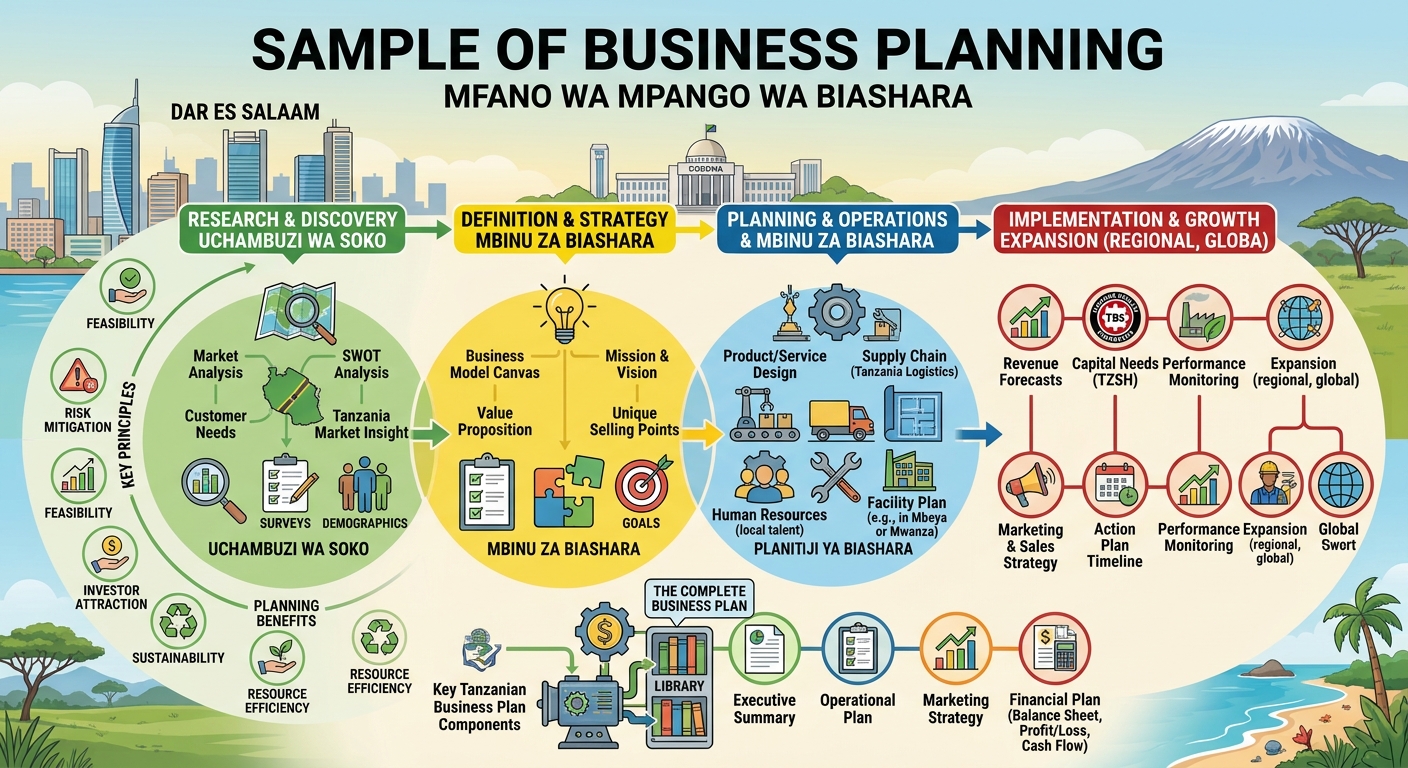
Business Planning – Comprehensive Study Guide (Form Five Business Studies)
Master the Art of Turning Ideas into Successful Ventures — From Identifying Opportunities to Developing a Complete Business Plan
This expertly structured study guide breaks down one of the most practical and examinable topics in business studies into clear, organized, and highly digestible sections. Whether you are preparing for national examinations, revising for class tests, or seeking a deeper understanding of how entrepreneurs identify opportunities and build solid business plans, this guide is your essential companion.
📖 What’s Inside
Identification of Business Opportunities
Business opportunities as attractive avenues in the environment for effective business idea development
The difference between a business idea (a creative thought) and an opportunity (an evaluated and promising idea)
How to scan the environment for unsatisfied needs and customer complaints
How ideas graduate to opportunities after evaluation on market potential, competition, resources, and entrepreneur’s ability
Generating Business Ideas
The four-step process: brainstorming → screening → ranking → mind-mapping on a Business Model Canvas (BMC)
Identifying gaps, problems, or unsatisfied needs in the market
Screening Business Ideas
Evaluating generated ideas to determine viability and potential for success
Critical questions: market potential, uniqueness, Key Success Factor (KSF), legal and ethical compatibility, community values, growth potential, capital requirements, and the entrepreneur’s suitability
Ranking Business Ideas
Prioritising screened ideas based on scores (1 to 5) on criteria: market availability, uniqueness, legal compatibility, community compatibility, entrepreneur’s capability, ability to raise capital, and growth potential
Selecting the idea with the highest total score
Mind Mapping on a Business Model Canvas (BMC)
Visually representing the business idea using a strategic management tool
The nine key components: customer segments, value propositions, channels, customer relationships, revenue streams, key resources, key activities, key partnerships, and cost structure
Business Plan Development
The seven components: business description, industrial analysis, market assessment, marketing plan, operations plan, management and organisational plan, and financial plan
The business plan as a roadmap for starting, managing, and growing a business
Business Description
Basic information: products, owners, location, mission, vision, core values, and legal structure
The proposed business name and owner’s details
Industrial Analysis
Internal aspects (strengths and weaknesses) and external aspects (opportunities and threats)
Understanding the competitive environment and identifying Key Success Factors (KSF)
Developing strategies to leverage strengths, address weaknesses, exploit opportunities, and mitigate threats
Market Assessment
Determining product demand and market SWOT
Evaluating Key Success Factors, customer profiles, and competitor profiles
Informing the marketing plan and strategies for generating more customers
Marketing Plan
Marketing objectives, product description, pricing, promotion, distribution, strategies, and predicted expenditure
SMART objectives and the marketing mix (product, pricing, promotion, distribution)
Based on market assessment and providing a roadmap for reaching target customers
Operations Plan
How products will be produced and delivered
Business location rationale, size of area, premises, facilities, equipment, raw materials, labour, utilities, and production/delivery plans
Justification for location (proximity to customers or raw materials)
Management and Organisational Plan
Human resources needed and their roles
Organisation structure, qualifications, job descriptions, and salaries/remunerations
Staff profile and hierarchy of positions and reporting relationships
Financial Plan
Roadmap for financial activities: funds needed, sources of funds, and expected financial performance
Income statement, statement of financial position, and cash flow statement
Initial and working capital requirements and key forecasting assumptions
Financial Performance
Projecting profit and loss (income statement), financial strengths (statement of financial position), cash flow (cash flow statement), and monthly cash budget
How the income statement, statement of financial position, cash flow statement, and monthly cash budget are structured
Chapter Summary Points
A concise recap of all key concepts: ranking factors, BMC mind mapping, and the seven components of a business plan
✨ Key Features
Concise and Structured — Every topic broken down into clear sections with bullet-point key points
Comprehensive Coverage — From opportunity identification and idea generation to screening, ranking, BMC, and the full business plan
Practical Tools — The Business Model Canvas, screening criteria, ranking criteria, and SMART marketing objectives
Exam-Focused Content — Structured key points and NECTA-standard questions designed for easy recall and revision
Clear Definitions — Key concepts explained: business idea vs. opportunity, Key Success Factor (KSF), Business Model Canvas (BMC), and more
Summary Section — A concise recap of all key points for quick revision before examinations
📝 Comprehensive Assessment Section
NECTA Standard Questions (15 Questions)
The concept of business opportunities vs. business ideas and the process of generating ideas
Screening and ranking criteria for business ideas
The importance and key components of the Business Model Canvas
The components of a well-packaged business plan
The importance of industrial analysis and how market assessment informs the marketing plan
The relationship between marketing plan, operations plan, and financial plan
The components of a management and organisational plan and an operations plan
The importance of business planning to the success of a medium-sized business in Tanzania
Procedures for developing a business plan and sources of business ideas
Comparison of the BMC and the traditional business plan
Key assumptions in projecting sales for a new business
Challenges facing entrepreneurs in developing a business plan and suggested solutions
The importance of projecting financial performance and the components of a cash flow statement
“Failure to plan is a plan to fail” — discussing the importance of business planning
🎯 Who This Guide Is For
Form Five and Form Six Business Studies students preparing for national examinations
Teachers seeking a well-organized reference and teaching resource
Anyone interested in understanding how entrepreneurs identify opportunities and build business plans
Students preparing for regional and international examinations on business and entrepreneurship
Aspiring entrepreneurs and business owners seeking practical planning knowledge
⭐ Why Choose This Guide
✅ Curriculum-Aligned — Follows the official Business Studies syllabus structure
✅ Exam-Focused — NECTA-standard questions and structured key points designed for easy recall and revision
✅ Clear and Concise — Complex planning concepts explained in simple, accessible language
✅ Comprehensive Coverage — From opportunity identification to the full seven-component business plan
✅ Practical Tools — The Business Model Canvas, screening and ranking criteria, and SMART objectives
✅ Summary Section — A concise recap of all key points for quick revision before examinations
Order your copy today and take control of your success!
MITIHANI POPOTE — Quality educational resources wherever you are.


Reviews
There are no reviews yet.